Test drive XM3's build quality to accelerate Renault Samsung's rebound

The Renault Samsung XM3 / Courtesy of Renault Samsung
By Nam Hyun-woo
The Renault Samsung XM3 is garnering favorable responses for its build quality and cost-efficiency and this is expected to help the company pick up momentum in its bid to manufacture the XM3s heading for the European market at its plant in Busan.
Renault Samsung will launch the XM3 on the domestic market, the vehicle's first release territory, today. The company initially planned to hold a large launch event and test drive session March 4, but changed this to multiple small test events due to the COVID-19 outbreak.
The XM3 is a 4.57-meter long compact crossover, which is designed, engineered and built by Renault Samsung based on the Renault Arkana and the Renault XM3 Inspire show cars.
Upon its launch, the five-seater drew keen attention with its cost, allowing drivers to enjoy engines used for Mercedes-Benz vehicles at prices starting from 20.83 million won ($17,489).
The XM3 comes in two gasoline engines ― the economic 1.6 GTe and the performance-centric TCe 260. The latter was developed by Daimler and the Renault-Nissan Alliance, and is also used for the Mercedes-Benz A180, A200 and CLA models.
Though the 1.6 GTe model represents a much more affordable price range, starting from 17.19 million won, the majority of customers are showing interest in the TCe 260. According to Renault Samsung, it has received more than 6,400 pre-orders since Feb. 21, and more than 80 percent of these were for the TCe 260.
During a test drive around the outskirts of Seoul, Friday, Renault Samsung offered the TCe 260 and the vehicle showed how the collaboration between two auto giants was successful. The 1.3-liter, four-cylinder engine created enough torque for low-speed acceleration, while its chassis and suspension had a balanced combination between stability and ride comfort.
Despite its affordable price, the XM3 also offers adaptive cruise control, lane keeping assist, park assist and a slew of other advanced driver assistance systems and safety features, which are typically available in vehicles in the higher price range.
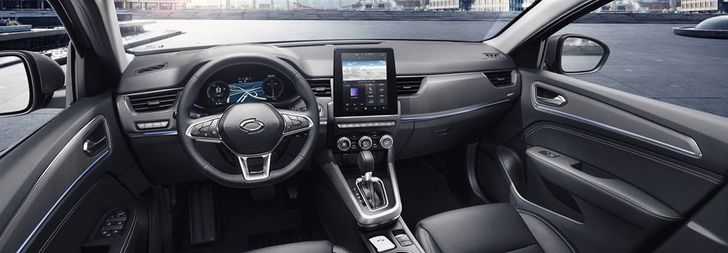
The inside of the Renault Samsung XM3 / Courtesy of Renault Samsung
Of particular notice was its build quality. It was hard to notice any minor flaws such as panel gaps, dents or other manufacturing glitches ― which have sometimes been noticed among volume production vehicles and have triggered a customer backlash. The vehicle did not use pricy or luxurious materials for the car's interior, but it meticulously finished those materials to help passengers feel it is a well-made vehicle.
“The XM3 had a favorable media response after test drives, mostly complimenting the vehicle's cost-efficiency and build quality,” an industry official said. “Though Renault Samsung has a labor dispute at its Busan plant over wages, the vehicle's quality and its capability to pack costly features into an affordable volume model shows the plant has competitiveness.”
Renault Samsung has been seeking to assemble the XM3 for the European market at its plant in Busan, in a bid to fill the production void after the end of its contract to manufacture the Nissan Rogue. The company has been promoting the plant's competitiveness to Renault headquarters for years, but the latter has yet to make a decision due to the plant's productivity declines due to repeated strikes over wages.
With the XM3 winning a favorable response, Renault Samsung hopes the new vehicle will be a steady seller, promoting a recovery. Last year, domestic sales declined by 3.9 percent year-on-year to 86,859 cars, which accounted for 5.64 percent of all vehicles sold in Korea.
The company said it aims to sell 40,000 XM3s in Korea this year, but added it could reset the target as the vehicle is drawing such a favorable response from not only media but also customers.
During the test event, Renault Samsung officials were cautious about talking about XM3s for the European market, but said the company has “done everything it can” on the vehicle and is confident about its quality.