INTERVIEW Access to big data paves way for advanced healthcare

Bio industry association chief welcomes revisions to data acts
By Nam Hyun-woo

Korea Biotechnology Industry Organization President Seo Jeong-sun
Recent revisions to laws related to accessing personal data have laid the groundwork for Korean biotechnology firms to provide advanced healthcare services using big data and artificial intelligence, the chief of the Korean bio industry association said.
However, he added that domestic bio-pharmacology companies are still required to adhere to strict ethical standards to address public concerns on the misuse of such data, given the industry is entering into an uncharted area where nobody can predict the potential adverse impacts of the industrialization of personal medical data.
“It is time for the Korean bio industry to start healthcare services using big data,” Korea Biotechnology Industry Organization President Seo Jeong-sun said during an interview with The Korea Times.
“The revision means that bio firms can use encrypted and anonymized personal medical data without consent for various purposes such as tailored examinations, prescriptions and drug development.”
On Jan. 9, the National Assembly passed revisions to three acts related to personal data, 14 months after they were first tabled. The revisions, which were made to the Personal Information Protection Act, the Act on Promotion of Information and the Credit Information Use and Protection Act, are aimed at allowing companies to use unidentified personal data to provide medical, financial and info-tech services tailored to customers.
In the medical industry, tapping into personal data is one of the most critical preconditions for tailored treatment and healthcare, which pharmaceutical and healthcare firms are pursuing as their future business model.
Korea has established a vast medical database including clinical records of patients, but bio companies have not been able to tap into the data mainly due to regulations prohibiting personal medical data from being handled outside of hospitals.
In September last year, the government opened a platform allowing private researchers and companies to access big data gathered by various public healthcare institutions, such as the National Health Insurance Service and the Korea Centers for Disease Control and Prevention, and some private institutions. However, the platform has not drawn a favorable response from the biopharmaceuticals industry, as the scalability and accuracy of the data were not good enough for commercial use.
As the regulations were lifted with the revisions, the volume and the quality of medical data companies can access are expected to increase significantly, as it will allow hospitals to provide data to firms and for firms to collect anonymized data without patients' permission. Seo said this will trigger firms to dive into advanced healthcare services, ranging from the prediction of diseases, tailored examination and the development of personalized drugs.
“Following the deregulation, the volume of medical data firms can access increases, and the increased data will be analyzed through machine learning technologies,” he said. “Then, this will significantly improve the accuracy of examination and prediction. It will also help pharmaceutical firms to develop personalized drugs.”
Seo said, however, the revision is just the beginning for big data-based healthcare services and there are remaining tasks for bio companies, the government and the public to address.
“Though the revision made legal grounds for biopharmaceutical firms to use medical big data, there remains a core task of setting up the clear definition of anonymization,” he said.
One of the reasons that the revision took time to pass the National Assembly was opposition from civic groups which raised concerns on the possibility of identification during the process of compiling personal information into big data, as the revisions took a vague definition of the term.
The revisions allowed firms to use personal data with concealed information such as addresses, full names, age or other indicators that could confirm identity. Civic groups, such as People's Solidarity for Participatory Democracy, claim that this is not anonymity, and firms could identify specific people with the given data.
Seo said another looming issue after the revisions was the moral debate over the value of the data.
“Though the big data was compiled as public property, it can be treated as private property as well because firms can use it for commercial purposes. And putting a value on this will create continuous debate over morality,” Seo said. “This is why biopharmaceutical firms will be required establish ethical standards.”
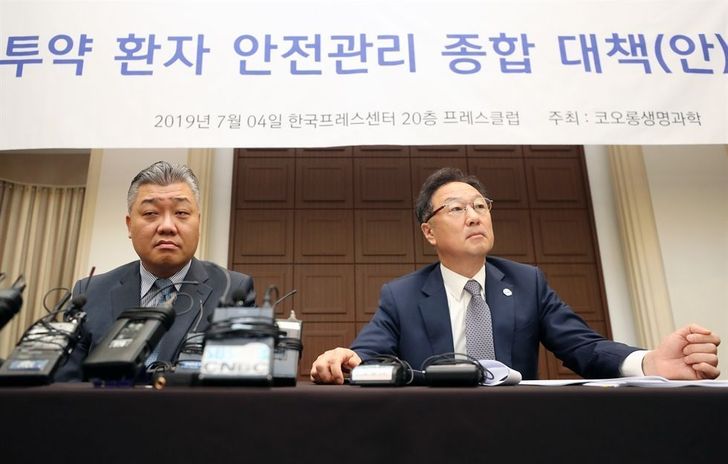
Kolon Life Science CEO Lee Woo-seok, right, listens to questions during a press conference on the company's revoked Invossa gene therapy drug at the Korea Press Center in Seoul, July 4, 2019. Yonhap
Expensive lesson
Along with the revisions to data privacy acts, Seo said the country's bio industry faced challenges in 2019, mixed with various events garnering public attention, and the industry should interpret incidents from last year as “expensive lessons.”
“Firms including Samsung BioLogics, SK Biopharmaceuticals, Celltrion and a number of others showed solid performance in 2019, consolidating the prowess of the Korean bio industry,” he said. “However, it was also a year full of painful lessons, as the industry was mired in a series of blunders and errors in clinical trials and distributing drugs.”
Last year, SK Biopharmaceutical created headlines, as its anti-epileptic drug Xcopri won U.S. Food & Drug Administration approval in November. Smaller bio firms also had favorable news, with Bridge Biotherapeutics and Alteogen each signing lucrative out-license deals.
However, Seo said the most important incident from last year was the case of Invossa by Kolon Life Science, which emphasized the importance of transparency to domestic drug makers.
In May, Kolon Life Science had the license for Invossa gene therapy revoked over an error in the ingredient for its osteoarthritis drug. At the time, the company said it was “a mislabeling” and the effects and safety of the drug remained the same, but it faced a public uproar, damage suits, and the company was delisted from the stock market, from which it is suspended for a year.
“The incident shows the importance of transparency,” Seo said. “From pharmaceutical firms' perspective, the same effect means it's the same. But this is unacceptable for most of the public because patients and customers don't share the perspective of the drug developers and have fears over having something different from what is written on the label going inside their body.”
Along with the Invossa case, a series of drug licenses Korean firms exported to global firms were returned, and a number of firms saw obstacles or blunders in their trials, raising doubts on the credibility of Korean biopharmaceutical firms. Of them, Helixmith drew criticism after its Engensis gene therapy was mixed up with placebo during a Phase III clinical trial.
“What we hope investors will understand is that bio and drug making firms are businesses of potential, meaning there is always the chance of failure,” Seo said. “At the same time, companies should make greater efforts to keep their credibility and to be responsible for errors that happen in the critical stages of drug development.”
“Rather than arguing who's wrong and who's right, we should see the case as a mistake that happened across many areas. And this taught a good lesson to the bio industry,” he added.