Doubts arise over construction of K-pop arenas
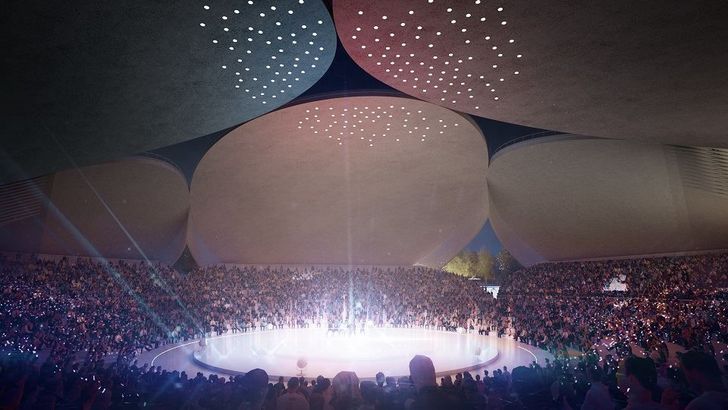
CJ Group will have the country's first K-pop arena built by 2024 in Goyang-si, Gyeonggi Province. / Courtesy of CJ LiveCity
By Kim Jae-heun
Local governments and private firms are scrambling to open the country's very first K-pop arena that can accommodate an audience of over 10,000.
But tourism and culture critics are skeptical about the need of such large-scale concert halls and question their profitability.
According to the entertainment sector, four auditoriums are set to open within the next two to four years on the outskirts of Seoul, including one in Dobong-gu, northern Seoul, and two in Goyang and Uijeongbu, Gyeonggi Province. Korea's largest integrated resort, Inspire, will be able to seat 15,000 spectators in its new concert arena on Yeongjong Island, Incheon, from this year.
Other venues are also being constructed to hold between 11,000 and 20,000 people.
“An increasing number of large-scale K-pop concerts will be built here. To date, there has been no arena that can hold a large audience,” said the CEO of CJ LiveCity Kim Cheon-soo, who has invested 1.8 trillion won in building the “cultural arena” in Goyang, together with the Anschutz Entertainment Group.
“When our venue opens, we will host many large-scale K-pop concerts that until now have only been held abroad. We expect the number of hallyu tourists to increase too.”
Cultural critic Bae Kuk-nam, however, said local governments and firms should concentrate more on developing K-pop content rather than building more facilities.
“In the past, local governments built filming sites of hit TV series to attract tourists. However, they all ended up going out of business because the content was weak and nobody would want to make a second visit.
“Building K-pop facilities is not important. What is important is to keep producing global K-pop stars to secure quality content. Governors only want to erect buildings because it's an easy way to give themselves credit for something” Bae said.
The stagnating number of tourists coming to Korea to experience K-pop culture is another reason why local governments and private firms should not be so eager to build concert arenas.
A little over 1 million K-pop fans visited Korea in 2015, which jumped to 1.36 million in 2016 and 1.42 million in 2017. However, the number has not increased since then.
“We have been conducting research on the popularity of hallyu abroad and we have actually received some positive feedback. We saw an increase in sales of Korean products and the experience of services provided by Korean companies compared to that of 2018. However, there is uncertainty about hallyu,” said Kim Ji-yeon, a researcher at the Korea Foundation for International Cultural Exchange. “We cannot expect the number of visitors to increase at a constant rate every year because of a number of variables ― be it a celebrity scandal or political issue.”
Kim also pointed out that three out of four K-pop arenas scheduled to open in the next four years are all outside of Seoul, which will make it difficult for foreigners to visit them.
“Accessibility is very important for foreigners as they could face problems traveling to certain places. If K-pop concert halls are outside of Seoul, many foreigners will have a difficult time travelling to the venue and may not return a second time,” Kim said.