Amorepacific, LG H&H losing clout in China
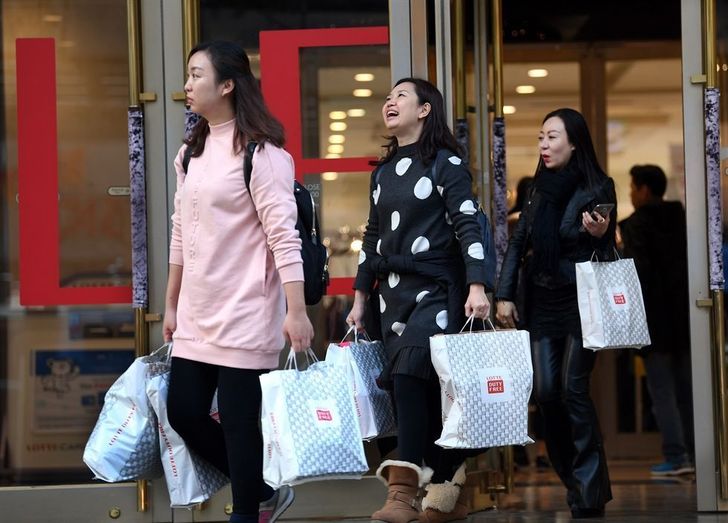
Chinese tourists exit Lotte Department Store in this Nov. 28, 2017, file photo. Korea Times file
By Kwak Yeon-soo
Amorepacific, LG Household & Healthcare and other K-beauty brands have been losing clout in China as more consumers in the world's second-largest beauty market are turning to home-grown brands and those from Japan, according to industry officials Tuesday.
The K-beauty industry, which has established itself in China along with the wild popularity of K-pop and K-drama, is on the brink of losing its No.1 status in the country's imported cosmetics market this year.
According to industry tracker IHS Global Trade Atlas, Korean companies accounted for 25.2 percent of China's imported cosmetics in the first 10 months of 2019, falling slightly behind Japanese rivals, whose combined market share was 25.5 percent.
China's imports of foreign cosmetic products in January-October period this year rose to $9.67 billion, up 31.7 percent from a year earlier, it said. The amount is expected to surpass the $10 billion mark by the end of this year.
Officials said K-beauty exports to China are slowing due to consumers' growing preference for premium and luxury brands as well as a shift toward online shopping.
“China is still the biggest buyer of our beauty products in Asia,” an Amorepacific official said, without revealing Chinese sales figures.
“In the mid- and low-priced cosmetics market, Chinese brands with competitive prices are doing well. As for the prestige beauty market, foreign brands including Sulwhasoo are still gaining traction in China.”
LG H&H's mid- and low-priced cosmetics units The Face Shop and Nature Collection sold all their remaining stores in China last year, citing online competition.
Since then, the company has focused on growing its luxury brands.
“Despite the rapidly changing beauty trends in China, LG H&H is witnessing growth buoyed by our luxury brands like The History of Whoo, Su:m and O Hui,” an LG H&H official said.
The declining number of Chinese tourists to Korea also attributed to the weaker demand, according to officials.
Korea has seen a 40.6 percent drop in Chinese tourists. Just 4.79 million visited last year, down from 8.06 million in 2016. In the same period, Japan saw the number of Chinese travelers jump 31.4 percent from 6.37 million to 8.38 million, according to data from the Federation of Korean Industries.
The Korea International Trade Association (KITA) said the country needs to advance into ASEAN markets as overdependence on China could undermine the cosmetics industry.
“Korea's heavy export dependence on China could be risky due to unfavorable conditions such as the ongoing U.S.-China trade war and anti-government protests in Hong Kong,” a KITA official said.
“Companies need to make inroads into ASEAN, including Vietnam and Thailand.”