Carmakers cutting prices to woo buyers
By Kwak Yeon-soo
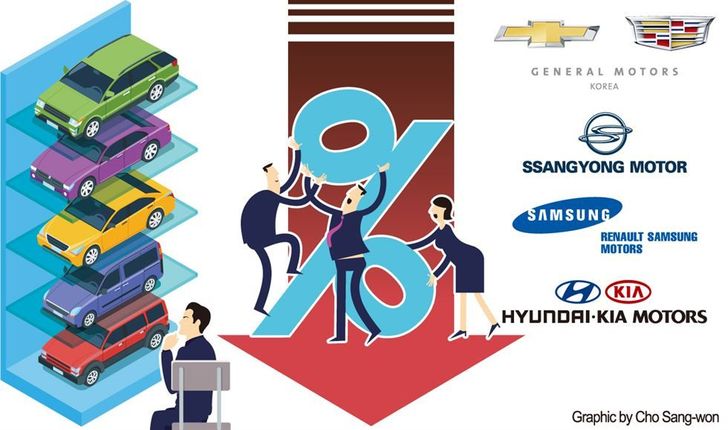
Automakers in Korea are offering steep discounts to boost sluggish sales as they struggle with labor unrest and other downsize risks, company officials said Wednesday.
The companies are expecting price cuts of around 10 percent will help revive the crisis-hit automobile industry.
Korea's car sales fell 2.3 percent in September from a year earlier mainly due to the U.S.-China trade war and soft demand from China.
The country's five carmakers ― Hyundai Motor, Kia Motors, GM Korea, Renault Samsung Motors and SsangYong Motor ― sold a combined 662,949 vehicles in September, compared with 678,229 units sold a year earlier, the companies' monthly sales data showed.
GM Korea announced on Tuesday it will cut prices of Chevrolet Impala by 5 million won ($4,150) while offering up to a 1.9 million won discount to Chevrolet Spark buyers in October.
The company said that it organized the sales to entice buyers.
GM Korea's sales fell sharply in September as its labor union held several rounds of strikes, resulting in output losses of over 10,000 vehicles. The company's sales plunged 39 percent last month to 21,393 from 34,816 a year earlier.
Other domestic carmakers are following the move to revive the market sentiment.
Renault Samsung said it will cut prices of the SM6 TCe by 4 million won in October. The company will also offer a 500,000 won discount to those who purchase its flagship sports utility vehicle (SUV) model QM6 the same month.
Meanwhile, SsangYong Motor added a four wheel drive system option, which is worth 1.92 million won, to 2020 G4 Rexton.
Hyundai Motor also announced festive season discounts, saying it will offer a five percent discount for the Grandeur. Kia Motors said it will cut the price of the K5 by 1.5 million won.
“We're offering discounts to help buyer sentiments and revive the market to boost demand,” an official at a domestic carmaker said. “We select the models that will be discounted depending on the previous month's sales performance.”
Officials said that there are other reasons for the aggressive promotional activities, besides weak domestic sales.
A big data analyst at Zigcar, a market platform for car exchange dealers, manufacturers and consumers, explained that large discounts started when Mercedes-Benz Korea took an initial move to take market share of BMW after the latter was hit by engine fire accidents last year.
He also said that as Japanese carmakers continue to struggle, local carmakers are trying to gain their market share.
“Since June, the average discount rate was about 10 percent, which is an unprecedented level,” a Zigcar analyst said. “As buyers have become smarter, car dealers are almost forced to cut prices.”