S-Oil pledges to invest W7 tril. for ethylene facilities
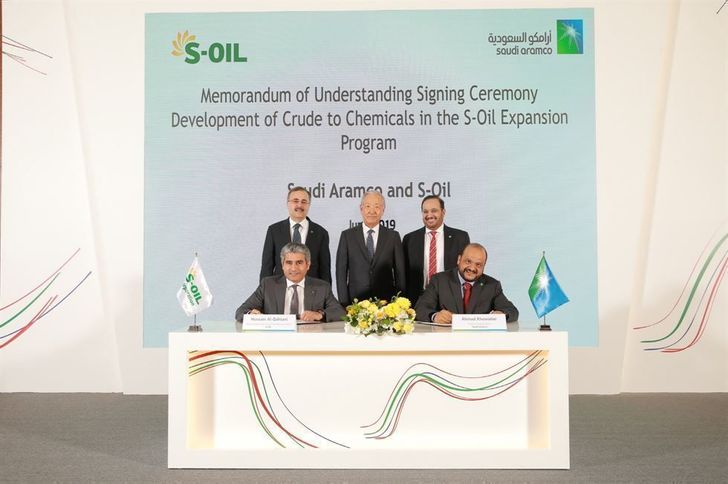
S-Oil CEO Hussain Al-Qahtani, bottom left, signs an MOU on a 7 trillion won investment plan with Saudi Aramco Chief Technology Officer Ahmad Khowaiter, bottom right, during a signing ceremony held Wednesday. From top left are Saudi Aramco CEO Amin Nasser, S-Oil Board Chairman Kim Chul-su and S-Oil Director Abdulaziz Al-Judaimi. Courtesy of S-Oil
By Nam Hyun-woo
S-Oil will invest 7 trillion won ($6 billion) by 2024 to build facilities producing ethylene and other basic chemicals in part of the company's bid to expand its businesses from refining and chemicals, the refiner announced Wednesday.
The announcement came amid S-Oil's inauguration of its Residue Upgrading Complex (RUC) and Olefin Downstream Complex (ODC), in the presence of President Moon Jae-in and Saudi Arabian Crown Prince Mohammed bin Salman Al-Saud during a ceremony in Seoul.
S-Oil CEO Hussain Al-Qahtani and Saudi Aramco CEO Amin Nasser signed an MOU over the new petrochemical investment project, which marks the second phase of S-Oil's initiative to invest 12 trillion won to secure petrochemical facilities. The RUC and ODC project, which cost 5 trillion won, was the first phase.
Saudi Aramco is the largest stakeholder of S-Oil and the world's largest energy and petrochemical company.
S-Oil said the new project is aimed at building a world scale cracker which produces ethylene and other basic chemicals out of naphtha and refinery off-gas. Also included in the project is additional olefin downstream facilities, which can produce high value-added products such as polyethylene and polypropylene.
Saudi Aramco said it will use the MOU as a platform to support S-Oil's successful delivery of the project by leveraging its experience with steam crackers, R&D skills around olefin downstream process, products and sales capabilities.
For the 7 trillion won project, S-Oil has already purchased a 400,000 square-meter tract of land for the project in Ulsan from Hyundai Heavy Industries. The land is near S-Oil's Onsan refinery in Ulsan.
The phase two project will mobilize 2.7 million workers on an annual average basis, create 400 permanent jobs, promote the construction industry and contribute to greater exports of petrochemical products all of which will enhance the Korean economy.
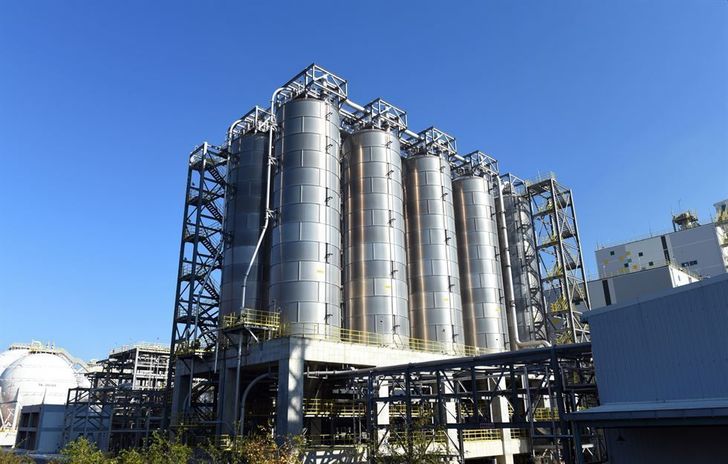
S-Oil's polypropylene plant at its new Residue Upgrading Complex and Olefin Downstream Complex in Ulsan / Courtesy of S-Oil
The 12 trillion won investment is expected to expedite S-Oil's efforts to expand its portfolio from refining to petrochemicals.
The RUC and ODC facilities, located in Ulsan and officially inaugurated after the ceremony, will create high value-added petrochemical products from low value residual oil.
When they go into full operation, the RUC will turn low value residual oil into high value-added products such as propylene and gasoline. Then the ODC will process propylene and produce 405,000 tons of polypropylene a year, with 70 percent of the volume shipped overseas, and 300,000 tons of propylene oxide a year.
After the phase one project, the portion of high value-added petrochemical products in S-Oil's total business output will increase to 13 percent from the current 8 percent, while that of heavy fuel, which is cheaper than crude oil, will go down to 4 percent from 12 percent.
Its petrochemical portfolio will also be more balanced, with the portion of para-xylene declining to 46 percent from 71 percent and olefin going up to 37 percent.
“The successful completion of the largest-ever project in the history of Korea's refining and petrochemical industry marks an innovative transformation for S-Oil, which started off as a small refinery 43 years ago,” S-Oil Board Chairman Kim Chul-su said.