Korea fails to secure long-term maintenance order for UAE nuclear plant
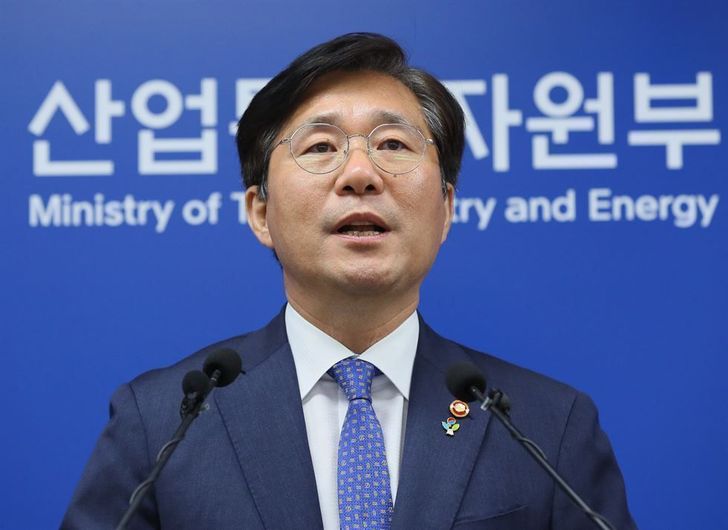
Trade, Industry and Energy Minister Sung Yun-mo speaks during a press briefing to announce that the consortium of Korea Hydro & Nuclear Power (KNHP) and KEPCO Plant Service & Engineering (KPS) signed a five-year long-term maintenance service deal with Nawa Energy Company in the UAE. Yonhap
By Kwak Yeon-soo
Korea has failed to secure a long-term maintenance agreement (LTMA) for the Barakah Nuclear Power Plant in the United Arab Emirates (UAE), the Ministry of Trade, Industry and Energy said Monday.
The consortium of Korea Hydro & Nuclear Power (KNHP) and KEPCO Plant Service & Engineering (KPS) signed a five-year maintenance service deal with Nawah Energy Company, the operator of the Barakah plant. The consortium said the contract can be extended for another five years if both sides agree.
But the deal falls far short of its initial goal to win a 3 trillion won ($2.5 billion) 15-year maintenance deal. KHNP did not disclose how much the contract is worth, but it is estimated to be less than 1 trillion won, according to industry analysts, who have blamed the Moon Jae-in administration's antinuclear campaign for Korea's difficulty in securing the exclusive maintenance agreement.
While the agreement signed covers the entire process of managing the nuclear plant, it falls short of providing maintenance services, nuclear scientists and engineers.
The latest deal came after Nawah Energy Company decided to strip KNHP of its exclusive status in bidding, and opened the process up to multiple players.
“The change in contract terms is due to the UAE's nuclear regulations,” Trade Minister Sung Yun-mo said Monday. “The KHNP consortium, supported by KPS, will conduct testing, diagnostics, inspections, maintenance and replacement services for the Barakah nuclear plant.”

The Barakah nuclear power plant / Korea Times file
Industry analysts blame President Moon Jae-in's anti-nuclear campaign for prompting a change in contract terms.
“This is 100 percent President Moon's fault. If he had not phased out nuclear energy from Korea's power planning, the UAE wouldn't have considered breaking down the deal for several players,” said Lee Duckhwan, a professor at Sogang University.
Lee added that it is hard to believe in the government's explanation citing the UAE's nuclear regulations and profits for the change in contract terms.
“Signing a long-term maintenance agreement has nothing to do with regulations or monetary benefits. The UAE is surely not going after money,” he said.
He also warned that if other countries take part in the maintenance, there is a high risk of leaks in core technologies for nuclear reactors.
“To maintain the facility, there is no possible way but to share the blueprint of APR 1400 with those firms, which is giving away technology which Korea put a huge amount of money and effort into developing.”
Jeong Yong-hoon, a professor at the Korea Advanced Institute of Science and Technology (KAIST), agreed that Moon administration's post-nuclear policy played a considerable role in turning the long-term project into a shorter-term one.
“Considering that the UAE has to operate the Barakah nuclear plant for at least 60 or 80 years, it makes no sense to give exclusive maintenance rights to a country that is committed to turning anti-nuclear,” Jeong said. “We've gone from being a partner to becoming a subcontractor.”