Korean firms' presence in China falling amid trade feud
By Baek Byung-yeul
Korea's top 10 conglomerates have been withdrawing from China and establishing more overseas branches in the United States in the wake of the trade dispute between the two economic giants and the THAAD crisis, industry data showed, Sunday.
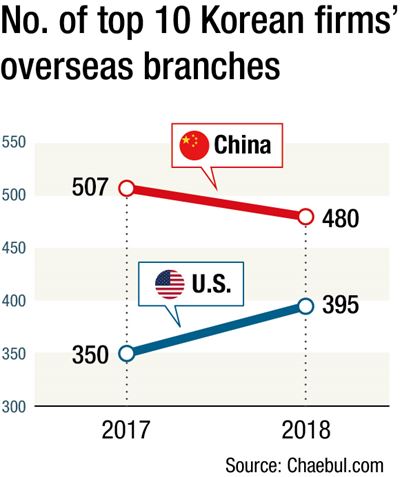
According to local corporate tracker Chaebul.com, the number of Chinese branches of the top 10 Korean companies decreased from 507 in March 2017 to 480 in March 2019, while their U.S. branches increased from 350 to 395 during the same period.
The corporate tracker elaborated, stating that the Korean companies have increased their localization efforts in the U.S. due to the Trump administration's policy that imposes more tariffs on imported products.
“Due to the strengthened tariff policy of the Donald Trump administration and growing calls to attract more foreign investments to the U.S., Korean companies have beefed up their localization efforts in the U.S. to achieve sustainable business growth there,” Chaebul.com said.
Among the top 10 conglomerates, the number of Chinese branches of Lotte Group recorded the biggest decrease, with their Chinese outlets falling by 42.7 percent to 47 in 2019 from 82 in 2017.
Chaebul.com claimed this to be a result of the THAAD crisis that began in 2017 when Chinese consumers boycotted Korean products, protesting Seoul's deployment of a U.S. Terminal High Altitude Area Defense (THAAD) system.
By country, China is still the largest outpost of the top 10 Korean companies as they have installed the largest number of overseas branches there, followed by the U.S.
Vietnam and Turkey shared the third place, following the world's top 2 economies with the number of overseas branches, with 97 each.
Vietnam has emerged as a popular investment destination among Korean companies thanks to the Moon Jae-in administration's New Southern Policy, which aims to strengthen economic ties with Southeast Asian countries. The number of overseas branches there in 2017 was 81 but rose to 97.
Turkey, which has a unique geographical position that connects Europe and Asia, saw a steep increase in the number of Korean firms' overseas branches, with the number rising from 45 in 2017 to 97 in 2019.
During the period, SK Group saw a 17.4 percent increase in the number of its overseas branches while Samsung Group decreased its overseas branches by 5.4 percent.