INTERVIEW Sun Kwang boasts high-tech container terminal
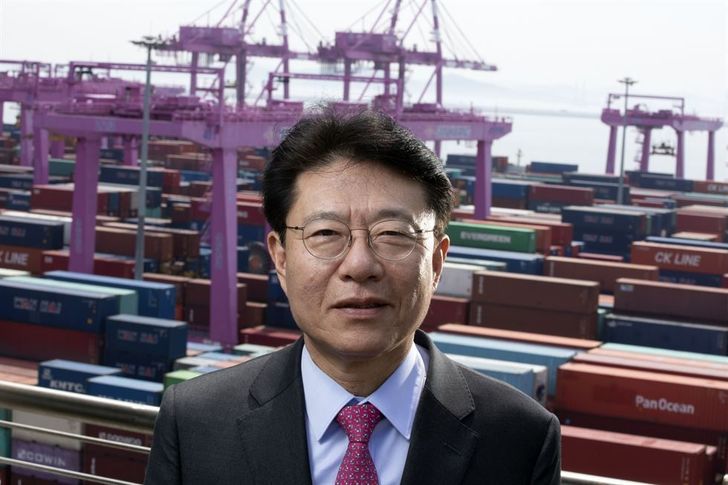
Sun Kwang Vice President Shim Choung-shik / Korea Times photo by Choi Won-suk
By Kwak Yeon-soo
Seaports hold great significance for Korea, an export-oriented economy surrounded by water on three sides. Above all, Incheon ports hold the greatest strategic importance in terms of logistics for their close proximity to major industrial complexes in Seoul and Gyeonggi Province. Incheon is also closer to major ports in China.
Thanks to this location and connectivity, it requires lower inland transportation time and cost compared to the Port of Busan.
To make the best use of the port city, Sun Kwang was founded in 1948 and since then has extended its business scope from running a storage business to constructing a container terminal at the South Port of Incheon to meet the increasing trade volume to and from China.
As a result, Sun Kwang Newport Container Terminal (SNCT) has become the biggest container terminal at Incheon, connecting to a prompt transportation system delivering to industrial complexes containing around 10,000 companies.
Former presidents Lee Myung-bak and Park Geun-hye as well as current Prime Minister Lee Nak-yon have visited the SNCT to address the importance of ports for the development of Korea's economy.
Vice Chairman Shim Choung-shik, who joined the company in 1986, has been at the forefront of growing the business along with planning port infrastructure.
His commitment to the delivery of higher levels of efficiency and quality of port services has been vital to the continued success of the company.
“The terminal market is sensitive to the global economy. In the long term, however, I expect the industry will continue to grow as the market will recover gradually from recession,” Shim said.
He added that SNCT is optimistic about future economic cooperation with North Korea, saying the company was linked to relations with the North, and its shares saw a boost during the recent U.S.-North Korea summits.
“We don't know when but if unification comes, that will provide strong growth momentum to Korea and the logistics business,” Shim said.
Although skepticism remains about whether Kim Jong-un will denuclearize and open North Korea's economy, optimism still hovers over improving relations between Pyongyang and Washington.
Jim Rogers, the billionaire investor, said North Korea might be one of the world's most attractive investor once the Korean Peninsula becomes unified, and economic cooperation between the two begins.
“It is very likely that railroads on the east and west coasts will be rebuilt and the Koreas will become a transportation hub,” Shim said. “Of all places, Incheon will likely serve as a hub for both cargo and flights.”
Sun Kwang currently handles about 2,000 trucks at the harbor each day.
“There are larger terminals with more advanced technologies in China, but we ensure safe passage in poor weather conditions, such as dense fog and windstorms,” Shim said.
In 2018, the volume of transit cargo that SNCT handled was around 980,000 twenty-foot equivalent units (TEU).
The company expects to take this growth even further in 2019, reaching 1.09 million TEU.
“We have also taken steps to modernize the existing equipment and operations over the last few years,” he said.
Sun Kwang is also committed to seeking new business opportunities for the port.
“Apart from secondhand cars and agricultural imports, we are looking to increase the volume of cold storage units at our terminal,” Shim said. “And being able to accommodate larger vessels is vital for Sun Kwang to remain competitive in the market.”
High-tech, green innovation
Meanwhile, SNCT is expecting more projects to increase efficiency of the terminals rather than to build new terminals or expand existing ones.
At SNCT, the whole process is automated, except for the loading of containers onto trucks.
“Automation in the industry is a universal trend already, and terminals will become unmanned gradually,” Shim said.
He explained that such a trend is to prevent human error and improve safety.
“It shortens planning time for large cargos, and decision-making focused on terminal optimization makes it more efficient,” he said.
But he pointed out automation has its downsides, too.
Because of the loss of jobs caused by automation, the company needs to resolve such an issue for the sustainable future of terminal operation.
“Obviously we bring in automation technologies to reduce labor costs, but we need to consider a plan to assign tasks to workers to create bigger value to the terminal,” he said.
In addition, SNCT is aiming to go green by increasing the technological capabilities of onshore power supply of vessels.
“The onshore power supply can reduce the level of harmful emissions and water pollution as well as help reduce noise in the ports,” Shim said.
“That will have positive effects both on the population of the port city and the marine ecosystem.”