Renault Samsung union criticized for 'greedy' strike
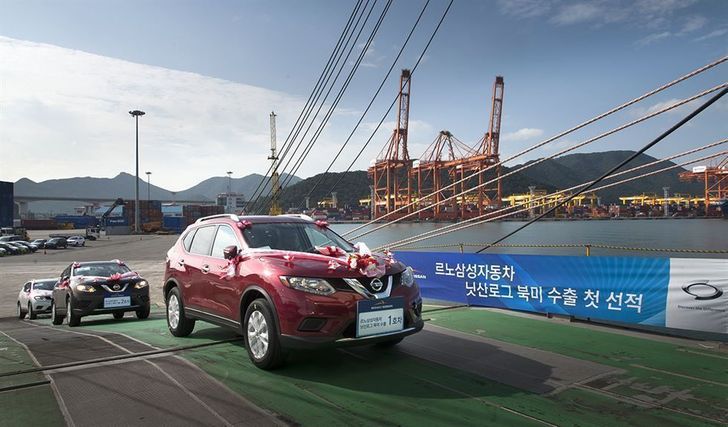
In this September 2014 photo, Renault Samsung employees ship the first batch of the Nissan Rogue, which was assigned to a Renault Samsung plant in Busan. The Rogue's manufacturing contract will end in September and Renault Samsung is suffering difficulties in seeking new models to keep the plant fully operational amid a conflict with its union. Courtesy of Renault Samsung Motors
By Nam Hyun-woo
Union workers at Renault Samsung Motors are facing growing criticism for making excessive demands in wage negotiations with management as the struggling carmaker continues to lose ground to Hyundai, Kia and other rivals.
The workers, who have been staging a series of partial strikes over the past four months, are demanding a hike in their base wage, but management wants to freeze it, saying the Korean unit of French automaker Renault has been grappling with sluggish sales and intensifying domestic and overseas competition.
The partial strikes are estimated to have cost the company 120 billion won ($110 million) in lost production, according to Renault Samsung officials. They said if the strikes continue, the company may not receive new production allocations from its French headquarters, which could lead to the dismissal of thousands of workers.
According to Renault Samsung, Wednesday, union workers at its Busan plant staged two four-hour partial strikes the same day, after their 14th round of wage negotiations with management ended without results a day earlier.
The union plans to stage another round of strikes Friday, which will be the 32nd, and increase stoppage time to 120 hours.
The union has been demanding a 100,667 won hike in employees' monthly base pay and several other regular incentives, citing Hyundai Motor workers' wages in comparison. The management is suggesting a lump sum payment of up to 14 million won for employees in return for keeping the base pay static.
Industry officials have criticized Renault Samsung union's demand for being excessive, given the plant's workers are already receiving top-level wages.
“Compared to Hyundai Motor workers, Renault Samsung employees receive less. However their wages are 20 percent higher than those of a Nissan plant in Japan, which is also a subsidiary of the Renault-Nissan-Mitsubishi alliance,” an industry official said asking not to be named. “Given that, the union's claim may seem unacceptable for not only Renault Samsung but also its headquarters.”
The tug of war is threatening Renault Samsung's survival in the domestic market.
To maintain its operations, Renault Samsung has to produce cars ― whether Renault cars for the domestic market or another alliance brand's models such as Nissan's Rogue ― by beating other Renault alliance plants across the world and winning new contracts from the headquarters.
Since the current contract for producing the Rogue will end in September, the company has to win contracts for new models, because the Rogue accounted for nearly 80 percent of its exports and half of its sales last year.
However, the union's stubborn stance is slowing talks over new contracts because the plant's inefficiency is undermining its competitiveness over other Renault plants worldwide.
Last week, Renault headquarters urged the union to suspend the strike, saying winning new contracts would be difficult as the walkout was contributing to “a lack of trust” in the Korean unit.
Renault Samsung is casting a more negative outlook over winning new models, saying last month was the last chance to win a new model.
“We are already late in negotiations with headquarters over new model allocations, given that we signed the contract for the Rogue one year before actual production started,” a company official said. “We don't think there will be any chance left unless the wage negotiations come to an agreement within this month.”
The unit released the Clio compact SUV and the Master commercial vehicle, which are imported, as their only new models last year, and has no plans to roll out new cars this year.
As it has failed to refresh its lineup, sales have also plunged. Renault Samsung's sales have declined from 111,101 in 2016 to 100,537 in 2017 and 90,369 last year. The company has been at the bottom among the five domestic carmakers by sales since 2017.
In January, Renault Samsung allowed Mercedes-Benz to become the country's No. 4 brand by sales, despite the price advantage it has as a manufacturer based in Korea.