Korail plagued with safety lapses under 'parachuted CEO'
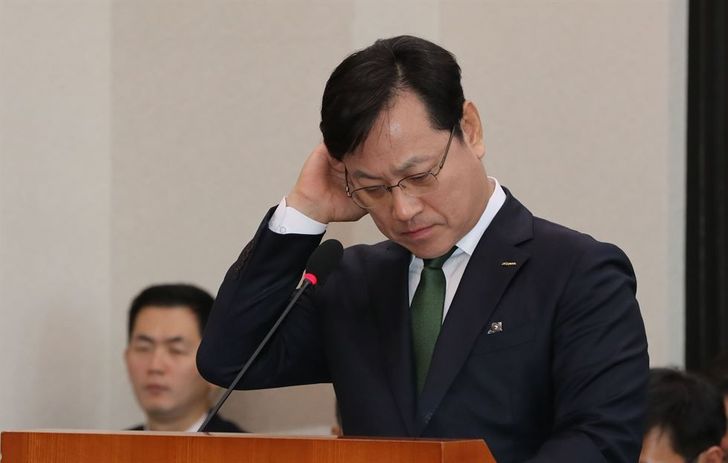
Korail CEO Oh Young-sik during a National Assembly hearing on recent malfunctions and accidents of its trains at the Assembly in Seoul, Thursday. / Yonhap
By Nam Hyun-woo
Korail has been reeling from a series of safety-related accidents in recent weeks, which have raised grave concerns over the country’s railway system, industry analysts said Monday.
Company CEO Oh Young-sik, who was appointed through political connections without any expertise in the field, has compounded the safety lapses dogging the state-run railway operator for years, they said.
The analysts noted that some of the train malfunctions were due to human error which could be related to poor discipline, while Oh is obsessed with political issues such as the joint rail project between South and North Koreas.
On Nov. 19, a high-speed train crashed into a forklift near Seoul Station injuring three people who were repairing the tracks. Though there were no casualties among the 149 passengers on board or the injured three, it could have been a huge accident as the KTX train’s engine room was severely damaged.
Following the crash, five more train malfunctions were reported until Saturday.
On Tuesday, a KTX train stopped at Osong Station in North Chungcheong Province due to an electrical glitch. Two days later, the Bundang Line subway, operated by Korail, stopped for more than an hour.
The CEO issued a public apology Friday and Korail launched emergency safety check programs, but a Mugunghwa train stopped near Wonju, Gangwon Province, the same day due to electrical problems, and two malfunctions on KTX trains were reported Saturday.
As breakdowns continue, criticism rising over Korail staff’s ability to cope with emergency situations, as some passengers were not informed properly about Tuesday’s malfunction and tried to break the train’s window to escape.
The criticism has led to questions on Oh’s management capability, as incidents have continued despite his pledge to prioritize safety. Oh’s appointment early this year raised complaints as the career politician beat a renowned railway specialist to become the head of Korail. He is a former lawmaker and was one of the core members of President Moon Jae-in’s election camp.
One of the key tasks for him was addressing Korail’s mounting debt, but the amount is still hovering over 14 trillion won and the debt ratio is over 300 percent.
While the company’s finances are deteriorating, Oh appears to be obsessed with political issues, such as reinstating fired employees or stressing the importance of a joint railway project between the two Koreas, which are in line with the Moon administration’s political direction.
“Linking South and North Korea via a railway could be a meaningful step toward denuclearization of the North,” Oh said in a National Assembly audit last month. “We will continue making progress in consideration of sanctions on the North.”
Also, his pursuit of a merger with Supreme Railways (SR), a private operator running SRT high-speed rail services, is creating controversy.
Oh is pushing forward with the merger saying it will garner publicity for the rail service and improve operating efficiency, while opposition lawmakers are concerned it will offset the improvements which Korail has made upon its competition with SR.
“It seems Korail is not concentrating on its core duty, while paying more attention on other issues,” a railway industry official said.