Struggling shipbuilders unload assets for cash
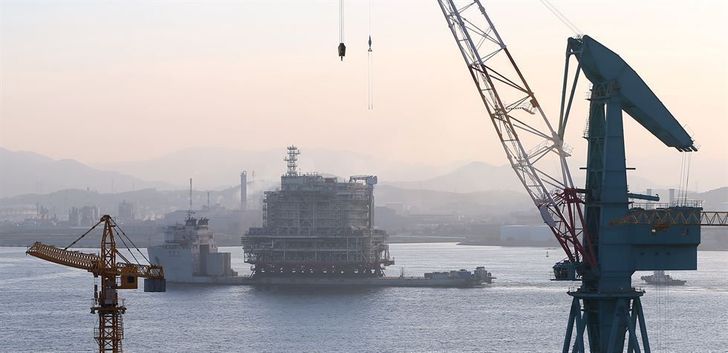
A vessel moves an offshore crude facility from a Hyundai Heavy Industries dock in Bangeo-dong, Ulsan, Monday. The facility was ordered in November 2014 by the United Arab Emirates and was the last offshore order Hyundai Heavy won. / Yonhap
By Nam Hyun-woo
Hyundai Heavy Industries and other struggling shipbuilders here are rushing to unload real estate and other non-essential assets for cash as they continue to grapple with declining orders.
Hyundai Heavy said Tuesday that its board of directors recently decided to sell its 200,000 square meter offshore modules yard in Onseon, Ulsan, as the site is currently only being used to store materials and facilities due to alack of orders.
Hyundai Heavy opened the Onseon yard in 2011 as its existing plant in Bangeo, Ulsan, could not manage soaring offshore demand. However, the yard, which employed more than 1,000 workers in its heyday, has been idle since 2016 as Hyundai Heavy has failed to win new offshore module orders since November 2014.
As such orders have stopped, Hyundai Heavy will also halt the operation of the 750,000 square meter Bangeo yard, which shipped an offshore crude facility ordered by the United Arab Emirates in November 2014. It was the last order Hyundai Heavy won.
Not only Hyundai Heavy but also its domestic peers are failing to win offshore module orders, as their rivals in China and Singapore are making aggressive bids backed by lower labor costs.
As all of its offshore module business stops, Hyundai Heavy plans to put nearly 2,000 employees on unpaid leave of absence, but the plan is strongly opposed by union members.
Daewoo Shipbuilding & Marine Engineering (DSME) is also striving to secure liquidity by putting its idle real estate assets up for sale.
According to the company, it plans to complete the sale of a 61,232 square-meter plot in Gangseo, Seoul, by the end of the year. DSME has been making efforts to sell the site since 2015 after its financial status became aggravated, but has made slow progress.
“About 10 percent of the overall site remains to be sold and we believe we can wrap up selling the site by the end of the year,” a DSME official said. The total worth of the real estate is estimated at 200 billion won.
Along with the Gangseo real estate, DSME is trying to sell its employee dormitory, offices and other assets on Geoje, South Gyeongsang Province. However, the appraised value of those assets reportedly has already been far depreciated.
Another ailing shipbuilder, STX Offshore & Shipbuilding, is also having a difficult time trying to sell its assets.
Last month, the company sold its research and development center in Changwon, South Gyeongsang Province, following its disposal of STX Europe last year. By selling those two, the company secured 110 billion won, which is 40 billion won short of a 150 billion won self-rescue plan the company pledged its creditors for this year.
To make up the difference, the company has put its employee apartments, a yard site in Jinhae, South Gyeongsang Province, and a floating dock up for sale, but progress is slow.
STX CEO Jang Yoon-geun said earlier this month that “the company has to secure operating funds on its own, but cash flow came to a crunch due to slow progress in the sale of non-operating assets and it is difficult to sign a new contract.”
The shipbuilders' belt tightening efforts came as the global plunge in shipbuilding orders between 2015 and 2016 was reflected in their earnings for this year.
In the second quarter, Hyundai Heavy logged 3.12 trillion won in sales, down 26.4 percent from a year earlier, and a 175.7 billion won operating loss. DSME posted a 2.33 trillion won in sales and 229.4 billion won in operating profit, down 32.7 percent and 65.5 percent year-on-year, respectively.