Uniqlo faces 'cannibalization' for GU entering Korea

GU President Osamu Yunoki introduces the brand to reporters at a press conference at the Four Seasons Hotel in Seoul, Thursday. / Courtesy of FRL Korea
By Park Jae-hyuk
FRL Korea may “cannibalize” its sales of Uniqlo products, following the introduction of GU, the sister brand of Uniqlo, on the Korean market.
After the joint venture between Japan's Fast Retailing and Lotte Shopping said Thursday it would open Korea's first GU store in the basement of Lotte World Mall, Sept. 14, fears have grown over the so-called “cannibalization effect.”
In marketing strategy, the effect refers to a reduction in sales or market share of one product as a result of the introduction of a new product by the same producer.
“Many Korean customers have urged us to open GU outlets in Korea, during their visits to our stores in Japan. Customers at Uniqlo stores in Korea also wanted GU to enter the Korean market,” GU President Osamu Yunoki said at a press conference in Seoul, Thursday.
FRL Korea tried to open GU outlets here in 2014 as well, but delayed the plan, considering the possible competition between GU and Uniqlo.
GU is another Fast Retailing fast fashion brand featuring lower prices than its sister brand Uniqlo's products, so the two brands target the same market.
Moreover, the nation's fast fashion market has already reached the saturation point, due to the fierce competition among domestic and foreign brands.
Against this backdrop, foreign brands, such as Zara and H&M, have suffered from declining growth rates.
According to regulatory filings, Zara Retail Korea posted 11.7 billion won ($10.3 million) in operating profits last year, down 52.7 percent from a year earlier. Its operating profit to sales ratio also declined to 3.3 percent last year from 7.5 percent in 2016.
H&M Hennes & Mauritz, the Korean subsidiary of H&M, posted 10.9 billion won in operating profits last year, which showed only a 2.8 percent year-on-year growth. In 2016, the company's operating profit was 10.6 billion won, up 179 percent from a year earlier.
Yunoki, however, said GU and Uniqlo will create synergy in Korea, rather than competing with each other.
“Customers will use each brand for different purposes. For example, they will buy basic items at Uniqlo, while buying trendy apparel at GU,” he said. “In Japan, many GU stores neighbor Uniqlo outlets. And the proximity allows the two brands to sell more.”
The president added GU can be distinguished from other fast fashion brands, in that it provides clothes satisfying tastes of men and women of all ages, and the clothes match well with other items and show each customer's individuality.
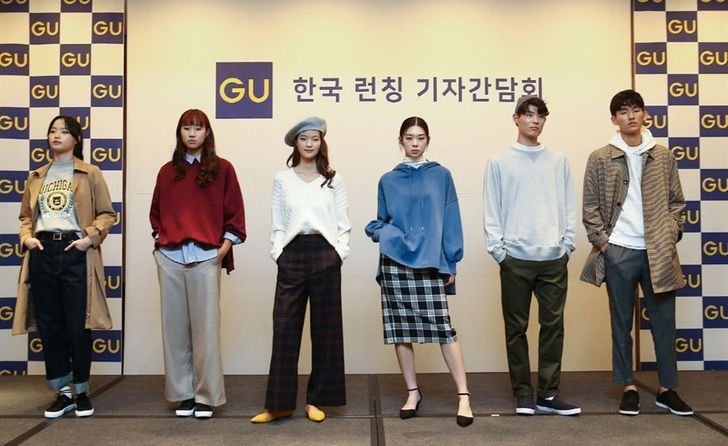
Models wearing GU clothes pose at Four Seasons Hotel in Seoul, Thursday. / Courtesy of FRL Korea
However, he declined to comment on prices of GU products in Korea and locations of additional outlets.
“For now, we are focusing on winning success at the first store,” he said. “Regarding the prices, I think slightly higher taxes will be imposed on our products in Korea than in Japan.”
GU's signature 990 yen ($8.78) jeans, which made the brand popular, will not be available in Korea, as the company stopped selling them in Japan in January 2014.
Before opening the first store, FRL Korea will open a smartphone app for GU Aug. 1 and the online store Sept. 1. It also plans to open a pop-up store near Hongik University in Seoul between Aug. 24 and Aug. 26.
Lotte is expected to aggressively promote the new brand. Lotte Shopping holds a 49 percent share in FRL Korea, while Fast Retailing holds the remaining 51 percent.
Fast Retailing opened GU's first overseas store in Shanghai in 2013. It has 19 overseas GU outlets in China, Taiwan and Hong Kong.