Hyundai boosts ties with Baidu for connected car
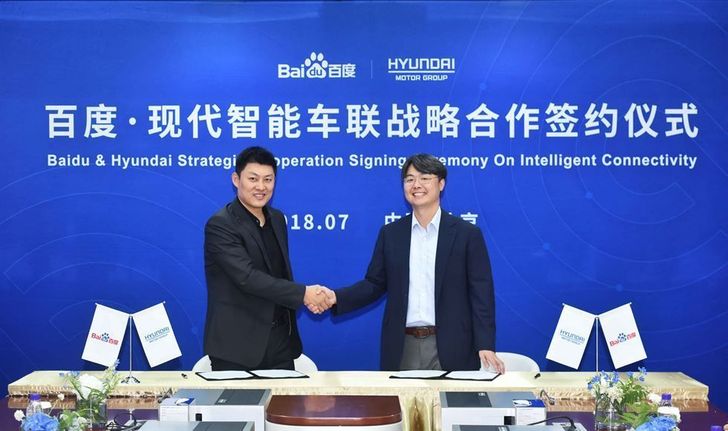
Hyundai Motor Infotainment Development Group Head Choo Kyo-woong, right, shakes hands with Baidu Internet of Vehicles General Manager Tan Su after signing a memorandum of understanding at the latter's headquarters in Beijing, Tuesday. / Courtesy of Hyundai
By Nam Hyun-woo
Hyundai Motor Group is strengthening its alliance with Chinese internet titan Baidu, in a bid to take the lead in the worldwide competition for intelligent vehicles.
According to the group, the two companies signed a memorandum of understanding (MOU) for “Internet of Vehicles,” Tuesday. Hyundai said the MOU shows the two companies' commitment to strengthen cooperation on next-generation connected car technologies.
Hyundai Motor Group, the world's fifth-largest automaker, and Baidu, the leading Chinese language internet search provider, already created a partnership in 2015 to jointly develop the CarLife in-vehicle infotainment platform. Since then, the two have been close partners, releasing new technologies and taking part in autonomous driving programs.
In the fresh deal, they outlined a four-pronged partnership roadmap -- connected car services, voice recognition, artificial intelligence (AI) and internet of things (IoT) service.
Hyundai and Baidu will co-develop a connected car service providing a wide range of in-vehicle content, including real-time traffic status and live information about the user's end-destinations, by tapping into big data, maps and portal services.
For voice recognition features, they will put their technological base on Baidu's natural language processing technology, which can recognize complex intonations in several Chinese dialects. Baidu's technology will be coupled with Hyundai's noise cancellation technology, to filter out background noise and enable improved in-vehicle voice commands.
The two will also collaborate on mass-producing Hyundai and Kia cars embedded with a Xiaodu in-car operating system. Xiaodu is an AI system, which interacts with the driver and serves as a hub for communication with the vehicle through voice commands on navigation, ventilation, media, door locks, as well as warning drivers of careless driving.
Xiaodu was first introduced at the Baidu Create 2018 AI developer conference earlier this month, embedded in the new Zhipao, the Chinese version of the Kia Sportage.
They agreed to continue efforts in speeding up the development of intelligent vehicle-to-home services, allowing a driver to control home appliances in the car and vice versa.
“The convergence of information and communication technologies and the automotive industry is taking place at an unprecedented rate, motivating us to develop and provide new possibilities for our customers,” said Hyundai Motor Group Infotainment Development Head Choo Kyo-woong.
“Through our partnership with Baidu, we will develop industry-leading connected-vehicles that exceed customer expectations.”
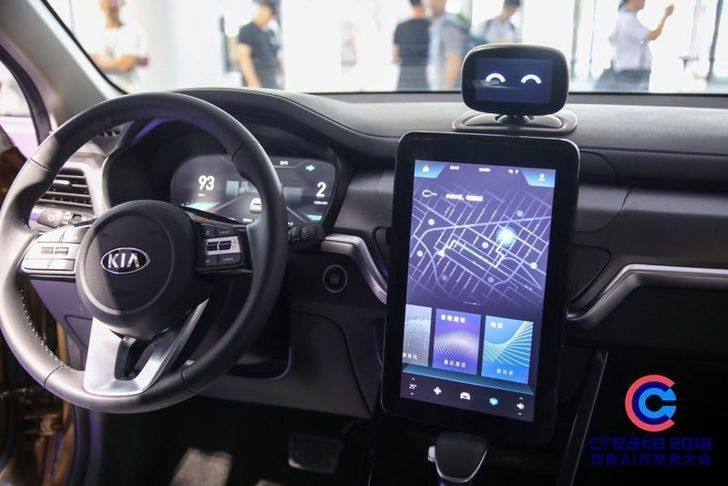
Xiaodu in-car operating system / Courtesy of Hyundai Motor Group