More Koreans to enter US without entry interview
AMCHAM stresses US to treat Hyundai same as Toyota
By Nam Hyun-woo
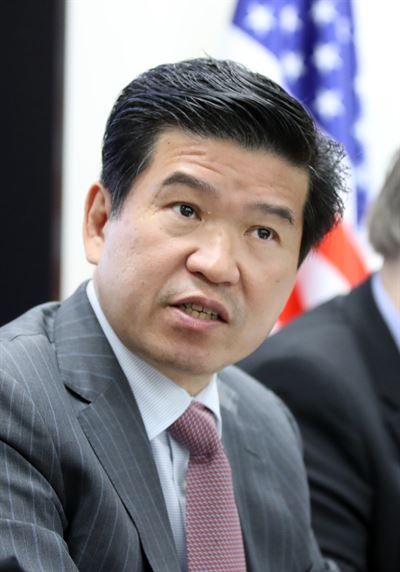
American Chamber of Commerce in Korea CEO James Kim speaks during a press conference at the chamber in Yeouido, Seoul, Tuesday. / Yonhap
Koreans are expected to bypass the long customs and immigration lines at United States airports and entry interviews for foreigners as early as next year, with U.S. politicians making efforts to put Korea onto the U.S. Global Entry program.
The American Chamber of Commerce in Korea (AMCHAM) said Tuesday it has called on U.S. congressmen to make efforts to enroll all eligible Koreans in the Global Entry program during its April visits to key figures of the Trump administration, congress and policy think tanks, called “AMCHAM Doorknock.”
During a press conference at the chamber in Yeouido, Seoul, AMCHAM Chairman & CEO James Kim said the U.S. Congress was very supportive of the initiative, with a view that “this will be a true win-win” for the two countries' transportation industries and helpful for U.S. states whose travel and tourism are major factors.
Global Entry is a U.S. Customs and Border Protection (CBP) program that allows expedited clearance for pre-approved, low-risk travelers upon arrival in the country. Members of the program enter the U.S. through automatic kiosks at select airports.
“This will enable Koreans to avoid difficult and sometimes threatening interviews when they enter the United States,” AMCHAM Chairman of Board of Governors Jeffrey Jones said. “AMCHAM pushed this hard during the Doorknock visit and the lawmakers there promised to make efforts for administrative approval from the U.S.”
According to David Ruch, former AMCHAM Chairman who gave more details about the initiative, Koreans are currently eligible to enroll in the program, but only 1,000 out of 7 million eligible Korean passport holders -- who have machine-readable passports and are enrolled in Korea's Smart Entry Service -- are in the program because they have to fly to the U.S. and have an interview to join the Global Entry program.
For easier entry to the U.S., AMCHAM is requesting the U.S. administration assign CBP agents to Korea to conduct Global Entry interviews here. Once finished with the interview, those who are in the program can bypass the long queues at U.S. airports.
“If we enroll only 10 percent of Korea's eligible passport holders, we believe it could generate an additional 500,000 Korean visitors to the U.S. each year, increasing the U.S. share of the Korean tourism market by 2 percent and tourism exports by $24 billion,” Ruch said.
Kim said he will visit the U.S. again in July for follow-ups for this initiative and expects the interview can take place in Korea as early as the first quarter next year.
During their visits to Washington D.C., the delegation, comprised of AMCHAM, United Airlines, Cigna Pfizer, Johnson & Johnson, WeWork and Hyundai Motor, met key figures of the Trump administration, including Michael Beeman, Assistant U.S. Trade Representative for the Korea-U.S. free trade agreement (KORUSFTA) Amendments; Douglas Bell, Deputy Assistant Secretary for Trade and Investment at the Department of the Treasury; Senators Ben Sasse and Cory Gardner.
Hyundai Motor joined the Doorknock delegation for the second time as a Korean member company, for their investment and job creation in the U.S. economy.
“The members of Congress were deeply impressed when we delivered the message that America is benefiting from the KORUS FTA. Because it allows companies like Hyundai Motor to freely invest in the U.S. By doing so, they create many jobs in the U.S,” Jones said.
“We found in the past that the U.S. government treats Toyota or Nissan as a U.S. company because they have such large production facilities in the U.S. but we found that it did not treat Hyundai in the same fashion. And part of our message was that it should treat Hyundai and Kia the same.”
Kim said the delegation delivered three key messages to them that: they are on track to balanced trade, grateful for the agreement in principle on the KORUS FTA amendment and the updated pact now needs full and faithful implementation.