Starbucks, most favored tenant for landlords
.jpg?w=728)
Starbucks Coffee Korea CEO Lee Seock-koo pours coffee at one of the company’s stores in this 2016 file photo. / Courtesy of Starbucks Coffee Korea
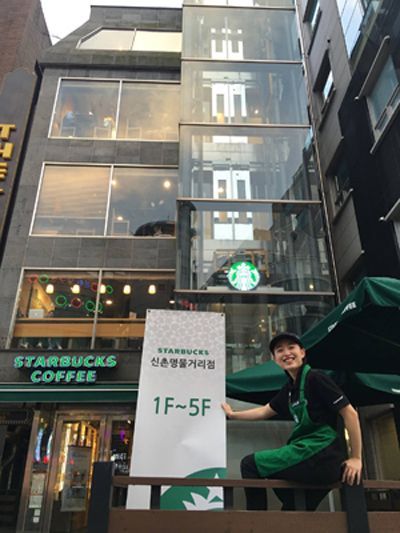
A Starbucks Coffee Korea employee poses in front of the coffee shop chain's Sinchon-Myungmul Street branch in Seoul in this file photo. Starbucks is using the entire space of the five-story building. / Courtesy of Starbucks Coffee Korea
By Park Jae-hyuk
Starbucks Coffee has recently been in the spotlight again for its status as a tenant that enhances the value of buildings that house its coffee shops, replacing McDonald's which was once regarded as the best.
In Korea, the two U.S.-based companies have raised the prices of buildings where they have opened their stores.
However, McDonald's Korea has recently shut its stores near Seoul National University (SNU) Station and those in Sinchon, Gangnam and Sadang because of a substantial rise in rent, while Starbucks Coffee is still in high demand among Korean landlords.
Most building owners here are trying their best to attract Starbucks Coffee Korea with various benefits.
“Some of our stores are not paying a fixed amount of rent, but pay depending on their revenue,” a Starbucks Coffee Korea spokesman said.
By contrast, the owners of the buildings that housed McDonald's did not accept the fast food chain's demands.
According to industry officials, McDonald's argued with its Gangnam store's landlord over remodeling of the building. Also, the company reportedly demanded its Sinchon store's landlord reduce the rent, but he refused to do so. As for the SNU Station branch, the landlord reportedly did not want to house a restaurant anymore.
McDonald's Korea admitted the higher rents, wages and cost ingredients have caused the recent shutdowns. Industry officials attributed the changing trend to McDonald's Korea's withdrawal from major business districts.
Still, Starbucks improves buildings' values and allows landlords to make profits from the sale of their buildings.
Some entertainers therefore put emphasis on Starbucks stores when they invest in real estate. If their buildings do not have Starbucks stores, they make efforts to attract the coffee shop chain.
In 2013, actress Jun Ji-hyun bought a building in Yongsan for 5.8 billion won ($5.4 million), because the two-story building was entirely occupied by Starbucks. Although the expected profit from rents was lower than other buildings, she seems to have recognized the long-term positive impact a contract with Starbucks would have.
Singer Daesung of Big Bang also purchased a building in Gangnam for 31 billion won last year, and the building has a Starbucks coffee shop on the ground floor.
Comedian Park Myung-soo's wife, who bought a four-story building in Seongbuk-gu for 2.9 billion won in 2011, sold the building for 4.6 billion won in 2014, after renting the entire space of the building to a Starbucks coffee shop. She also attracted Starbucks to another building that she bought in 2014.
Starbucks Coffee Korea posted 1 trillion won in sales and 100 billion won in operating profits last year, while McDonald's Korea has suffered from declining profits over the past few years.
However, Starbucks has also closed stores due to excessive rent.
The spokesman of Starbucks Coffee Korea cited an excessive rise in rent as one of reasons for closure of its Gangnam store last year.
If Starbucks Coffee Korea cannot afford the rent, the company opens another store nearby, following the closure of its previous store at the expiration of its rental contract, the spokesman said.
He added his company closes less than 10 stores on average annually.
Some experts expected the upcoming change of the businesses playing its role as the key tenant.
In Korea, cinemas and aquariums were regarded as the key tenants in the 1980s, while family restaurants played the role up until the 1990s. In the early 2000s, international fast fashion brands, such as Uniqlo, Zara and H&M, were the key tenants.
Recently, health and beauty stores have inherited the role. According to industry officials, Boots and Olive Young will open their stores at the spaces where McDonald's operated its stores in Sinchon and near SNU Station.