Korean cars - Trump's next target?
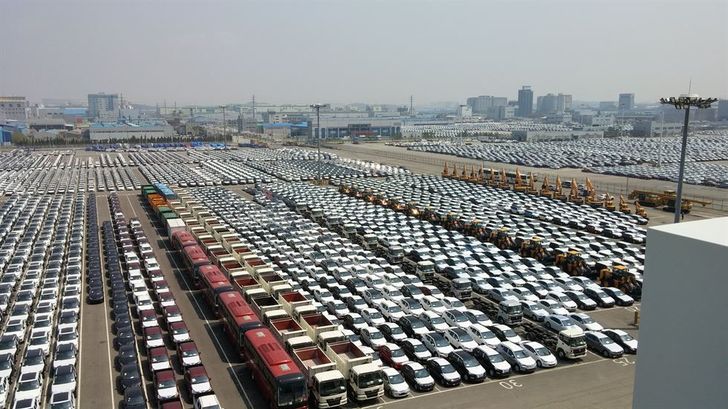
Vehicles are lined up for export at the Port of Pyeongtaek in Gyeonggi Province in this file photo. / Korea Times file
Tariffs on automobiles to weigh on US carmakers
By Park Jae-hyuk
U.S. automakers, which have experienced a significant plunge in their share prices following U.S. President Donald Trump’s announcement of a plan to levy 25 percent tariffs on imported steel, may suffer from another unfavorable factor — tariffs on imported automobiles.
According to automotive industry experts, Sunday, Trump’s attempts to protect his country’s car industry will boomerang on U.S. carmakers, just as steel tariffs for the rust belt of the northeastern U.S. have ironically caused the U.S. manufacturers to struggle.
After the U.S. president’s announcement on steel tariffs last week, there are expectations that semiconductors and automobiles, both of which are Korea’s major export items, will be the next target.
A large number of his supporters live in the declining industrial area, so Trump has shown keen interest in his country’s car industry, since he was a presidential candidate.
The Korea Trade-Investment Promotion Agency (KOTRA) also picked automobiles as an item that is expected to face U.S. trade barriers.
“Trump specifically mentioned the names of companies, such as General Motors (GM), Ford and Toyota, when he forced them to increase manufacturing facilities in the U.S.,” KOTRA wrote in a recent report. “This also weighed on Korean firms, although they were not mentioned.”
The U.S. has been trying to amend its free trade agreement with Korea, (KORUS FTA), so as to impose tariffs on Korean cars. Trump has regarded the agreement as the main reason behind his country’s trade deficit with Korea.
KOTRA expected the U.S government’s efforts to enhance regulations on imported vehicles to affect the amendment of the KORUS FTA.
Amid concerns about the beginning of a trade war, steel and automobile shares took a nosedive as well.
Prof. Kim Pil-soo at Daelim University, however, pointed out that Korea will also be able to impose tariffs on the U.S. automobiles, if the KORUS FTA is revised as Trump wants.
If so, the U.S. carmakers with lower price competitiveness will face risks in exporting their cars, according to the expert. He cited GM’s cars as examples of the U.S. vehicles that have not sold well in Korea, due to their low quality compared to their price.
Already, the U.S. automobile firms complain about the expected increase in auto parts prices following the expected rise in steel prices. Factory workers in the U.S. fear unemployment as well.
Ford closed down 1.4 percent while GM dropped 1.8 percent in Friday trading.
The Wall Street Journal even wrote in its editorial, “Mr. Trump has handed a giant gift to foreign car makers, which will now have a cost advantage over Detroit.” The New York Times and the Washington Post also criticized Trump’s decision.
Some Republicans also oppose the U.S. president’s arbitrary decision, according to Politico.