Dongwha invites foreign employees to Korea
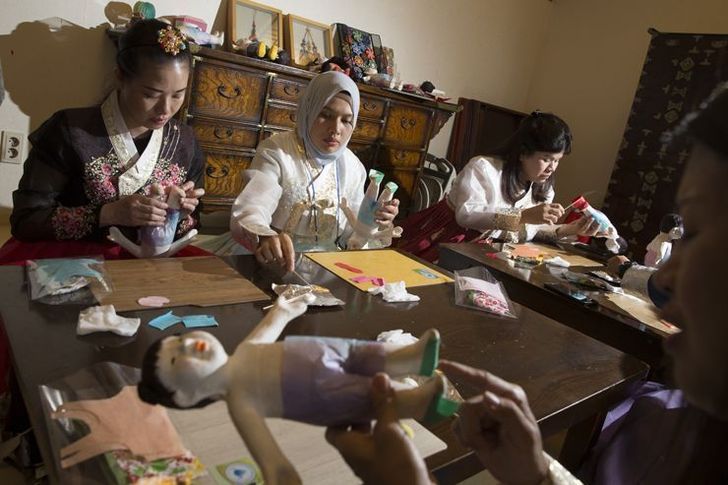
Dongwha employees from Vietnam, Malaysia, Australia and India make traditional Korean dolls with paper, wearing traditional Korean clothes at the Traditional Crafts Center at Bukchon Hanok Village in Seoul last week. Dongwha invited the foreign workers here, so they could understand their company better. / Korea Times photo by Choi Won-suk
Workers from four countries learn more about company
By Park Jae-hyuk
Dozens of foreign workers from Dongwha Group’s overseas affiliates went to the Traditional Crafts Center, one of the traditional Korean-style houses at Bukchon Hanok Village in Seoul, Tuesday last week.
Wearing traditional Korean clothing, hanbok, the employees from Vietnam, Malaysia, Australia and India made traditional Korean paper dolls.
Although some of them felt awkward about wearing hanbok and sitting on the floor, all of them seemed to be satisfied with the dolls they made after the experience.
Dongwha International’s (DWI) India Office sales manager Ashish Shah, who visited Korea for the first time, also expressed his satisfaction with the experience and his company.
“I am very happy to be here,” he said. “I expect to understand the culture of Korea, as well as the company I work for, during this visit. I expect to get some more knowledge about the working culture and other systems that we follow in this company.”
The event was a part of the One Dongwha Camp, Dongwha Group’s cultural initiative aimed at better communication and as a reward for its hardworking overseas employees.
Since 2014, Korea’s leading wood panel manufacturer has invited its employees from overseas affiliates to Korea every year so they can understand the company and the country better.
This year, 26 employees working for Dongwha Malaysia (DMY), VRG Dongwha (VRGDW) in Vietnam, Dongwha Timber (DWT) in Australia and DWI’s offices in Vietnam and India came to Korea.
Starting from Tuesday and running through Saturday last week, they went on tours to Bukchon Hanok Village, Myeong-dong and Gyeongbok Palace in Seoul, as well as China Town in Incheon.
They also visited Dongwha’s medium-density fiberboard (MDF) factories at Incheon and Asan, South Chungcheong Province, and Dongwha MPARK, Korea’s largest used car complex in Incheon.
The five-day visit also offered workshops and performances for the workers to foster better communication with each other living across different borders.
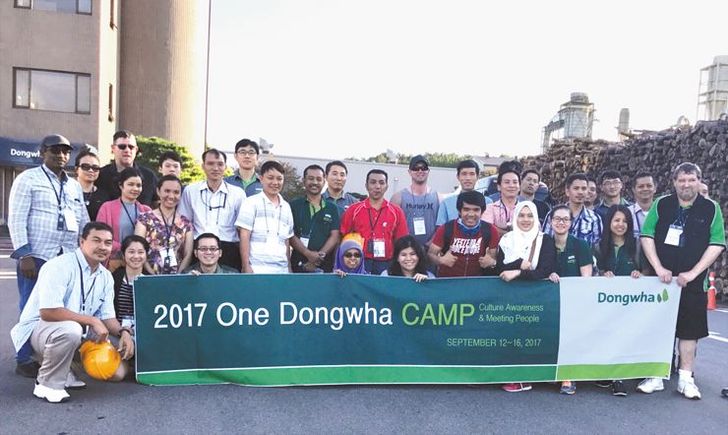
Dongwha’s foreign employees pose at the company's medium-density fiberboard factory in Asan, South Chungcheong Province, last week. / Courtesy of Dongwha Group
Recommended company
Despite their diverse nationalities, Dongwha’s foreign workers unanimously praised their company for its corporate culture.
Shah, who moved to Dongwha earlier this year from an Indian company where he served in the same position, said only one thing was changed after the transfer ― the working culture.
“The way of working at Dongwha is very different than at Indian companies,” he said. “Indian companies focus only on sales, nothing else. But Dongwha deals with more issues, such as sales, market information and the introduction of new products.”
Saying he could develop his abilities at Dongwha, the sales manager said Dongwha is spending more for the well-being of its employees than his previous company did.
Luong Ke Luc, the sales manager at DWI’s Hanoi office in Vietnam, said his life has totally been changed since the Forestry University graduate moved to Dongwha in 2012 from IKEA, the Swedish home furnishing company.
“I feel I have improved myself and my family,” he said. “The work with Dongwha fostered my leadership, helping me to become more industrious.”
DMY’s production worker Mohd Soberi Bin Ahmad regards smarter working culture as Dongwha’s advantage, compared to his previous workplace and companies in Malaysia.
Ahmad, who has worked for DMY for more than 20 years, said the company posted good performances as well.
By setting up a production base in Australia in 1996, Dongwha started its overseas moves earlier than its rivals and set up a series of production sites in Vietnam, Malaysia, New Zealand and Australia.
It has now grown into Korea’s leading building materials manufacturer and a global provider of wood panels, such as particle boards and MDF.
The company’s Vietnamese affiliate posted 36 percent in its operating profit ratio in 2015, three years after the first line began operations. The second production line, which opened this year, is expected to help the company’s sales for this year rise over 20 percent from 113.8 billion won ($100 million) last year.
The company’s plants in Malaysia, Australia and New Zealand have also shown fast growth, leading the wood panel industry in each country.
Given the achievements, the foreign employees recommended their company to their countries’ jobseekers, even to the members of their families.
“I hope more friends of mine interact with Dongwha,” Luong said. “I have two sons, and I will recommend they consider becoming part of the Dongwha family when they grow up.”
Michael Dyer, the engineer at DWT who joined the company in 2004, said his son actually works at one of the sections at Dongwha’s plant which produces commercial board.
Feeling regretful about the fact that most Australians have yet to realize Dongwha’s capacities as a global enterprise, Dyer said he has tried hard to promote his company to his friends and neighbors.
Dyer, who was in Korea for the second time, said he wants to contribute more to DWT, when he goes back to his country. Shah also said he expects the factory tours will allow him to understand the capacity and technologies of Dongwha better.
Established in 1948 as a wood producer, Dongwha Group has become one of the nation’s leading players in building decorative materials, manufacturing wood boards, chemicals, construction and homebuilding materials and substances.
The Seoul-headquartered group extended its business horizon to secondhand automobiles by founding Dongwha MPARK in 2011 and to media via the acquisition of the Hankook Ilbo and The Korea Times.
It holds a total of five subsidiaries including Dongwha Enterprise, the leading floor material maker in Korea, and Daesung Wood, the top-tier player in the domestic timber industry.
Korea Times intern Rha Hae-sung contributed to this article.