Conglomerates face government extortion
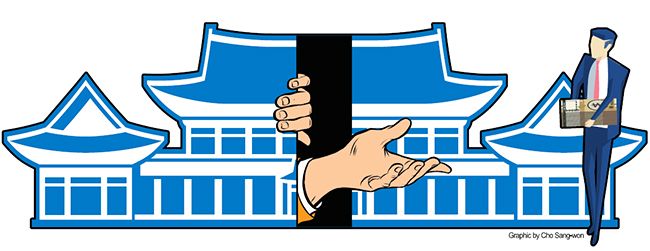
Big companies forced to contribute billions of won to gov’t initiatives
By Kim Tae-gyu
Prosecutors’ investigations show that domestic conglomerates have been forced to contribute a total of 77.4 billion won to the Mir and K-Sports foundations, which were masterminded by President Park Geun-hye’s shadowy aide Choi Soon-sil.
The amount is not small even for big companies, which complain that it was by no means the first time the government pressured them for donations.
Midway through 2015, President Park came up with the idea herself of creating the Youth Hope Fund, which finances various programs for young jobseekers to grapple with the rising unemployment rate.
Corporate giants coughed up 88 billion won for the fund.
They also had to cough up 21 billion won for a research institute on “intelligent knowledge,” 20 billion won for a fund on internet-based promotional campaigns and 10 billion won for a fund for small-sized merchants.
Overall, local groups donated 216.4 billion won under the Park administration, which was inaugurated in early 2013. And the problem is that such goodwill activities are not voluntarily done.
“When senior government bureaucrats ask us to take part in a specific government-initiated project, we practically have no choice but to accept it,” said an official at a Seoul-based group.
“The incumbent administration seems to regard companies as its private ATM. We don’t understand why we should give money for initiatives, which should be collected through taxes.”
Also while establishing 17 innovation centers across the world geared toward stimulating the creative economy, 15 companies were compelled to take charge of creation of a center and its operation.
As a basic economic tenet in her campaign platform, Park has tried to realize a creative economy through convergence of different industries and promotion of startups.
But criticisms have sprung up that the concept lacks concrete content and the related efforts failed to boost the moribund economy, which has struggled to find its feet in recent years.
“The government announced its blueprint for the creative economy innovation centers in September 2014. And it let us know our region a day before through the Federation of Korean Industries (FKI),” said a representative of another conglomerate.
“Back then, we asked what we should do and the answers were like, ‘You can do whatever you are good at.’ Then, we were at a loss regarding what we should do with the center.”
Origin of forced donations
President Park might grumble that she just followed suit from her predecessors and that is true.
The forced donations practice stretches back to 1983 when the Ilhae Foundation was set up as part of efforts to deal with the aftermath of North Korea’s deadly bombing in Yangon earlier in the year.
Then South Korean President Chun Doo-hwan, the intended target of the attack, avoided the attack but 17 South Koreans including Cabinet ministers and four Burmese officials were killed.
The Ilhae Foundation, which was named after Chun’s penname, was designed to support the families of the victims. Toward that end, companies were to give 59.8 billion won in 1984.
Chun and his successor Roh Tae-woo, both army generals-turned-presidents, covertly requested slush funds from companies. But after they were punished in the 1990s for their misdeeds and the relevant law was strengthened in 2004, such unlawful demands almost disappeared.
Sometime later, forced donations became the norm again.
During the Kim Dae-jung administration that spearheaded an initiative providing fertilizers to North Korea, controversies sprouted up as it was found to have solicited 10 billion won from companies.
President Park’s immediate predecessor Lee Myung-bak also resorted to this method of raising funds _ his government conducted two campaigns of helping the financially vulnerable and seeking shared growth between big firms and small ones.
The corporate side contributed around 500 billion won and 700 billion won for the two initiatives, respectively.
“When tycoons are embroiled in scandals or illegal activities, they tend to give reluctant consent to the idea of donating their private funds in order to beg for forgiveness,” said an industry source who asked not to be named.
“When the country suffers natural disasters including droughts and floods, we also have to donate money. That is the case for major sporting events like the Olympics. The accumulated amount would reach trillions of won.”
How to bring change?
Understandably, the business circle is opposed to the involuntary contributions. And an increasing number of experts agree something should be done.
“From the perspective of companies, they would not be able to flatly refuse the government’s demands because it has so many tools to disrupt their business such as tax audits and antitrust investigations,” said a Seoul analyst.
“Hence, the government can easily twist the arms of conglomerates to collect funds.”
In the case of Choi, who is suspected of having illegitimately meddled in state affairs, observers said she could flex her muscles to make firms open up their purses.
Prof. Kim Sang-jo at Hansung University claims a new regulation should be introduced.
“We need to phase in a new corporate rule that dubious expenditures including forced donations should be reported to and discussed at board of directors’ meetings,” Kim said.
Out of 23 companies that transferred more than 1 billion won to the Mir and K-Sports foundations, only two discussed it at board of directors’ meetings.
Public citizens are also implicated by the forced contribution.
For example, tax experts said that out of 77.4 billion won funded to the Mir and K-Sports foundations, a maximum of 18.7 billion won would be returned to the donors in the form of tax credits.
In other words, the two foundations were created on 58.7 billion won donations and 18.7 billion won taxes, which would further raise the ire of already-angry taxpayers.