Korea's R&D overhaul needed for new age
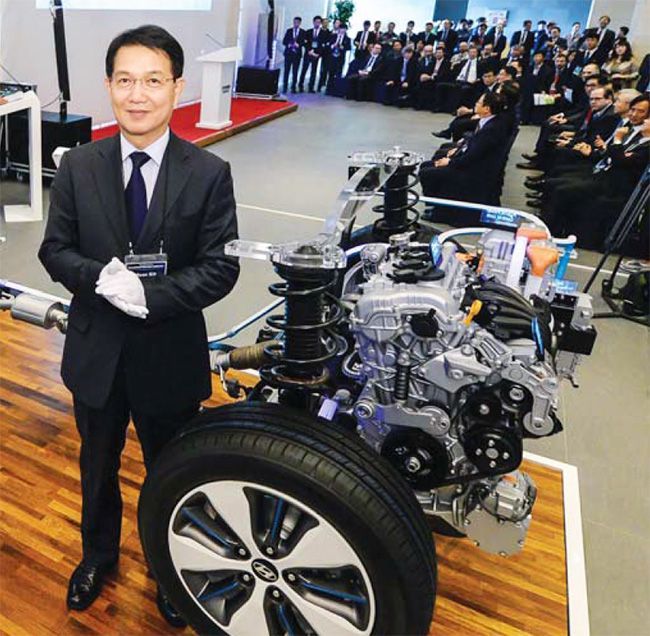
An R&D official of Hyundai Motor Group poses at a recent technology fair and conference in Hwaseong, Gyeonggi Province. Korea ranks top in business research and development in the Organization for Economic Cooperation and Development. / Yonhap
By Park Hyong-ki
A new era is about to come that will alter the way people access and absorb information and consume and experience products.
As a wide range of new technologies, from virtual reality and robotics to artificial intelligence and drones, is rapidly introduced to digital consumers, the global economy is bracing for the fourth industrial revolution.
This new age will bring changes to both the cyber and physical landscapes in the near future, where practically almost every object will be connected to wireless networks for remote control, access and information processing.
To prepare for this revolution, new ways of thinking will be needed that enable new ways of strategizing and realizing those new ideas into services that are integrated with state-of-the-art automated technologies. And to this end, an economy must also undergo a paradigm shift in terms of the way governments, businesses and academia conduct research and development (R&D) and innovate.
An overhaul in R&D is especially urgent for Korea, which has relied on carrying out science and technology projects that can show immediate results and catch up to the standards of advanced economies.
An R&D policy focused on rapidly developing and commercializing products through reverse engineering may be fit for a country in its developing stage like Korea in the 1970s and 1980s, when its top priority was to grow out of poverty. But this aging R&D strategy no longer works for today’s Korea, which faces growing uncertainties and chaos in an information-laden and technology-driven world.
.jpg?w=728)
Asia’s fourth-largest economy is recognized for its large and intensive R&D investment in proportion to its gross domestic product (GDP); Korea invests more than 4 percent of its GDP in R&D, higher than the United States’ 2.7 percent, Japan’s 3.6 percent and China’s 2 percent, according to the Organization for Economic Cooperation and Development (OECD). However, most of its R&D projects are not for the sake of advancing scientific discoveries, inventing new technologies or disrupting conventional thinking, but rather, focus heavily on delivering short-term results that can show immediate commercial viability.
“Korea’s high R&D investment is hardly felt in the research field especially when it comes to long-term projects in basic science that may last more than 10 years, as most of the funds are allocated to backing three-year R&D that can prove it can make money in the short-term,” said Professor Cho Hyung-koun of Sungkyunkwan University’s School of Advanced Materials Science and Engineering.
Industry sources say this short-term thinking environment is a serious problem, as it hinders innovation in the long-run, which Korea direly needs as it faces declining growth in traditional industries such as manufacturing, shipbuilding, construction and shipping.
“Robots, AI (artificial intelligence) and augmented reality ― the technologies we hear about today ― were years in the making and really started out from basic science research then proceeded with collaborations between universities, businesses and state agencies,” an IT industry source said.
A case in point is the Internet, which was developed in the defense sector then expanded to universities and businesses. Similarly, computer animation took years of research at universities before it was commercialized by Pixar, an animation studio acquired by Steve Jobs from Lucasfilm.
.jpg?w=728)
These new technologies were all made possible in an environment that allows not only risk-taking but also failure. And unlike Silicon Valley in the United States, Korea lacks this type of R&D and business environment.
“The society here generally does not accept failure, which discourages researchers or even young people from taking risks and creating something,” Cho said.
This disadvantage is one of the reasons Korea has not yet won a single Nobel Prize in science, whereas the United States, Europe and Japan have already won many, industry sources say.
To better prepare for the future ― the new industrial revolution ― in the face of aging population, low productivity and low growth, Korea needs to change its thinking by embracing innovation.
“The country needs to allow people to take on long-term and riskier R&D especially in basic science and give them more independence in pursuing those projects,” said Lee Chang-yang, economist at KAIST College of Business.
Furthermore, researchers in Korea face many administrative hurdles while carrying out their projects, as they need to constantly report their progress.
The OECD also recommended stronger partnership between universities, businesses and state research agencies for innovation.
“Policies to strengthen links between industry, university and government research institutes are needed to improve technology transfers and commercialization,” the OECD said in a May 2016 report, “OECD Economic Surveys: Korea.”
“Limited co-patenting reflects Korea’s conglomerate structure, which tends to retain technology within the group. As firms approach the technological frontier, Korea needs to better connect to global science and innovation networks.”
Hyundai Research Institute said for Korea to progress from being a fast follower to becoming a first mover, it needs to put more weight on investing in basic science over technology applications, as the only alternative for the country’s economic sustainability is an R&D policy that promotes innovation to overcome the low birth rate, aging society and decreasing labor productivity and capital.