Samsung bets on Africa as last emerging market

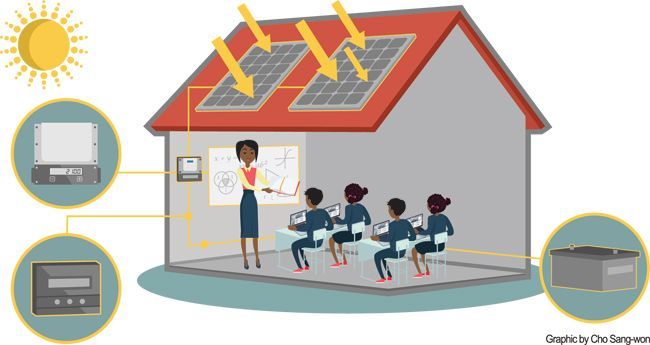
Seen is Samsung Electronics’ Digital Village near Johannesburg, South Africa. The electronics company established the facility in 2013 and set up moving clinic car, telemedicine center, solar-powered internet school and power generator to meet local residents’ demands. / Courtesy of Samsung Electronics

By Yoon Sung-won
Samsung Electronics is pouring multifaceted efforts into boosting its presence in the African market amid market saturation in other parts of the world.
The nation’s top electronics company is expanding its business including human resources and manufacturing facilities in the region to seize what could be the world’s last emerging market opportunity.
.jpg)
“We are pushing for strengthening our drive to capture the African market, which we believe is the last emerging market in the world,” a Samsung Electronics official said.
The African market has drawn much attention from global enterprises. According to data from Korea Trade Investment Promotion Agency (KOTRA), the African market has recorded a growth rate of about 6 percent every year since 2011. In particular, seven out of the 10 fastest-growing countries around the globe between 2011 and 2015 have been on the African continent, KOTRA said.
In preparation to expedite its business on the continent, Samsung Electronics has established a new regional headquarters in South Africa to oversee business operations in the region, separating its exiting Central Asian headquarters into African and Middle Eastern headquarters in December 2009.
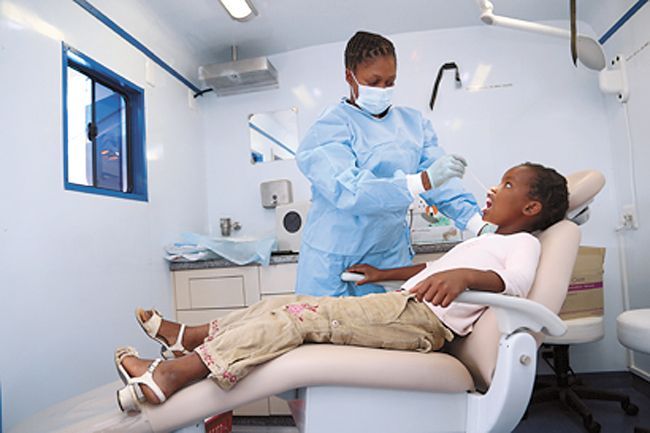
A dentist treats a patient at the solar-powered health center in Samsung Electronics’ Digital Village near Johannesburg, South Africa, in this file photo. / Courtesy of Samsung Electronics
“We have established a separate African headquarters to strengthen field-oriented business capabilities in the growing African regions,” the Samsung Electronics official said. “This also aimed at expanding our existing business approach, which used to concentrate on major countries and metropolitan areas, to neighboring countries and smaller cities.”
This year, Samsung Electronics started operating a home appliance assembly facility in Zimbabwe. It also opened a store for its flagship brand in South Africa to boost its brand image and sales at the same time.
At the same time, it has continued to increase the number of employees working in the African region. As of last year, the company had 958 employees in Africa.
Accordingly, Africa’s importance to Samsung Electronics’ global performance has also risen in recent years. The company said markets in Africa and Asia, excluding China, have generated 22 percent of its total global sales, up from 19 percent in 2013.
Product localization
Samsung Electronics is rolling out localized products, themed “built for Africa,” in the region and is striving to boost the premium image for its brand.
“We maintain an overwhelming dominance in market shares of Africa’s five largest markets in South Africa, Nigeria, Kenya, Ghana and Senegal,” Samsung Electronics said. “Other home appliances including TVs, refrigerators and washing machines are also holding the biggest market shares in major African countries such as South Africa.”
As the top electronics brand in Africa, the company said it is introducing locally specialized marketing activities and expanding sales of premium products to gradually increase profits, while solidifying trust relationships with business partners in the region.
Samsung Electronics has also provided localized products with features that are dedicated to meeting the special demands of African customers.
One such localized product is a deep freeze dubbed “chest freezer.” Due to the lack of sufficient and reliable electricity supply network, African customers undergo frequent blackouts. Considering this local situation, Samsung Electronics has designed the device to allow users to store foods by freezing them.
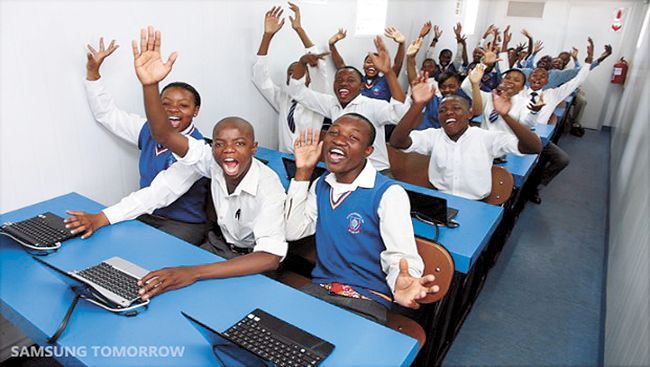
African students attend a class at the solar-powered internet school in Samsung Electronics’ Digital Village near Johannesburg, South Africa, in this file photo. / Courtesy of Samsung Electronics
The chest freezer was first released in the African market in the latter half of 2013. Since then, the company has added what it calls the “cool pack” feature, which helps the freezer maintain subzero temperatures for a longer time even without power supply.
Considering the hot weather of the region, the company has also rolled out refrigerators with a “twin cooling” feature, highly efficient system air conditioners and Active Dual Wash washing machines.
Besides new products, Samsung Electronics has added localized features to existing global models.
One example is a special TV feature called “Africa Cinema Mode.” Launched in 2015, this mode offers detailed contrast adjustment options to help users distinguish people even in dark backgrounds.
Another example is what is called the “Clear View” feature. Launched also last year, this feature reduces video noise to boost quality of analog-based broadcasting content in Africa.
As a countermeasure to sudden voltage changes in households, Samsung Electronics’ televisions sold in the African market have what the company calls its “All Care Protection” feature. Introduced in 2011, this feature provides more durability against electric surges, unexpected voltage changes, humidity, dust and insects.
For premium customers, Samsung Electronics applied the “Music TV” feature to premium models this year. To supplement unstable wireless internet connections in the region, the latest Samsung Electronics premium televisions support Bluetooth connections to allow users to connect their televisions to other mobile and multimedia devices.
Besides marketing activities for consumers, Samsung Electronics is also strengthening its drives in the business-to-business (B2B) and online market sectors and has operated a department dedicated to them.
“Though the online business market in Africa is currently in its early stages, it has high potential for future growth,” the company said. “Considering that the internet will continue to penetrate the market, we are seeking tighter partnerships with online retail businesses to launch collaborative marketing activities with online distributors.”
Brand improvement
Aiming at improving brand image as a whole, Samsung Electronics is launching diverse marketing activities based on football, which enjoys high popularity in Africa.
The company has sponsored the Africa Cup of Nations between 2008 and 2015, as well as the 2013 Africa U-20 Championship in Algeria and the 2015 U-20 event in Senegal.
Samsung Electronics said it is also implementing diverse corporate social responsibility (CSR) activities in the African countries.
To provide education and healthcare support, the company has established a cooperation network with Korea Education and Research Information Service (KERIS), local governments and non-governmental organizations.
It has tapped into its own technological capabilities to boost information technology and vocational education. To this end, it opened a community center called Digital Village near Johannesburg, South Africa, in 2013 to provide basic medical care and education services.
The company has also built smart schools, solar-power internet schools (SPIS) and engineering academies across the continent.
Earlier in March, Nigeria’s President Muhammadu Buhari asked Samsung Electronics to support the country by building additional smart schools.
Last December, the company established the country’s first smart school under cooperation with Ogun State in Nigeria. It expected that the facility will train more than 10,000 teachers and 5,000 students in the next five years.
As of 2014, Samsung Electronics has established more than 1,200 smart schools around the world and has introduced its mobile devices for educational use.
Expectations are high that the spread of smart schools and engineering academies throughout Africa will help the company reach out in the educational device and service market.