Concern grows over nuclear plant safety

Members of Justice Party visit Wolsong Nuclear Power Plant in the country’s southeastern resort city of Gyeongju, Tuesday, to check possible damage after a series of earthquakes. / Yonhap
By Jhoo Dong-chan
A series of earthquakes that has jolted North Gyeongsang Province over the last two weeks, including the biggest one ever recorded in the country with a magnitude of 5.8, triggered public safety worries about nuclear plants clustered in the area.
Fourteen people were reported to be injured, and the public is now raising questions about why most of the nation’s nuclear power plants were built in the quake-prone East Coast area.
Of the country’s 34 nuclear reactors, including ones currently under construction or maintenance, 28 are located in the area. There is also a low to intermediate level radioactive waste disposal facility in Gyeongju, the epicenter of the earthquake, Sept. 12.
Since the earthquake struck the area last week, a taskforce, including geology professors from Seoul, Pusan and Pukyong national universities, has analyzed aftershocks near the epicenter with 27 seismographs.
They have concluded that the epicenter was located just above an active fault line after studying some 300 aftershocks since the tremor, and hinted at the possibility of stronger quakes hitting the area in the future.
“We have learned that an active fault line does exist underneath where the aftershocks took place,” Prof. Kang Tae-seop of Pukyong National University was quoted as saying by a local daily.
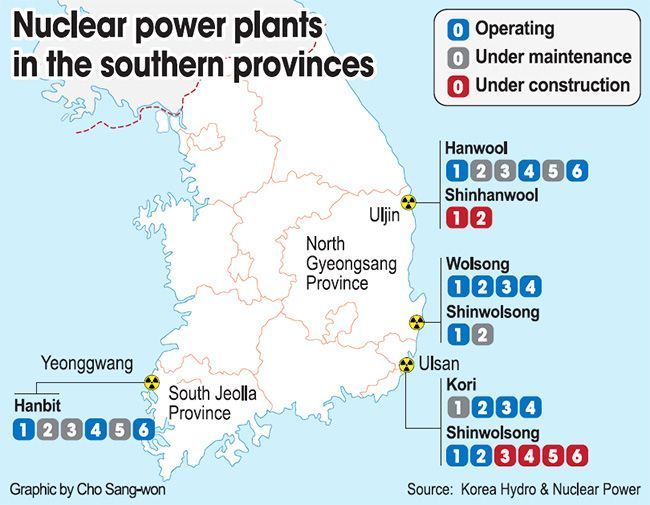
According to an anti-nuclear power civic group in South Gyeongsang Province, no more nuclear power plants should be built in areas near major cities such as Ulsan and Gyeongju because they are close to the active fault line.
“Government officials claim that nuclear reactors in the area can endure up to a 7.0 magnitude quake. But if they are continuously exposed to minor aftershock damage, they could be destroyed if a powerful earthquake really strikes the area,” an anti-nuclear civic activist said.
Rep. Cho Kyung-tae of the ruling Saenuri Party also claimed that operations at all reactors in the Gori and Wolseong regions in North Gyeongsang Province should be suspended until safety concerns are dealt with.
“The reactors in Gori and Wolseong should be taken off line until we make sure they are safe from possible quakes,” Cho said in a statement.
However, the state-run Korea Hydro and Nuclear Power (KHNP) said this was unnecessary, claiming that all nuclear power plants in the area, including those in the Wolsong and Gori plants, wouldn’t be damaged by aftershocks or up to a 6.5-magnitude earthquake.
“Unlike regular buildings, nuclear power plants are built 20 meters into the ground,” a KHNP official said. “Before the construction, the KHNP also conducts a thorough investigation into the geological structure and quality of the rock in the area. The construction process also includes stress testing of nuclear reactors. Our nuclear power plants won’t be damaged at all unless powerful earthquakes with a magnitude of 5 or above strike the area on a daily basis; something that is highly unlikely.”
He also said that most of the nation’s nuclear power plants were built in Korea’s southeastern region because of the area’s high power demands.
“There are several production plants in Gyeongsang Province, including shipyards, car manufacturing plants and steel mills. Considering power transmission costs, it is better off to have power plants near where demand is the most,” an official said.
“Plus, nuclear power plants also require a massive amount of cooling water. That’s why most of the nation’s nuclear power plants are built near coastal areas.”
The government has avoided built nuclear power plants in the nation’s northern region due to possible sabotage by North Korean agents, he added.
According to the Korea Electric Power Corp. data, Korea’s nuclear power plants cover roughly one third of power demand in the country.
After the East Japan Earthquake struck Fukushima in 2011, the KHNP was ordered to carry out safety inspections on all its nuclear power plants and to enhance their safety, including raising seawalls and reinforcing waterproofed facilities.