Samsung faces backlash for canceling Saemangeum investment
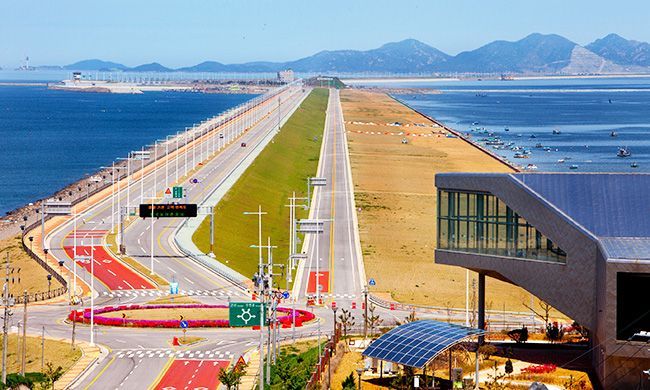
Saemangeum Seawall stretches 33.9 kilometers along the southwestern coast in North Jeolla Province. In 2011, Samsung pledged 7.6 trillion won in investments to build energy-related facilities in this region, but recently canceled its plan — citing a lack of funds — drawing protests from local residents. / Courtesy of Saemangeum Development and Investment Agency
By Lee Hyo-sik
Samsung Group is facing backlash from residents of North Jeolla Province for scrapping a plan to invest 7.6 trillion won (6.9 billion dollars) in Saemangeum, the 400-square-kilometer reclaimed tidal flat off the southwestern part of the country.
Korea’s largest family-controlled conglomerate had signed an agreement with the North Jeolla Provincial Government (NJPG) in 2011 to build an eco-friendly energy complex, but recently decided not to go forward with the scheme, citing a lack of cash.
But the provincial government and residents have been protesting Samsung’s decision, arguing that the company should keep its promise. Some residents and lawmakers elected from the province even raised speculation that from the beginning, Samsung had no intention of investing in Saemangeum.
Some lawmakers hailing from North Jeolla are even pushing to summon Samsung Electronics Vice Chairman Lee Jae-yong to the upcoming Assembly audit of government agencies, to quiz him about Samsung’s position on Saemangeum.
According to NJPG officials Monday, Samsung informed NJPG in May that it would not invest in Saemangeum, saying it lacks the money to construct an energy complex there amid the prolonged global economic downturn.
On April 27, 2011, Samsung signed a memorandum of understanding (MOU) with NJPG to spend 7.6 trillion won from 2021 to 2025 to build wind power generators, solar fuel cell plants and other energy-related facilities on an 11.5-square-kilometer site. However, Samsung has done nothing over the past five years to follow up on its promise, according to NJPG officials.
‘Samsung should be more sincere’
“We had high hopes for Samsung to make a difference in Saemangeum, but unfortunately it turned out to be an empty dream,” said Choi Jae-yong, director general of NJPG’s Saemangeum project support bureau. “We are very disappointed in Samsung’s decision not to invest in North Jeolla Province. If not building an energy complex, we are hoping that Samsung does something else for the province.”
Choi then called on Samsung to be more sincere, saying NJPG has not received any official notice from the conglomerate.
“In May, some Samsung employees came and told us that the company wouldn’t be able to invest in Saemangeum,” he said. “We would like Samsung to state its position publically and officially. We want Samsung to take a proactive approach to resolve the issue.”
Recently, NPJG Governor Song Ha-jin told local council members that he would push for a fact-finding probe into the matter, even calling Samsung’s about-face “politically motivated.” The governor said North Jeolla residents deserve to know the truth, adding he will release all the records surrounding the issue.
In addition, Rep. Kim Kwan-young of the People’s Party and other lawmakers elected from the province have expressed regret over Samsung’s decision, stressing that revitalizing the Saemangeum project is vital to propping up the sluggish local economy. Some have even been pushing to call in Samsung’s vice chairman for a planned National Assembly inspection.
“I know MOUs are nonbinding, but nonetheless, we really had high hopes for Samsung. We are very disappointed,” a 70-year-old resident told The Korea Times. “It seems that we are being discriminated against because North Jeolla Province has a small population. Samsung has not a single plant here, while operating some production facilities in 15 other metropolitan cities and provinces. Some even say that we should boycott Samsung products.”
‘Times have changed’
However, Samsung said it had no choice but to cancel its investment plan, given the rapidly changing business conditions.
“Things have changed drastically over the past five years,” said a Samsung Group official, who declined to be named. “We had planned to build a renewable, eco-friendly energy complex in Saemangeum. But we have sold our solar panel and other renewable energy businesses over the past few years so we cannot create the energy complex there.”
The official added that Samsung will continue to engage in dialogue with NJPG to reach a mutually satisfactory conclusion.
The national government has spent around 3 trillion won since 1991 to build the world’s longest 33.9-kilometer-long seawall to reclaim 40,100 hectares of new land and create a freshwater lake.
Initially, the project was exclusively to secure farmland but its purpose has been modified a number of times over the past two decades.
In March 2011, the government finalized the Saemangeum plan under which about 30 percent of the reclaimed land will be set aside for farming, while the remaining 70 percent will be used for other functions, including an eco-friendly manufacturing hub for cars, industrial materials and reusable energy companies. On top of that, tourism and leisure complexes and housing will be constructed.
But the project has largely remained stalled over the years due to a lack of investments.