Apple's customer policy comes under fire
.jpg?w=728)
U.S. tech giant’s high-handed approach causes uproar
This is the fourth of a series highlighting industry leaders that struggle to deal with their flaws and mistakes. ― ED.
By Kim Tae-gyu
In the business world, companies tend to believe in the time-honored motto, “the customer is king.” But the customer seems to have become dethroned when it comes to Apple's services in Korea.
Here are some examples involving Korean customers of Apple products.
Oh Won-guk, an office worker man in Gwangju, bought an iPhone 5 on Dec. 12, 2012, and something went wrong with its battery. He went to nearby service center on Nov. 14, 2013.
An engineer told him that a partial repair would be performed and he would be notified of the cost later. Five days later, however, the center told Oh that the repair was not possible. Instead, it said he should put a purchase placement device, or a refurbished phone, for 340,000 won ($305).
Not wanting to spend the money on a refurbished unit, Oh requested that Apple return his phone but the tech giant refused to do so, citing company policy.
Generally speaking, refurbished phones are used phones that have been fixed and tested. They are supposed to function like a new phone and come with a warranty just like a new phone does.
An Apple Korea service center representative said that the company provides reconditioned products, which undergo stringent testing prior to being offered.
“I just wanted to get my own handset back since it has so many of my pictures and phone numbers. But Apple Korea did not accept my demand and I cannot understand why,” Oh said.
Oh asked the state-run Korea Consumer Agency to arbitrate the dispute. But Apple refused to engage in mediation, which prompted Oh to take the case to court in January 2014.
Then, Apple offered to provide a new phone or money amounting to the phone’s price of 1.02 million won, which Oh did not accept.
“I was really disappointed by Apple’s attitude in dealing with my complaint. The lawsuit consumed much of my time and energy but I wanted to beat Apple so that it can learn some lessons,” the 32-year-old said.
In late 2014, the court sided with Oh by ordering Apple Korea to pay 1.02 million won for the device and an additional 500,000 won for personal data incorporated in his iPhone 5.
Park Soo-min, a graduate student in her 20s in Suwon, is another disgruntled iPhone customer.
“I got a refurbished phone but realized that its home button was faulty. So I called the service center to complain on the very day when I got the smartphone,” she said.
“The next day, I visited the service center and asked for a replacement. But an engineer turned me down, saying that the refurbished unit was broken in unauthorized ways.”
Park managed to get repairs in a month but she sold the handset as soon as she could.
“I know Apple products stand out but I couldn’t tolerate its service,” she said.
An easy solution to their dissatisfaction would be the introduction of the Genius Bar, a tech support station where well-trained Apple employees help customers troubleshoot any problems.
Apple operates Genius Bars across the world but it has yet to set one up in Korea where authorized Apple service centers seemingly have not pleased Korean customers.
Last year, a local research institute dubbed Consumer Insight carried out a survey of people who lately took advantage of after-sales services of mobile phone manufacturers.
The Korean brand LG Electronics topped the survey with 772 points out of 1,000 followed by the world’s top smartphone producer Samsung Electronics with 764 points. Apple got the lowest score of 677 points.
In the case of repairs, Apple users paid an average of 265,000 won for each repair, which is more than double that of its rivals of Samsung and LG.
In fact, Apple Korea’s after-sales service has been under fire for the past several years. The Fair Trade Commission and a number of lawmakers urged the firm to change the refurbished product-based approach.
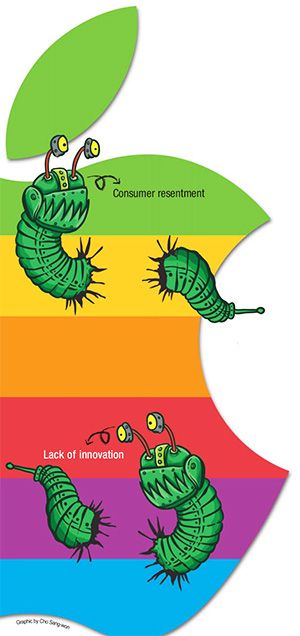
At the heart of the conflict is Apple’s principle of never returning submitted units once it provides refurbished ones. Critics also point out that Apple forces its customers to overspend on services. Yet, it has yet to change the policy in question.
“Although we acknowledge that Korean customers are feeling burdened with the refurbished goods-based policy, we believe it is right to remain this way on after-sales service in the long run in order to raise customer satisfaction,” Apple Korea General Manager Richard Yoon told lawmakers late last year during a parliamentary inspection.
In its U.S. home turf, Apple has been the major target for troll lawsuits with regard to refurbished phones. Recently, two plaintiffs accused the Cupertino, California-based outfit of failing to provide replacement devices that are “equivalent to new units in performance and reliability” as stated in its service terms and conditions.
Lack of next-generation cash cows
Earlier this year, Time Magazine named the iPhone the most influential device of all time while publishing a list ranking 50 innovative products.
“Apple was the first company to put a truly powerful computer in the pockets of millions when it launched the iPhone in 2007. Smartphones had technically existed for years, but none came together as accessibly and beautifully as the iPhone,” the magazine said.
“The iPhone is a family of very successful products. But, more than that, it fundamentally changed our relationship to computing and information _ a change likely to have repercussions for decades to come.”
It also praised the device for popularizing mobile applications.
Other Apple products that made the list were the Macintosh, iPad and iBook, which means that 8 percent of the most influential devices in history came from Apple, according to Time.
However, the company has failed to come up with new innovations of late while its traditional cash cows including the iPhone are losing steam amid fierce global competition.
As a result, the enterprise saw its turnover decline almost 15 percent year-on-year during its fiscal third quarter, which ranges from April to June of this year. In the previous quarter, it also suffered a decline in sales.
The company experienced contractions in sales for consecutive quarters for the first time in 14 years, which caused its stock price to remain weak.
“If the economy shrinks for two straight quarters, we call it a recession and that’s where Apple stands now. Investors worry about how the company will make money in the future as it failed to show innovative products after its founder Steve Jobs died,” a Seoul analyst said.
This is comparable to its chief competitor Samsung Electronics, which showed robust performance this year on solid sales of its flagship product Galaxy S7 phones.
After its introduction in New York this month, Samsung’s latest big-screen smartphone, Galaxy Note 7, also gained positive response thanks in no small part to technological innovations such as iris recognition and its advanced S-Pen stylus.
An executive at a local technology start-up said that people would not tolerate Apple’s high-handed attitude in after-sales service if it stops providing phenomenal and innovative products.
“Many people managed to accept Apple’s after-sales service at issue because its products were so innovative. You can remain unique when you provide a unique value proposition,” he said.
“Yet, such an approach will backfire as soon as you stop innovating. And I’m afraid that Apple has failed to produce innovative products or services for quite a long time, and the public is starting to become disenchanted with the ‘Apple magic.’”
He added that Apple has to take action to remain ahead of the curve.
“Let me put things like this. If Steve Jobs was alive, would he be fine with Apple’s current situation? I don’t think he would,” he noted.