Korea Inc. urged to develop service businesses
.jpg?w=728)
McKinsey advises President to encourage business leaders to develop service businesses
By Kim Jae-kyoung
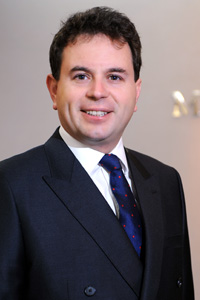
Richard Dobbs McKinsey Global Institute director
SINGAPORE ― President Park Geun-hye should encourage business leaders to develop more services oriented business models to transform Korea into a more competitive economy, according to a global consultant recently.
“Park should sit down and ask business leaders about how they can build services and improve profitability,” Richard Dobbs, director of McKinsey Global Institute (MGI), said in an interview in Singapore.
MGI is the business and economics research arm of global consulting firm McKinsey & Company.
He said Park should push them into going beyond a traditional mindset and adapting to new changes, such as disruptive technologies and urbanization in China and India.
“She could challenge them a bit more by sitting together and asking them to tell how they can grow services, how they are operating as a market leader, not attacker, and what they are doing to grow profitability, not just sales,” he added.
He said that Korean firms should take the initiative and push services as aggressively as they did manufacturing in the past.
“It’s about industry leadership and change. This is what multiple players can do. In the end, business leaders, government, and Korean people should make a big push,” he added.
His advice is based on the belief that Korea is lacking a sense of urgency in coping with new threats, such as rise of Chinese firms and technology disruptions.
He said that Korea is being trapped in the “boiling frog syndrome,” calling for the country to speed up its structural reform. Back in 2013, he described Korea as “a frog in a pot of slowly boiling water.”
“I think stresses are not getting much worse but a frog is still sitting there and hasn’t jumped. You have to be careful because Chinese firms’ threats are increasing,” he said.
“Eventually, the water temperature will carry on going up over time. So Korea needs to work on figuring out how to leap,” he added.
Dobbs, who spent six years in McKinsey’s Seoul office from 2007 to 2013, said that in order to “help the frog jump,” there are three key issues Korean companies must resolve immediately ― low profitability, manufacturing-oriented model and follower’s mindset.
According to the consultant, the first thing Korean firms should do is to shift their focus to profitability from growth. Korean firms’ average return on investment capital hovers around 5 percent, around a third of their North American peers’ average of 15 percent.
“The trouble is that overall profitability is going down. If U.S. companies earn 10 percent, Korean companies will not be earning anything,” he said.
“Many Korean companies historically manage growth, not profitability. How to build capabilities for profitability is very important,” he added.
The director at McKinsey, based in London, said that Korean firms are focusing too much on promotional activities to increase market share.
“A lot of Korean companies sell products on promotions. Apple phones are not heavily sold on promotions as Korean companies’ products. You have to figure out how you move away from promotional activities,” he said.
“If you focus only on how you are growing market share sometimes you damage profitability. When you are market leaders, you need to grow profitability as well as share,” he added.
Revamping business model
Dobbs also recommended Korean manufacturers revamp their business models in a way of offering new “value propositions” combining products with services.
“More companies are working hardware around software together. I think that’s the model Korean companies think through,” he said.
The veteran consultant said that Korean firms should break their perception of services and figure out what kind of services they can sell alongside products.
“Korean companies are still not going after services as aggressively as they could be. Korea can do services really well but there is not enough emphasis,” he said.
He said that Korean firms need to take a cue from British aircraft engine maker Rolls-Royce.
“Take the Rolls-Royce model. Over half of their income comes from services after the firm changed the nature of their contracts. Korea should do the same,” he said.
“For example, instead of selling televisions, Korean firms can let customers pay monthly fees and get the latest televisions at home,” he added.
Changing from an old model of selling airlines engines first, and then parts and service, the U.K. firm created a “power by the hour” model, which allows customers to pay a fee for every hour that an engine runs, while promising to maintain it and replace it if it breaks down.
This has proved to be a win-win model as the world’s second-largest maker of aircraft engines can earn profits over time, while an airline can reduce repair costs.
“Follower mindset” in Dobb’s view is an obstacle preventing Korean firms from becoming a true industry leader.
“What is really important for companies in Korea is to behave as the market leader when you are the market leader rather than an attacker,” he said.
“When you are an attacker, you are focusing on growing share and attacking someone else. However, when you are the market leader you have to behave differently,” he added. “You have to behave like the leader and think about how you can change the industry not just attack it.”