21 Korean firms listed on DJSI for 3 years
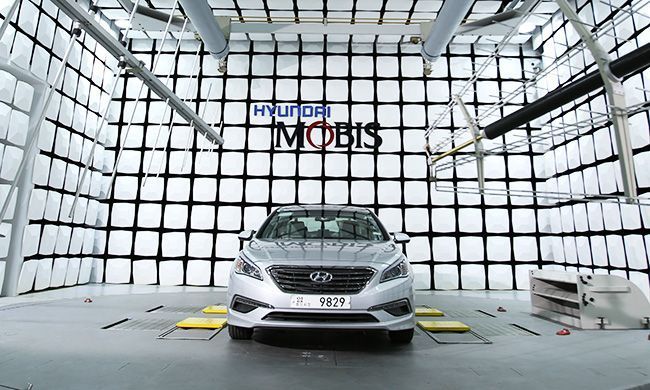
A compact sedan made by Hyundai Motor is under testing at Hyundai Mobis’s eletromagnetic darkroom in Yongin, Gyeonggi Provinceto in this August 2015 file photo. In the electromagnetic darkroom, vehicles undergo tolerance testing of parts such as telematics, smart keys and a variety of sensors. / Courtesy of Hyundai Mobis
By Choi Kyong-ae


LG Group’s Twin Towers in Yeoido, southwestern Seoul / Courtesy of LG Group
Twenty one Korean companies have been listed on the Dow Jones Sustainability Index (DJSI) World for three straight years through 2015, an indication that their financial health and social contribution activities have improved.
The number of Korean firms incorporated into the DJSI World jumped seven times to 21 in 2013 from only three in 2008. The number remained the same at 21 over the past three years in the globally recognized index published by RobecoSAM.
“More and more investors look at companies’ environmental policies and track records in making their investment decisions,” said David Blitzer, managing director and chairman of the Index Committee at S&P Dow Jones Indices, said in a statement released in September last year.
“The Dow Jones sustainability indices are comprehensive benchmarks that allow investors to gauge the collective performance of those companies that meet the RobecoSAM standard for corporate sustainability, and to formulate global allocations consistent with sustainable investment standards and practices.”
RobecoSAM announced the results of the annual DJSI World review on Sept. 10, last year. DJSI World, launched in 1999, is the first global index to track leading sustainability-driven companies worldwide based on an analysis of financially important environmental, social, and governance factors.
In the 2015 results, SK Telecom and POSCO stood out among the 21 companies as the latter stayed on the DJSI World for a 11 straight years and the former for eight through 2015, said the Korea Productivity Center (KPC) which has coordinated with S&P Dow Jones Indices and RobecoSAM since 2008 for business partnerships in Korea.
“The two companies’ incorporation into the DJSI World for more than 8 years shows their strenuous efforts to be socially responsible in economics, the environment and social contribution,” KPC Managing Director Lee Chun-seon said.
The DJ Sustainable Indices includes DJSI World, DJSI Asia Pacific and DJSI Korea. DJSI World analyzes the world’s top 2,500 enterprises in terms of market capitalization; DJSI Asia Pacific reviews Asia’s top 600 businesses; and DJSI Korea assesses the country’s top 200 firms, the KPC said.
Forty-one Korean companies were incorporated into the DJSI Asia Pacific and 52 companies were included in the DJSI Korea last year, it noted. The 21 companies incorporated into the DJSI World also include Samsung Electronics, Samsung SDI, LG Electronics, Hyundai Mobis, KT, SK hynix, AmorePacific, Samsung Securities, S-Oil and Lotte Shopping.
Hyundai Mobis executives held 217 daily quality-control meetings and made 46 visits to its production facilities in 2014. The country’s biggest auto parts company by sales has increased investment in developing more fuel-efficient vehicles. From 2009 to 2014, the number of environmentally-friendly auto parts it supplied reached more than 1.3 million, said the KPC.
LG Electronics has developed products to help underprivileged people in underdeveloped and low-income countries. The products include an air conditioner which keeps mosquitoes away using ultrasound for use in countries whose people often suffer from malaria and other mosquito-related diseases. Moreover, it also developed a battery-powered TV to allow them to enjoy watching TV even if the electricity is cut off, it said.
Samsung Life and Insurance has increased the number of products focusing on life after work as people live longer than before. It also runs a social contribution program to help pregnant would-be mothers and their family members learn how to raise children, it said.
“Despite those efforts, the number of Korean companies incorporated into the DJSI World has remained the same at 21 in the past three years,” KPC Chief Executive Hong Soon-jick said.
“This means Korean companies lag behind advanced companies particularly in terms of social contribution activities under global standards. Reaching the global level will be a prerequisite for Korean companies to make a presence in global markets.”
Kim Dong-soo, director of the KPC’s Sustainability Management Center, said social contribution activities have become familiar with an increasing number of Korean companies but they still have a long way to go in terms of the value.
“Moreover, there are still many things to be improved or overhauled when it comes to ethical management and corporate governance structure in most of the reviewed Korean companies. Social responsibility has emerged a core value to be sought by businesses,” Kim said in the statement. “Short-term donation or discontinued efforts to improve ethical management and corporate governance structure won’t receive recognition for their sustainability practices.”
In human resources management, however, companies have increasingly recognized workers as one of their major assets to continue operations by offering education and training programs and strengthened welfare programs, he said.
KPC officials said if Korean companies aim for a bigger share in global markets, they are required to meet global standards in social responsibility and sustainable growth.
In the past decade, Korean companies such as Samsung Electronics and Hyundai Motor have seen a growing need to expand their operations abroad to boost profits due to the nearly saturated domestic market and its low demand. In global markets, they face a tough battle with rivals such as Chinese telecom-equipment maker Huawei Technologies and Japan’s biggest carmaker Toyota Motor.
To leave them behind or beat them, Korean firms are advised to improve their corporate governance structure and strengthen social contribution activities on top of producing quality, price-competitive products.