Hanjin founder pioneers business with artist's mind
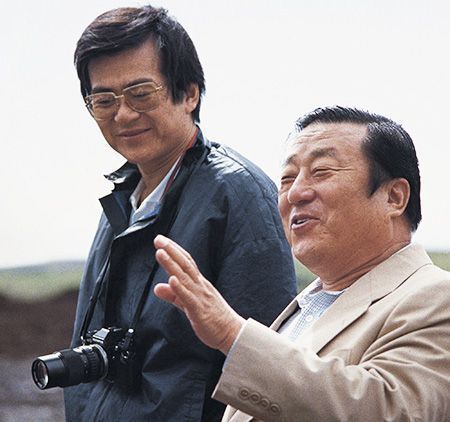
Hanjin Group founder Cho Choong-hoon, right, talks with his eldest son Yang-ho at Jedong Ranch on Jeju Island in 1979. Cho thought business was an art which needs craftsmanship to be managed well. / Courtesy of Hanjin Group
By Kim Jae-won
Hanjin Group founder Cho Choong-hoon had a unique business philosophy. The late entrepreneur said business is an art that can grow in new ways with a creative mind.
He thought a company established by a creative entrepreneur lasts a long time, just like an art piece made by an artist’s passion keeps its value for a thousand years. That is why he focused on transportation and logistics businesses, concentrating on them with an artistic viewpoint.
Cho displayed his artistry in matters of business through focused creativity, wholly dedicating his energy to making the transportation industry his masterpiece. He had no interest in imitating other people’s business practices.
“For him, each business he pioneered was a work of art, and he was a master of the art of business, designing each project like an artist,” according to Cho’s biography, “Business as an Art,” written by journalist Lee Im-gwang.
“He was not motivated solely by money but by his love of the work itself, pouring the creativity of his heart and soul into it just as an artist does,” said Lee in the book published in October.
Cho entered the airline industry partly due to his passion to draw a big picture in the sky with his business. He spread out a map of the world, looked decades into the future and drew up potential routes for Korean Air, making Seoul a hub of Asia and selecting bases for North American and European routes.
“When we look at the network of routes that Korean Air pioneered and still flies today, it is amazing to see the foresight and careful thought that went into the basic plan 40 years ago,” wrote Lee in the biography. “The map is far more than just a nice diagram ― it is indeed a work of art.”
The essence of art is the pursuit of beauty, and both the process of creation and the end product must be beautiful. This also held true for the businesses Cho created and developed.
Even in cutthroat competition, he never forgot the wisdom and virtue of “winning by losing.” This attitude helped him not only avoid making enemies but also win the goodwill of competitors despite his enviably great success in business.
Cho often compared a businessman to an artist. “A company needs a businessman’s creativity, good ideas and energetic efforts to make progress, and just as there is no such thing as perfection in art, neither is business a finished work of perfection,” he was quoted as saying by the book. “It is a process of ceaseless efforts toward success.”
It was an artist’s passion to cultivate barren land in Jeju, developing it into Jedong Ranch. If he had cared only about making a profit, he would never have considered taking over such businesses and certainly would not have made such bold yet risky investments.
The Hanjin founder knew business was not all about making money, but also about creating an artistic work giving pleasure to people.