Hanjin founder pioneers biz with challenging spirit
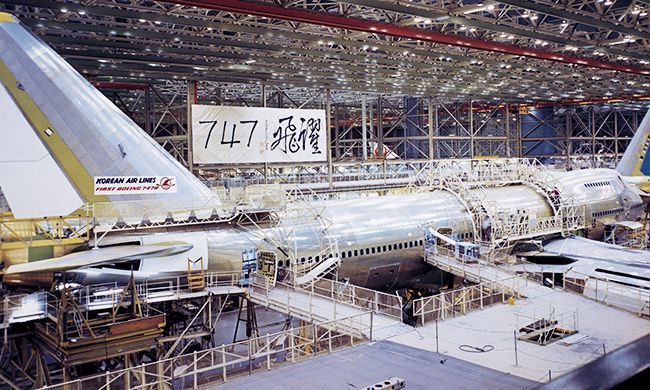
A Korean Air’s first Boeing 747 aircraft is under construction in 1972. Hajin Group founder Cho Choong-hoon decided to buy jumbo jets to make the group’s airline affiliate fly high. He was a pioneer who launched new projects being not afraid of failures. / Courtesy of Hanjin Group
By Kim Jae-won

Hanjin Group founder Cho Choong-hoon pioneered new businesses ― from an airline to shipbuilding and construction ― with his unique spirit of challenge, according to a biography titled “Business as an Art.”
The late entrepreneur could transform a small trading company in Incheon into a world-class logistics group because he had passion for the business and enjoyed the work, rather than pursuing money, said Lee Im-gwang, the journalist who wrote the book.
“From his business in Vietnam, Cho took away something much more valuable than financial gains and rewards,” said Lee in the book, published in October. “He gained confidence from succeeding at challenging tasks and that was his greatest reward.”
Cho successfully expanded his business during the war in Vietnam by providing unloading and transportation services for the U.S. Armed Forces. He overcame many challenges, including attacks from Vietnamese soldiers, by bravely leading his employees at the front line.
Lee said Cho’s strong confidence became the psychological pillar that helped him solve difficult problems that Hanjin encountered later as it grew into a comprehensive logistics corporation.
As a leader, Cho was not afraid to take a road that nobody had traveled before. In September 1974, he put a jumbo jet on a cargo route for the first time in the world. It was for the Pacific route, one of the world’s largest air-cargo markets.
At first, the introduction of jumbo jets caused a financial burden, but it changed the brand image of Korean Air from a novice in the airline industry to a powerful global carrier.
“Without challenges, there is no growth,” Cho often said to his employees. As time went on, the jumbo jet turned into an engine of growth for Korean Air.
Cho’s spirit of challenge also worked in the field of construction, which he jumped into in 1968 by establishing Hanil Development. He was innovative and courageous enough to build a high-rise building with a steel frame for the first time in the country.
He built the 26-story office building to house the company’s headquarters on Namdaemun-ro 2-ga, a busy street in downtown Seoul. It was the first building in Korea with a steel frame, causing a sensation in the industry.
Hanjin’s acquisition of debt-ridden Korean Air Lines in 1969 was also a challenging task. But he persuaded the group’s executives to buy the state-run company, asking them to overcome difficulties together.
“What we have here is a business that could benefit everyone, and for a company, there’s nothing more rewarding than overcoming a thousand difficulties to build and develop a business like this,” Cho said.
And he was right. Korean Air has become the nation’s largest airline and one of the leading carriers in Asia, connecting people and cargo in Korea to the world and vice versa.
The spirit of challenge was one of the key elements that made Cho expand Hanjin, which he started with a truck seven decades ago, into a global logistics company.