Korean Air expands aerospace business

The Korean Air Tech Center, also known as the Korean Air Aerospace Division (KAL-ASD), performs aircraft maintenance, repair services, aerostructure development and production in the southern port city of Busan. / Courtesy of Korean Air
Unmanned aerial system development rising as driving force
By Chung Ah-young
BUSAN — Spanning a 710,000-square-meter landmass in the southern port city of Busan, the Korean Air Tech Center houses both old-fashioned and state-of-art facilities, conveying both the past and future of the nation’s aerospace and defense industry.
Relatively little known to the public owing to the limited accessibility and tight security, the center, also known as the Korean Air Aerospace Division (KAL-ASD), has some 66 buildings, ranging from hangars to warehouses and production facilities.
It has been growing into one of the most promising businesses of the nation’s flagship carrier.
Although the passenger and cargo services account for most of the sales of the company, the aerospace business has been rapidly expanding its presence in recent years.
Since its inception in 1976, the center has been seeing its aerospace business’s international presence grow owing to its excellent aircraft maintenance, repair services and aerostructure development.
The KAL-ASD posted 920 billion won in sales in 2014, almost tripling from the 2009 sales of 327 billion won. The figure is expected to hit the one-trillion mark this year.
Currently, aerostructure manufacturing represents 55 percent of the KAL-ASD’s total aerospace business sales portfolio, while military aircraft maintenance and upgrade services account for 25 percent. The center plans to grow unmanned aerial system development, which makes up 10 percent of its sales portfolio, as the driving force of the aerospace business.
“The center aims to expand the contribution of unmanned aerial system development in the total aerospace business portfolio,” Lee Jai-choon, general manager of the center’s business planning team, said.
The KAL-ASD produced the 500MD, the nation’s first helicopter and F-5 fighter plane, as well as the UH-60, a mid-sized mobile helicopter, which laid the foundation for the center’s advanced aircraft development.
The KAL-ASD manufactures and supplies parts to various international aircraft manufacturers, such as Boeing and Airbus. It also provides a comprehensive range of aircraft services, including painting aircraft exteriors.
The center has painted some 367 planes from 24 airlines from around the world in its environment-friendly hangar, which is equipped with facilities such as purification devices. A Boeing 777-302R, which is 74 meters long and has a 64 meter wingspan, is currently being repainted in the hangar. According to the hangar operators, they perform several pre-painting steps, such as the removal of existing paint and contamination, varnishing for chemical coasting and painting adhesion, before performing the final painting.
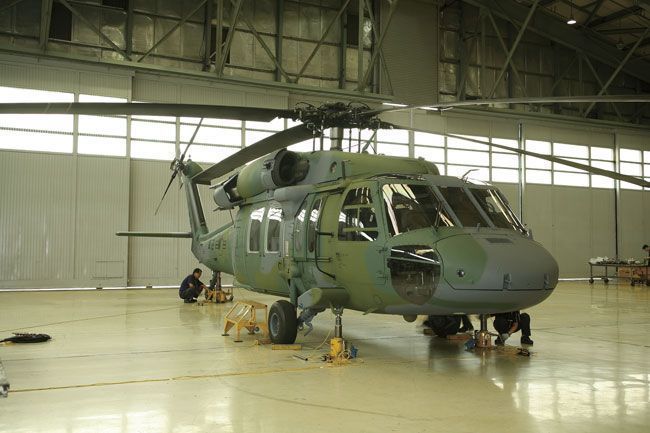
UH-60, a mid-sized mobile helicopter, produced by KAL-ASD
UAV development
Since the center began developing close-range spy unmanned aerial vehicles (UAVs) in 2004, it has become the leading developer of UAVs for tactical surveillance, target search and tracking and electronic warfare and combat. UAVs can be used for commercial purposes such as homeland security, weather data acquisition and cartography.
The center developed the close-range surveillance UAV KUS-7 in 2007 and its upgrade, the next generation tactical UAV, the KUS-9. It also recently developed a division-level reconnaissance UAV, which Korean Air aims to produce starting from 2016.
The company has completed developing the TR-6X, the nation’s first unmanned tilt-rotor aircraft, after the Korea Aerospace Research Institute (KARI) transferred related technologies to Korean Air.
“The aerospace division sees the annual sales grow by 25 percent. UAV development and aircraft performance improvement will become a driving engine for future growth,” Lee said.
Currently, the KAL-ASD has been remodeling its 40-year-old 500MD helicopter into the unmanned aircraft.
The global UAV industry has been growing rapidly, from a value of $2.4 billion in 2000 to $5 billion in 2010. Its value is expected to reach up to $10 billion in 2020.
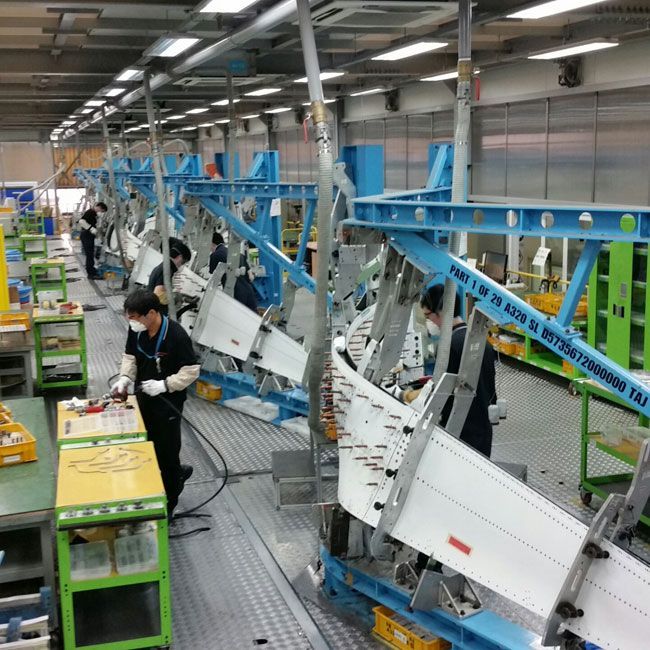
The KAL-ASD manufactures Sharklet wingtip devices for Airbus carriers.
Aerostructure development
The center has been building state-of-the-art technologies for commercial aerostructure development and manufacturing since the 1980s. It has long been a supplier of aircraft parts, such as wing, fuselage and tail parts, to Boeing and Airbus.
The KAL-ASD has been manufacturing six core parts, such as raked wing tips, after bodies and flap support fairing, for Boeing 787 since 2006. The ultra-light, fuel-efficient aircraft is made of composite material; it also has higher cabin humidity, wider windows and a higher ceiling, which altogether create a more comfortable atmosphere for passengers. In 2013, the company was selected as the provider for the wing core parts for the Boeing 737 MAX model aircraft.
As the sole supplier to the best-selling A320 family of single-aisle aircraft, the KAL-ASD also manufactures the Sharklet wingtip devices for Airbus carriers. The Sharklet devices are known for improving aircraft fuel efficiency by 3.5 percent.
The division has provided the parts, such as elevator sections for the A320 family, fuselage skin panels and floor assemblies for the A330/A340 family, as well as the cargo doors for the new A350 XWB.
Airbus and Korean Air marked the handover of the 1,000th Sharklet device for the A320 family in April, 2012, 22 months after the former first supplied the device to in the latter.
Korean Air will also supply the Sharklet component of the A330neo — the new variant of the A330 family of wide-body aircraft — and manufacture the new composite wingtip devices at its Busan facility starting in 2016.
To meet the demands for the A320 series parts, the center installed auto-moving lines in 2013, which are designed to produce up to 100 Sharklet devices a month.
Maintenance base
Since 1978, the KAL-ASD has served as the largest military aircraft maintenance base in the Asia-Pacific region for repairing more than 4,000 military aircraft.
The Aircraft Heavy Maintenance Plant consists of three bays, two hangars, a paint hangar and an engine run-up that can accommodate some 120 carriers a year for modification and repairs.
Not only Korean aircraft such as the F-4, 500MD and UH-60 but also U.S. aircraft such as the F-15, A-10 and HH-60 receive support from the programmed depot maintenance and life extension program and go-abroad maintenance trip. The center has some 30 U.S. supervisors for its depot maintenance services.
The KAL-ASD plans to introduce “Performance-Based Logistics,” a next-generation maintenance strategy which improves total system capacity while minimizing cost and logistics footprint.
The center provides support not only to military aircraft but also to commercial carriers; it provides heavy maintenance services to Korean Air’s fleet and those of other airlines, such as Boeing 747 fleets. For example, it has been providing such services to more than 100 United Airlines carriers since 2005. It also made additional cabin modification contracts for the B747-400 aircraft with United Airlines in 2008.