Imported vehicles likely to lose market share here
.jpg?w=728)
By Park Jin-hai
The seemingly unstoppable growth of imported cars in Korea has hit a big snag, showing signs of a possible slowdown soon.
Volkswagen’s emissions cheating scandal has put a damper on demand. Coupled with government measures aimed at imported cars, market experts say imported cars could lose half their market share .
Kim Pil-soo, an automotive engineering professor at Daelim University, said that although no significant change had happened so far, the emissions scandal had the potential to shake up the market for imported cars.
“The positive image that customers had of diesel has reversed,” he said. “When a series of government measures to revise relevant laws on imported cars take effect all at once in one or two years, not only Volkswagen but also the sales of all imported cars may shrink to half of what it is now.”
The Volkswagen scandal could hasten the scheduled introduction of low emission zones.
Old pollution-emitting diesels will be banned from urban areas, while heightened environmental standards and increased environmental taxes will hurt diesel models, which make up nearly 70 percent of imported cars in Korea.
The government is also taking steps to revise the tax system, replacing engine size-based taxation, while closing legal loopholes that give tax benefits to drivers who register luxury imported cars under corporate names but use the vehicles for personal use.
Forty percent of imported car sales are to corporations. In the category of luxury models costing more than 200 million won, 90 percent are sold to corporations.
Shin Chung-kwan, an analyst at KB Securities and Investment, agrees that the Volkswagen scandal will hit the imported car market.
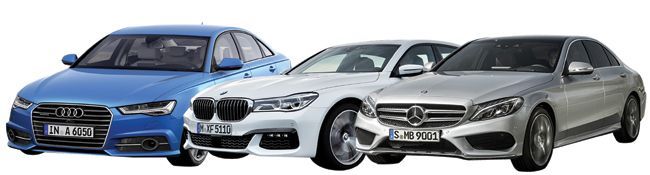
“Because diesels make up most of the imported cars here and Audi-Volkswagen’s combined share is nearly 30 percent, the scandal will slow diesel sales, dropping the carmaker’s market share,” he said.
“When the National Assembly passes the tax revision on corporate cars, their market share is expected to fall.”
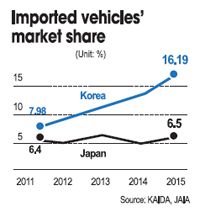
The imported car industry has prospered in recent years, nearly doubling its market share over the past five years. Their market share has risen to 16 percent in 2015, from just 8 percent in 2011.
Sales of imported cars have already shown signs of slowing. A total of 179,120 imported new cars were registered in the first nine months of this year, up 22.8 percent. But, compared with the 27.1 percent rise in the first half of this year, sales have been slowing over the past three months.
In Gangnam, the number of visitors to Audi showrooms has plunged 20-30 percent compared with August.
Some BMW showrooms report a similar drop, although BMW is not directly involved with the scandal.
Analysts say the Volkswagen scandal has caused a change in the auto industry.
“One result is that all automakers are becoming more aware of the significance of compliance with emissions standards,” said James Chao, Asia Pacific managing director at IHS Automotive.
“It’s not only the regulatory risks they face. More important, it’s their reputations.”
Local analysts believe Hyundai Motor could increase its global market share, as customers looking for options other than diesels.
Hyundai has launched hybrid and electric vehicles in the U.S., and in August its sibling Kia’s Soul EV topped sales in the electric vehicle market in Germany.
Industry experts believe Hyundai can expect 0.2-0.4 percent market share increase in the U.S., assuming that Volkswagen’s diesel sedans are banned and that total VW sedan sales drop 50 percent and small trucks sales fall 30 percent there.
If Hyundai and Kia maintain their market share of 12.8 percent for sedans, and 3.9 percent for small trucks, the nation’s largest carmaker can expect a minimum 0.21 percent increase in U.S. market share.
Equally, Hyundai and Kia can expect a 1.6-3 percent rise in its market share in Europe.
SK Securities analyst Lee Yoon-suk, and other analysts anticipate that Hyundai Motor’s performance will bottom out in the fourth quarter.
“Hyundai’s sales slump in China has passed the worst phase, and the company can expect some benefits from the Volkswagen scandal,” said Lee.
He expects Hyundai to post 23.4 trillion won in sales, down 0.9 percent.
He predicts a 1.7 trillion won operating profit in the last quarter, down 9.2 percent year-on-year.
IBK Investment and Securities also estimates that Hyundai’s performance will bottom out in the fourth quarter, after a growth in operating profit for seven consecutive months,
He predicts 1.9 trillion won operating profit, up 5.6 percent year-on-year.
But HIS, an international market research firm, believes the Volkswagen scandal will have only a small effect on Hyundai sales.
“Globally, Hyundai is changing its fast-follower image,” said Chao.
“For example, in the U.S., it has a reputation for being a fuel-efficient SUV maker as well as gaining a reputation in making larger, more expensive cars.
“That said, in some markets, like China, Hyundai is still striving to improve its image, which is slotted between Chinese brands and the other international brands.”
He added that Hyundai is forecast to have 3.7 percent annual growth through the end of this decade (from 2015) in China, and flat growth in the U.S. in the mid-term, to 2020.