Foodpolis - strategic base for exporters to Asia

Kim Han-jun, second from right, CEO of Joun Health, shakes hands with Lee Ju-myeong, director general at the Ministry of Agriculture, Food and Rural Affairs, after signing a memorandum of understanding at the Korea National Food Cluster Promotion Hall in Iksan, North Jeolla Province, on Dec. 15, 2014. Joun Health plans to build a plant inside the cluster to produce health-boosting supplements for consumers in Korea, China and other Asian countries. / Courtesy of Ministry of Agriculture, Food and Rural Affairs
By Lee Hyo-sik
The Korea National Food Cluster, named Foodpolis, is expected to become a strategic base for food companies seeking to enter China, Japan and other Asian markets.
The proposed cluster in Iksan, North Jeolla Province, has attracted more than 100 food producers at home and abroad thanks to its geographical proximity to key markets, advanced research and development (R&D) and information technology infrastructure, skilled manpower, attractive business incentives and other advantages.
The envisioned food industry hub, which will be completed in 2016, is expected to churn out $14 billion in output annually and generate 22,000 new jobs at over 150 companies and 10 research centers.
The Ministry of Agriculture, Food and Rural Affairs will invest a total of $500 million to build the food industry complex on a 2.32 million square meter site in the southwestern region. The cluster is largely designed to attract companies aiming to export a wide range of value-added, processed food products.
The agriculture ministry has so far signed an agreement with 109 companies and research centers, including 51 from overseas, who are willing to set up a presence in Foodpolis.
The Korea Times recently interviewed the CEOs of three domestic food companies planning to set up production facilities in Foodpolis, in a bid to figure out what they think of the cluster and what made them decide to establish a presence there.
The three firms are Harim Foods, Joun Health and Wonkwang Pharm.
The CEOs were also asked about their business plans and the support they need from Foodpolis authorities.
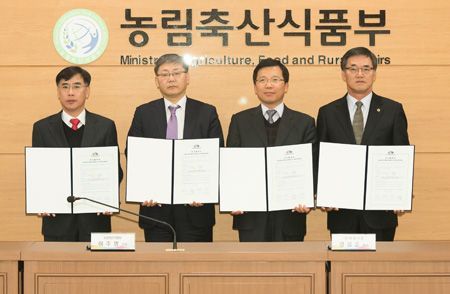
Lee Ju-myeong, second from left, director general at the Ministry of Agriculture, Food and Rural Affairs, poses with Yang Sung-jun, third from left, director of Harim Foods, after signing an investment agreement at the Korea National Food Cluster Promotion Hall in Iksan, North Jeolla Province, on Dec. 15, 2014. Harim decided to construct a plant inside the cluster to produce noodles and other processed food products for Korea, China and other Asian markets. / Courtesy of Ministry of Agriculture, Food and Rural Affairs
Harim Foods
Harim Foods, a processed food making unit of Harim Group, has pledged to build a plant on a 53,600 square-meter plot inside the food cluster. The company, which produces mostly noodles and other foods from processed grains, has not yet decided what products the envisioned facility will make, but said it will produce what consumers in Korea, China and other countries, demand.
“We will soon start constructing a plant inside Foodpolis. We will make what consumers want,” said company CEO Kim Hong-kuk, who is also the chairman of Harim Group, the country’s largest poultry breeder and animal feed maker.
“What I can say at the moment is that the plant will be our strategic production base, which will be globally competitive and will produce what consumers need,” he said.
Harim Foods also considers building a research center to take advantage of Foodpolis’s state-of-the-art R&D facilities where companies can use high-tech equipment at low fees.
“We would like to create both production and research facilities to make the best of being part of Foodpolis, which I believe will become Asia’s largest food industry hub,” Kim said.
“We think Foodpolis will serve as our strategic point for China, Japan and other Asian markets because of its geographical proximity to those markets and advanced business infrastructure,” the CEO said. “Above all, the government and food companies are planning to construct dozens of research centers on various food categories, which will foster cross-field cooperation and produce innovative products and services. This will also help attract talented manpower.”
Kim gave high marks to the agriculture ministry and municipal administrations for offering tax breaks and other incentives to those setting up a presence in Foodpolis.
“Nonetheless, they should do more to bring multinational food companies and research centers into the cluster,” the CEO said. “Like the United States and other business-friendly nations, which place top priority on job creation, Korea should revise its laws, if necessary, to attract enterprises and generate new jobs.”
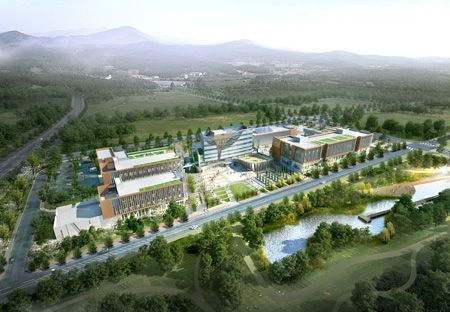
An artist’s rendering of the business support complex inside the Korea National Food Cluster, named Foodpolis, which will be completed in Iksan, North Jeolla Province, by 2016. / Courtesy of Ministry of Agriculture, Food and Rural Affairs
Joun Health
Kim Han-jun, CEO of Joun Health, which produces probiotics, multi-vitamins, omega-3 fatty acid capsules and other health supplements, echoed Harim CEO’s views, stressing that he expects more from the central and municipal administrations.
The company makes 16 types of health-boosting products and sells them through 4,000 pharmacies nationwide, and imports various nutritional supplements from the United States.
“We purchased an 8,748-square-meter site in the cluster and will soon begin the plant construction. We estimate that it will cost about 4 billion won ($3.3 million) to build a plant and other business facilities there,” Kim said. “In the process, we expect full support from Foodpolis authorities and other involved agencies.”
He said the company decided to build a plant in Foodpolis for its geographical proximity to China and its advanced R&D infrastructure.
The CEO then said it is difficult to ship food products to China because of the country’s strict safety guidelines and other non-tariff barriers on food products, despite the Korea-China Free Trade Agreement.
“It is really hard to export food products to the world’s second-largest economy, as it is difficult to get approval from the Chinese government, and this process often takes a long time,” Kim said. “So we would like Foodpolis authorities to establish an effective business support system to help companies more easily make inroads into China.”
He also called for making it easier for Joun Health and other firms to conduct clinical trials in the development of new health products.
“It is a must for us to have new products recognized domestically. Only then, we bring them to other countries. In this respect, we expect full support from Foodpolis operator by enabling us to easily run clinical trials.”
Wonkwang Pharm.
Choi Gyung-soo, CEO of Wonkwang Pharm., which produces multivitamins and other health supplements, said the company plans to start production in early 2018.
“We decided to invest in Foodpolis because of its advanced R&D, packaging, product safety and other business-related support,” Choi said. “We spent 730 million won to purchase a 4,629 square-meter plot and plans to spend additional 5 billion won to build a plant there. We will produce red ginseng and other innovative health products using only natural ingredients.”
Wonkwang Pharm. does business domestically, but plans to advance to China and Vietnam to target the increasing number of health-conscious consumers there.
“When we start building the plant in 2017, we expect active administrative assistance from Foodpolis authorities,” the CEO said. “I think to attract more local companies, which operate mostly in and outside Seoul, Foodpolis should offer more generous incentives, including cash subsidies.”