All state entities will embrace peak wages
By Park Si-soo
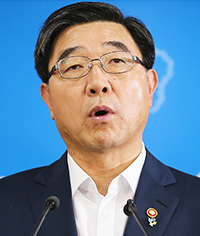
Labor Minister Lee Ki-kwon
All state-run institutions will adopt paying peak wages and performance-based salaries despite strong opposition from unions.
At the same time, private firms in six areas may receive subsidies for adopting these two systems aimed at sharing jobs and increasing efficiency. They are shipbuilding, finance, pharmaceuticals, auto-making, wholesale and retail.
Tax benefits will be offered to firms that treat suppliers fairly.
“The nation’s competitiveness hinges on the labor market’s health,” Labor Minister Lee Ki-kwon said in a televised national address at the government building in downtown Seoul. “Our labor market faces various challenges. To make the market healthier, we cannot leave them unresolved.”
The reform package came after the government held nearly 100 rounds of talks with labor union representatives, scholars and experts, during which they reached a consensus on the need for reform but were divided on how.
The Korean Confederation of Trade Unions, the nation’s second biggest umbrella union with some 670,000 members, has threatened to stage a major strike, should the government push forward with the introduction of a peak wage system by private companies.
Acting Prime Minister Choi Kyung-hwan said that the government will announce a second reform package with a concrete action plan for the first package in August or September.
“We will announce the second package after having meetings with labor experts and union representatives,” Choi said. “Reforming the labor market is crucial to give the young generation hopes and dreams. The government is fully committed to implementing the reform.”
The peak wage system is at the core of this.
According to state data, only 9.9 percent of companies here have adopted the system, which extends retirement age for senior employees in return for gradually reducing their salaries in the years leading up to retirement. This figure jumps to 23.2 percent at companies with 300 or more employees.
The government believes the system will enable companies to save money to hire young workers. The labor ministry has already announced that all government organizations will adopt the system next year, which it hopes will create at least 6,700 jobs.
To encourage private firms to adopt the system, the ministry plans to pay subsidies of up to 900,000 won ($820) per month for each worker they hire for a certain period.
The unemployment rate for people between 15 and 29 reached 11.1 percent in February, compared with the overall jobless rate of 4.6 percent in the same month. The overall jobless rate has reached its highest level in five years, according to government data.
Unions oppose the system’s promotion. They claim the system will give employers greater leeway to fire workers.