Elliott forces vote on `vulture'
US hedge fund exploits myths on Samsung, regulations
This is the second and last in a two-part series by National University of Singapore Professor Shin Jang-sup about Elliott Associates' attempt to block Samsung's intra-subsidiary merger. ― ED.
By Shin Jang-Sup

Shin Jang-Sup
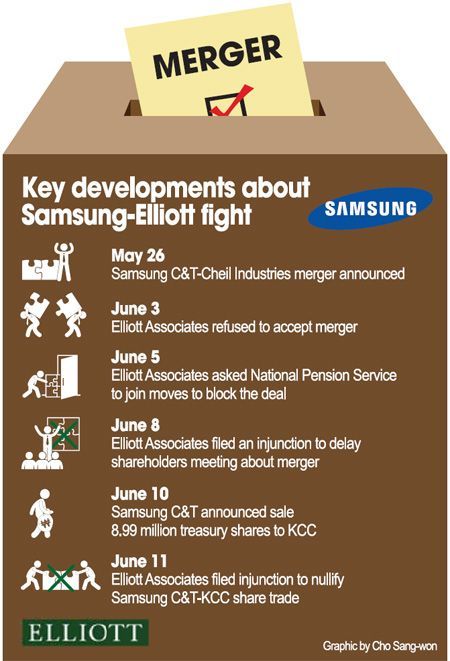
July 17 will be the day of a global referendum between “vulture” and chaebol as shareholders of Samsung C&T shareholders vote on the merger proposal between the company and Cheil Industries.
Samsung Group, Korea’s biggest chaebol firm, has pushed the merger as part of consolidating the Lee family’s ownership of the group and argues it would "create synergy ... and pre-emptively secure core competencies."
Elliott Associates, a pioneer “vulture fund,” that emerged as the number-three shareholder of Samsung C&T by suddenly raising its stake to 7.12 percent on June 4, contends the merger by is “unlawful” and “neither fair nor in the best interests of company shareholders.”
The result of the contest between Elliott and Samsung will be determined by how global and local alliances because neither Elliott nor Samsung own enough shares to pass or block the merger independently.
For the merger to go ahead, two-thirds of shareholders at the meeting need to approve it.
But the stake of the Lee family and “friends” is less than 20 percent of Samsung C&T even if the 5.79 percent of treasury shares Samsung hurriedly sold to KCC, its white knight, are included. Both sides now need to woo the other shareholders standing in the middle.
On the surface, the battle centers on the fairness of the planned merger, especially to minority shareholders of Samsung C&T. Elliott, whatever it had done in the past picnicking around the globe, presented itself as a defender of fairness and promoter of minority shareholders’ rights. Elliott argues that the ratio of stock swaps, 0.35 to 1, is “unfair” and even “unlawful” because Samsung C&T is undervalued.
For instance, Elliott points out that the value of assets held by Samsung C&T, including shares in Samsung Electronics, is a lot higher than the company’s entire market capitalization.
This claim may be valid to some extent if companies are allowed to exercise their discretion in setting stock swap ratios.
But the Korean financial authority does not allow room for discretion in its crusade to wipe out stock market manipulation.
According to its regulations on capital market and financial investment, companies should set the ratio by averaging the three closing market prices of stocks — those of one month, one week and one day before announcing merger plans.
The merger ratios are a result of pure maths in Korea. The 0.35-to-1 ratio only reflects that Samsung C&T share prices were low during the period while those of Cheil Industries were high.
Elliott calls spade heart
If Elliott contends that Samsung Group should have set the ratio by allowing for “undervaluation” of Samsung C&T’s actual assets, this is tantamount to asking the group to do an “unlawful” act.
If the fund thinks the method of setting the ratio based on market prices is “unfair,” it should have directed its criticisms at Korea’s financial authority, not at Samsung.
In fact, market prices are commonly employed in determining stock swap ratios in the U.S. and other parts of the world.
If the stock market functions as “efficiently” as economics textbooks assume, market price is a better measure than asset valuation to determine the swap ratios because market price is the end result that reflects all the market factors including asset valuation and growth potential.
This is why big companies often pay high prices to acquire venture companies for their attractive growth potential although they do not have assets to justify those prices.
Some venture companies even acquire big companies mainly by leveraging on their inflated share prices. If asset valuation is a “fairer” and more “lawful” measure than market price to determine stock swap ratios, there should have been a series of lawsuits against those companies that made such deals based on market prices. But those stories are hardly found in Western media.
Moreover, no loss has incurred to shareholders of Samsung C&T until now.
In fact, they gained handsome profits. When the merger plan was announced on May 26, the company’s share price jumped from 55,300 won to 63,500, a 14.8 percent increase.
This reflects that, even at the 0.35-to-1 ratio, investors thought that through the merger the company would ride on the premium of Cheil Industries as de facto holding company of Samsung Group.
The merger plan has so far brought about a “win-win” situation between investors of the two companies.
On June 12, the share price closed at 68,400 won, a 23.7 percent increase during about half a month, although it climbed down from its peak of 72,200 won on June 8.
Paul Singer, from Harvard Law School, began his career as an investment bank attorney. Elliott’s successes in “vulture picnics” around the globe have been largely based on his legal expertise.
After Elliott earned a billion-dollar profit by attacking asbestos victims, Greg Palast bitterly commented, “It’s legal, it’s brilliant, it’s sick, it’s Singer.” (He likened Singer to Moriaty, a genius mathematics professor and criminal mastermind who was Sherlock Holmes’ ultimate adversary.) It is unthinkable that Elliott was ignorant of Korea’s financial regulation when it staged its accused Samsung Group for being “unfair.” What then is the essence of the showdown between Elliott and Samsung?
As a consummate vulture, Elliott brilliantly took advantage of Samsung’s weakness at the final stage of succession of its patriarchal power from the second-generation Chairman Lee Kun-hee to his son Vice Chairman Lee Jay-yong.
There is a deep-seated anti-chaebol sentiment in Korea as well as overseas.
Although Samsung Group was able to build the world’s largest electronics company competing on equal terms against Apple and Intel, the concentration of power and money to a few chaebol members has brought about public resentment along with awe and jealousy.
Singer uses anti-Samsung sentiment
Many people, even intellectuals and policymakers, simply believe the succession of a family business as wrong and aberrational in a democratic society. They hardly acknowledge that family management, even in the U.S., has generally brought about better performance than professional management both in terms of sales and profits (refer to Miller and Le Breton-Miller’s “Managing for the Long Run: Lessons in Competitive Advantage from Great Family Businesses,” Harvard Business School Press, 2005).
They do not ask questions why, in the U.S, an icon of democratic society, families such as Ford and Rockefeller have continued succession of their businesses and why the Bush family has even continued succession of political power.
Fund managers, who are supposed to make rational investment decisions, are also not free from this sentiment. When Samsung Group was growing exponentially in the 2000s, some investment houses introduced “Samsung Group Fund” in which they bought only stocks of Samsung companies.
They sold the fund to the public by advertising that Samsung Group stocks would perform much better than the market average. The fund was actually a great success and returned handsome profits. However, when issues of family business arise like the present confrontation, many funds are ambivalent.
A local fund manager was quoted as saying, “This incident happened because Samsung unduly tried the succession”.
Elliott rode on this anti-chaebol sentiment with its past track record of returning good profits to its customers and followers. It is wooing Samsung C&T shareholders with the prospect of “greater” and “quicker” gains.
On the other hand, Samsung promises steady, long-term gains. Samsung argues that Samsung C&T investors have already made handsome gains and that it will continue to work hard to increase the value of the merged company.
From Elliott’s point of view, however, the current level of profit it has already earned and the growth potential Samsung promises are still “unfair.”
This sentiment is only understandable if one considers that the fund reaped at least “$1.29 billion in profits, about 44 times its original investment” with the Delphi operation.