BMW seeks to go electric for all models
By Lee Hyo-sik
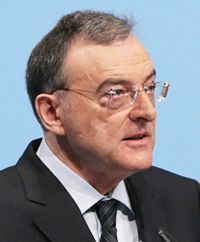
Norbert Reithofer BMW AG chairman
MUNICH — BMW Automotive Group (AG) will launch 15 new and updated models this year to further expand its market share across the globe.
The German premium automaker plans to produce electric-powered versions of all its existing vehicles in order to attract the growing number of environment-conscious motorists amid strengthening environmental protection regulations.
At an annual press conference in Munich, Wednesday, BMW AG Chairman Norbert Reithofer said the carmaker will introduce 15 new and updated models of BMW and MINI branded vehicles in 2015. In addition, the company plans to launch five new motorcycles.
BMW AG has three brands; BMW, MINI and Rolls-Royce. The group also has the motorcycle unit BMW Motorrad.
“We just showcased the BMW 2 Series Gran Tourer, the highly-functional vehicle with up to seven seats, at the recent Geneva Motor Show,” Reithofer said. “The 2 Series Convertible has also been available since the end of February.”
The carmaker will begin selling updated BMW 1 Series vehicles in late March, in addition to the updated 6 Series convertible, coupe and M models.
“We launched the first MINI with five doors in 2014, which was a huge success. This year, we will present the MINI Clubman, the concept car that shows where MINI is headed,” the chairman said.
BMW aims to continue its success story in 2015, despite the current volatile environment, according to Reithofer, who said the company is seeking solid growth and striving to achieve new record figures for sales and operating profits this year.
“The momentum in 2015 will come from BMW Group’s attractive model ranges and the expected positive development of international automobile markets,” he said. “We are well positioned to capitalize on the growing global car market. We intend to remain the world’s leading premium car company and increase our operating profits by 8 to 10 percent.”
Reithofer said that BMW will introduce more electricity-powered vehicles to pursue sustainable growth.
“We believe that the future of mobility has to be sustainable. The increasing political regulations on climate protection and continuing urbanization prove this trend,” the chairman said. “Vehicles in Europe are required to emit less than 130 grams of carbon dioxide per kilometer. So, we are increasingly applying our expertise and experience gained with the BMW i electric vehicle to our conventional models.”
BMW began mass producing the i3 in September 2013, and it has been available for Korean consumers since April 2014.
The vehicle is a five-door electric car with a range of up to 160 kilometers. The company sold a total of 17,793 i3ss worldwide in 2014.
The carmaker also introduced the i8 plug-in hybrid sports car in summer 2014 and has sold 1,741.
“In its first year in the market, our BMW i3 already ranks third among all electric cars sold worldwide. The BMW i3 is present in 32 countries,” Reithofer said. “Sales were particularly high in the United States and Norway where governments offer tangible incentives for electric-powered and other environment-friendly vehicles.”
To ensure continued growth in the future, BMW will continue to expand its global production networks in Germany, Brazil, Mexico, China and the United States, he said.
“In addition, we want to become good corporate citizens. How you produce is just as important as what you produce. Since 2006, we have reduced resource consumption and emissions per unit produced by 45 percent on average,” he said.
BMW will provide digitalization and connected services for its customers, according to the chairman, who said the firm’s state-of-the-art connective technology featuring multiple driver assistance functions will increase safety for drivers and passengers.