Hyundai Motor aims for post-8 mil. sales era
This is the fourth in a series of articles highlighting New Year challenges facing corporate leaders of Korea Inc. ― ED.
By Park Jin-hai
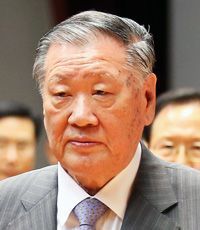
Chung Mong-koo Hyundai Motor Chairman
With Hyundai Motor Group’s record-high 81-trillion-won investment plan announced Tuesday, the company is gearing up to slowly make a turnaround this year.
Foreign investors ceased an 18-day-long sell-off rampage Wednesday, buying 13.1 billion won worth of Hyundai shares, pushing up its price by 3.34 percent to close at 170,000 won.
Analysts say that Hyundai’s investment has worked.
“While the company’s fourth quarter performance is expected to be similar to last year, its investment plan to raise future competitiveness has worked as the main factor to draw in foreign investors,” said Choi Won-kyung, an analyst at Kiwoom Securities.
Of the total 81 trillion won ($73 billion) allocated for the next four years, 49.1 trillion won will be invested in building new plants and 31.6 trillion won will be used for research and development.
Under the plan, it will spend an annual average of 20.2 trillion won through 2018, a more than 35-percent rise from its previous all-time high of 14.9 trillion won in 2014.
In comparison, the Seoul government has allocated 18.9 trillion won for the nation's R&D budget this year.
Hyundai Motor Chairman Chung Mong-koo in his New Year speech to employees strongly expressed his will to lift up quality and competitiveness, preparing for a post 8-million global sales era.
Chung said that, “Proactively answering the calls of customers by raising competitiveness in quality and brand value as well as launching eco-friendly and strategic vehicles are our top priorities.”
Hyundai/Kia Motors’ annual global sales surpassed the 8 million mark, while Hyundai’s operating profit stood relatively high at 8.66 percent in 2014.
Yet it has many outstanding challenges as well.
Its growth has slowed down in the global market as Japanese and American carmakers have returned to boost their businesses after restructuring.
In the dominant home turf, it has lost its 70 percent market share for the first time, faced with imported carmakers that are expanding their market shares.
“Two of the biggest challenges for Hyundai are the weakness of the yen versus the won, which makes Japanese OEMs more price competitive, as well as the lack of capacity for Hyundai in key markets, including China,” said James Chao, an analyst at IHS Automotive Advisory Services.
Although it will build two more plants in China, for this year alone there will be no significant increase in output since existing plants are already running on their full capacity and the new factories will not be completed within two years.
“Some cost cutting in the face of a weak yen will be necessary. And for the long-term, additional investments into R&D will help keep Hyundai competitive in key markets like China and the U.S.,” he added.
Lee Hang-koo, a researcher at the Korea Institute for Industrial Economics and Trade, said that Hyundai has become the world’s fifth largest carmaker in volume, but it still lack strategic models.
“The world automotive market is clearly divided by compacts and luxury cars. Since it didn’t have a luxury brand, it launched luxury models like Aslan and Genesis. It didn’t work in the United States,” he said. “The company’s so-far strategic mid-size sedans the Elantra and the Sonata have also aged but no other model has taken their place yet.”
What is encouraging, Lee said, is its recent hiring of BMW’s chief engineer to head its premium, high-performance vehicle development unit. “This is the way the company should take in the future automotive market. This, however, will take some time.”
Shin Chung-kwan, an analyst at KB Securities & Investment, said Hyundai needs to recover shareholders confidence. “The company already has adopted shareholder-friendly policies and plans to raise dividends. What remains to be done now is the smooth settlement of this year’s collective bargaining, showing that the management and the union are working for the same goal,” he said.