Petrochemical industry to be major FTA winner

Employees work in the dealing room of the Foreign Exchange Bank’s headquarters in downtown Seoul, Monday, as a display shows the benchmark Korea Composite Stock Price Index (KOSPI) closing at 1,958.23, up 18.36 points, or 0.95 percent from the previous session due to reports of Seoul’s free trade agreement with Beijing. / Yonhap
By Lee Hyo-sik
Petrochemical and cosmetics firms are expected to benefit most from the Korea-China Free Trade Agreement (FTA), analysts said Monday.
They say these industries, when the pact goes into effect, will likely boost their shipments to the world’s second-largest economy, thanks to strengthened price-competitiveness as a result of the removal or reduction of import tariffs.
However, they agreed to exclude the automobile industry from the FTA.
Government officials said that Hyundai Motor and Kia Motors will see no major impact from the exclusion of vehicles from the agreement as they operate each three plants in China.
However, the exclusion is expected to deal a blow to Ssangyong Motor and Renault Samsung Motors which planned to expand exports to the country following the FTA, analysts said.
According to Woori Investment and Securities, petrochemical companies and other consumer goods popular with the Chinese will be able to export more.
But telecommunications equipment, displays and other industrial products will benefit less from the trade agreement because China already imposes low import tariffs on them.
``Petrochemical companies and consumer goods makers will benefit most from the FTA pact,’’ said Kang Hyun-chul, an analyst at Woori Investment and Securities. ``Airlines and shipping firms will likely also benefit from growing travel demand and increasing trade volumes between the two countries.’’
The airline industry is also set to benefit from the FTA thanks to increased air traffic between the two.
``We operate 30 routes flying to 22 Chinese cities,’’ an Asiana Airlines spokeswoman said. ``When the pact goes into effect, it will boost the volume of passenger traffic between the two countries. In addition, closer economic ties will increase shipments of automobiles, semiconductors and other industrial goods on both sides.’’
Korea’s cosmetics firms are expected to be another beneficiary of the trade agreement.
``When the FTA takes effect, the removal of a 6.5 percent import duty on made-in-Korea cosmetics will boost the price competitiveness of our products on the Chinese market,’’ a spokeswoman for AMORE PACIFIC said. ``We will continue to develop innovative products sought by Chinese consumers and expand our presence in the world’s fastest-growing consumer market.’’
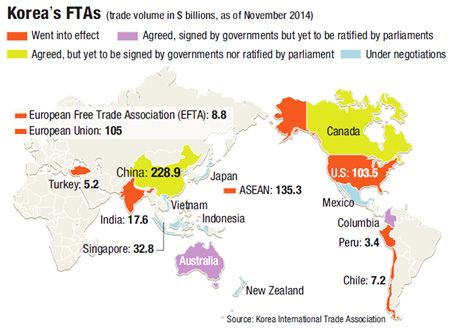
The Ministry of Trade, Industry and Energy said that the Korea-China FTA is expected to help boost the countries' annual bilateral trade to $300 billion in 2015, up 40 percent from $215.1 billion in 2012.
South Korea's trade territory, represented by the combined gross domestic product of countries with which South Korea has a free trade pact, will be expanded from the current 61 percent to 73 percent.