Ssangyong Motor sets example for workplace harmony

Employees report for work at Ssangyong Motor’s Pyeongtaek plant,in Gyeonggi Province. The union and management have maintained a cooperative relationship, helping the company post stronger sales this year. / Courtesy of Ssangyong Motor
Rebound gains momentum on cooperative relationship between company, workers
By Park Jin-hai
PYEONGTAEK, Gyeonggi Province ― An Du-hean, who has worked on an assembly line in Ssangyong Motor's plant here for 16 years, says that he learned more about the importance of his job and family the hard way.
"when unionists waged a 77-day strike in 2009, I doubted that I might lose my job," he said. "Only after the company was put into court receivership and made massive layoffs, did I learn the painful lesson that I can only make a living when the company is in good shape."
Hyundai Motor and Renault Samsung Motors' unions have long locked horns with management over wages and other labor issues, but Ssangyong Motor's labor-management relationship is quite different.
The union says its primary interest is to ensure the production of top-quality vehicles, while the company says it is working to stay in good financial shape so that it can provide secure employment for workers.
Ssangyong Motor closed this year's collective bargaining negotiations in July.
This was the fifth straight year that the company and its union agreed to a deal on wages without a major dispute.
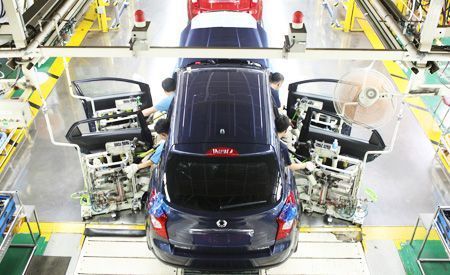
Employees work at an assembly line at Ssangyong Motor’s Pyeongtaek plant in Gyeonggi Province.
The assembly line making the company's flagship SUV, the Korando C, is in full operation and workers seem to be full of energy.
An says what he is most happy about now is that all the employees work in an air-conditioned factory.
"A senior official visited the assembly lines here one day. When he toured the factory and patted the back of a worker for encouragement, he found it soaked with sweat," he said.
The official promised to install air-conditioning so that everyone could work in a pleasant environment.
This year the company had the whole factory air-conditioned.
"If the senior official hadn't come down to the site and met with workers, the factory might not have gotten air-conditioning," he said.
Ha Kwang-yong, executive director of Ssangyong Motor's production headquarters, says the "cooperative labor-management relationship" is something about which he is most proud.
"We have learned all too well the importance of employment and how miserable one's life can be when the company is in trouble," he said. "I try to meet as many workers as possible on the site and open all channels to listen to them."
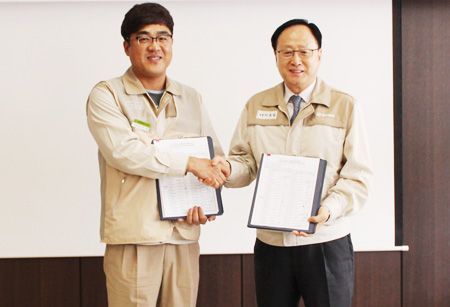
Lee Yoo-il, right, Ssangyong Motor CEO, shakes hands with union leader Kim Kyu-han, after they closed the annual wage deal at the company's Pyeongtaek plant in Gyeonggi Province, July 29. Ssangyong became the first Korean carmaker to finalize the year’s deal.
Since 2007, Ssangyong's high ranking officials have been touring its factories, rewarding and encouraging the workers.
The head of the Pyeongtaek plant holds meetings every month, where he reports how many cars the company has sold domestically and overseas, and keeps workers updated about the state of the company, something the company did not do in the past.
All these efforts have paid off.
After being released from court receivership in 2011, the company has been growing fast, backed by the Indian auto giant Mahindra & Mahindra.
The company sold 33,235 vehicles in the first half of this year domestically, which is a 13.5 percent increase from a year earlier. The automaker also exported 41,000 during the period, up 2.1 percent year-on-year.
Last year, it posted its best sales numbers since 2002, by selling 63,970 in the local market, and exporting 81,679.
During this year's wage deal, the company suggested including bonuses as ordinary wages to stave off "endless and consuming" debate. The union has agreed to the wage deal, which is less attractive than what is on the negotiation tables at other automakers.
Thanks to the cooperative labor-management relationship, Ssangyong Motor's production lines are at full capacity. The 190 workers who assemble the Korando C on Line 1 produce 24 cars per hour.
Both workers and management show high expectations for the future of the company, since its all-new model "X100" will debut early next year.
"All workers are of one mind, wishing our new car will be successful. What we want from the company is making well-designed, best-selling models, when we do our part making the best-quality cars," An said.