Banks revamp services to support foreign workers in Korea

Customers consult clerks at a bank in downtown Seoul, in this August 2022 photo. Yonhap
Local lenders asked to streamline administrative procedures
By Lee Yeon-woo
As Korea's foreign workforce continues to grow, Korean banks are introducing an array of advanced services designed to better meet the diverse needs of clients.
In addition to operating specialized branches for foreign nationals, they are expanding their boundaries by making it easier to open of bank accounts without the necessity of in-person visits, increasing the number of language services and offering nationality-specific transfer options.
“The population is indeed considered very important, as they are the foundation for banks to grow into global financial institutions. It's not just that they go back to their country and halt transactions with the bank. Even after their return, they might still maintain transactions (with the bank's foreign branch),” an official from a bank said.
As of 2022, the number of non-Koreans working in Korea reached 843,000, compared with 791,000 in 2012. Factoring in those who are also residing in the country, the total climbs to 2.2 million ― a figure nearing the population of Daegu, the sixth-largest city in Korea.
Ana Cortez, a Spanish teacher who has resided in Korea since 2013, shared how things have improved significantly since her arrival.
“Back then, I went to the bank to open an account. My English was not very good, and neither was the bank clerk's, so we both struggled,” Cortez chuckled. “However, the quality of translation services has greatly improved and they are now available in various languages.”
She expressed particular appreciation for the non-face-to-face account opening service, which is currently offered by Hana Bank and Toss Bank.
“I've tried it and it's incredibly convenient. For newcomers to Korea, I still believe visiting banks would be beneficial, as they can receive full guidance and necessary explanations. However, for people like me who have lived and worked here for some time, this service can be extremely helpful,” Cortez told The Korea Times.
Banking services are critical even for those not intending to settle permanently in Korea. Bank officials note that the service used most frequently by short-term foreign workers is still transferring savings back home. Since 2017, the proportion of personal overseas remittances made by foreign workers has expanded by about 40 percent.
To address this demand, Korean banks have introduced special transfer services primarily targeting countries in Southeast Asia, a region that constitutes a significant proportion of the foreign workforce in Korea.
For instance, Woori Bank collaborated with Cambodia's Wing Bank in March to introduce a simplified transfer service. This service allows Cambodian customers to send money home easily using basic information such as their bank account number and phone number. This service is available across all Woori Bank branches.
Shinhan Bank has not only partnered with Wing Bank but also with Kasikornbank in Thailand to provide a similar convenient transfer service for Thai customers. Hana Bank has even launched Hana EZ, an exclusive mobile app dedicated solely to facilitating transfers. NH NongHyup Bank, leveraging its stronghold in the agricultural sector, offers favorable exchange rates to foreign agricultural workers.
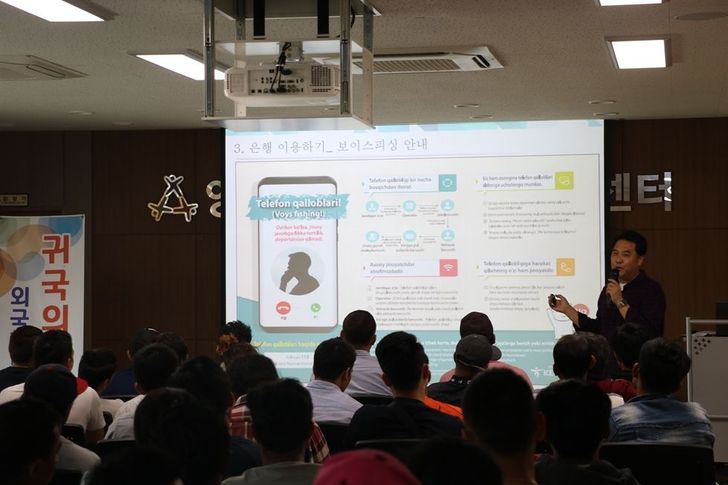
A Hana Bank official explains ways to prevent financial fraud at a foreign workers' support center in Yangsan, South Gyeongsang Province, in this October 2019 photo. Courtesy of Hana
These services extends beyond just banking. Hana Bank, in collaboration with foreign workers' support centers across nine regions, runs educational programs aimed at promoting healthy financial practices among foreign workers. These initiatives include asset formation through savings and financial fraud prevention. Additionally, the bank assists in setting up specialized accounts that allow them to enroll and make insurance payments.
Most foreign nationals interviewed by The Korea Times appreciated the banks' efforts to expand their services. However, they also pointed out some lingering administrative hurdles, particularly in loan applications. Some described the process as intricate, complicated and not user-friendly.
"It's not that I haven't tried. I went to the bank to ask about qualifications so that I can get a better residence. But I felt the difficulties when preparing necessary documents by myself, and there weren't many banks that offer a loan service to foreign nationals," said an Argentine national who asked to be identified only by her first name, Mila.
"I understand banks being careful. That's what banks do. But I think it would have been better if there was more administrative support."
A Bolivian office worker who asked to be identified only by his first name, David, said that he chose to live in a “gosiwon,” an extremely small rental room, instead of renting a decent property near his office in Yeoksam-dong, southern Seoul, on loans.
“The loan procedure for foreigners was very tedious and complicated. And they said they can offer only a very small amount of loan for me. It seemed to be of little help unless you are in an emergency.”