Net-zero banking: nice to have? Or necessary for survival?
By Choi Jung-kiu
Global temperatures are projected to reach an increase of 1.5 degrees Celsius far ahead of early expectations of around 2050, breaching this limit around 2030 according to IPCC reports. The world is, and should be, undergoing a net-zero transformation, and banking will be a vital part in delivering this success as we seek to tackle growing carbon emissions.
Global annual carbon emissions have risen from around 26 billion tons of CO2 in 2001 to over 31 billion tons by 2021. While this continued growth is cause for alarm, there are encouraging signs of a carbon-neutral shift in recent years. A remarkable 90 percent of the global economy is pledged to a net-zero future today, a huge acceleration of the 16 percent covered by pledges as of 2019.
There are already strong indications of this vital transition gaining traction in financial institutions. Analysis by Boston Consulting Group (BCG) indicates that more than 450 banks globally now have a net-zero commitment. But genuine strategy and concrete action plans to achieve these goals must be in place, with few banks yet demonstrating a clear aspiration, strategy, sector solutions, governance, risk management and holistic approach fundamental to a successful delivery.
Banking will be pivotal to a successful net-zero transition, with transition financing expected to reach $68 trillion globally by 2030. Asia will be at the heart of this transformation, with $37 trillion of the total transition value expected to be financed in the region.
Being part of this journey is key for banks seeking to maintain a competitive position in Korea and beyond, as global and regional financial institutions are moving rapidly to support this journey. Those who move first will capture the greatest share of these opportunities, while laggards will face the risk of being left behind in a once-in-a-generation shift.
It's not just missed opportunity, but the cliff-edge of regulatory risk which institutions must be aware of. Increasingly strict environmental, social and governance (ESG) mandates could leave some banks struggling to maintain compliance, as nations and regulators raise the bar on climate management and reporting expectations.
It's vital to move now, to mobilize capital ahead of the competitive curve and allow employees and stakeholders to be part of this multi-year journey towards a more climate-optimized business model.

gettyimagesbank
Focusing minds and investment in Korea
Korea has made significant leaps forward with net-zero commitments in recent years, progressing from the government of Korea's landmark emissions reduction proposal in 2015. The nation's declared commitment is now broadly in line with other mature economies around the world, but the reality is that its emissions performance has yet to catch up with these commitments.
Korean financial institutions are also broadly behind the global curve, and the industry risks falling behind unless important forward steps are taken. Much like the broader national landscape, Korea's financial institutions have made important commitments towards the net-zero transition, but lack sector-specific targets in the most critical and high-emitting industries such as oil and gas, automotive, aviation and shipping.
Unless Korean financial institutions adopt plans to target sector-specific solutions for these key industries, Korean companies operating globally in these high-emission sectors may be forced to approach international banks to deliver genuine fit-for-purpose transition finance.
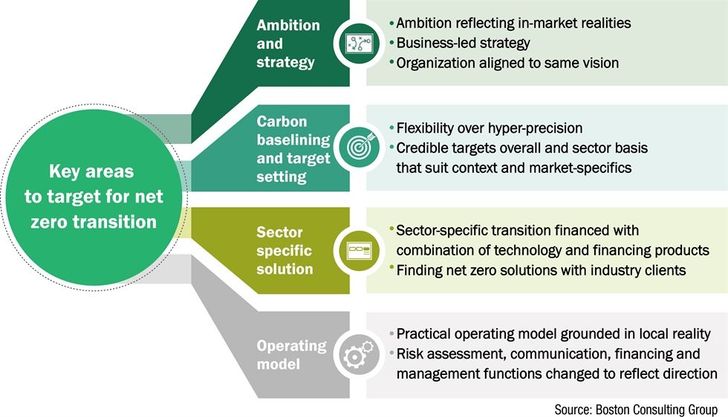
There are four areas that banks should target to deliver on this need ― ambition and strategy, carbon baselining and target setting, sector-specific solutions and operating models.
First, there is ambition and strategy. Embed an ambition that reflects Korea's in-market realities, while adopting a strategy that is business-led, but deeply integrated into products, risk management, sales force, and organization structure. It is critical to align an entire organization to the same vision, direction and rationale with organization-wide understanding and dedication. As the transformation requirement is very high, it cannot be simply forced from the top.
Second, there is carbon baselining and target setting. Embrace flexibility over hyper-precision, and set credible targets that suit the context and market-specifics. Korean financial institutions with substantial Scope 3 (supply chain) carbon footprints could be at risk, as global counterparts increasingly look to distance themselves from these large emissions burden for their own Scope 3 management.
Third, there are sector-specific solutions. Shape a mix of clients and products to fit emissions targets, and aim to provide transition financing with a combination of solution technology and financing products for the largest carbon emission sectors and clients to deliver the targets. In Korea, this means sectors such as oil and gas, automobiles, aviation and shipping. A nuanced view that reflects this reality is vital. It is more effective to find net-zero solutions jointly with industry clients.
Last, there are operating models. Design an operating model that is practical and grounded in the local reality. Ensure risks, communications, finance, and change management functions are all optimized and aligned to reflect this direction.
With the right strategy in place, Korean financial institutions have an opportunity to leapfrog global leaders by focusing on proper transition finance that meets local needs, leveraging Korea's ecosystem of major global companies.
Investing in the future
The global financing landscape is shifting, with projections that 70 percent to 75 percent of revenue generated from traditional finance today will contribute as little as 25 percent of the revenue landscape by 2025―2030. As much as 70 percent of revenue is likely to be generated by transition finance and other products over that period.
Korean financial institutions need to adapt now, and embrace the huge value opportunity they have in the key Asian landscape. Those who move first will be best-positioned to succeed. Those who fail to act are vulnerable to losing valuable market share, and exposed to major revenue losses during this period of remarkable global financial transformation.
The writer is a managing director and partner at Boston Consulting Group in Singapore. He has more than 30 years of professional experience across management consulting, international banking and in leading and growing digital businesses in China and Indonesia. He is a senior fellow at the National University of Singapore, teaching the Digital Transformation Leadership Program to senior executives and author of the book "The allDigitalFuture Playbook: How to Succeed in Digital Transformation and Innovation in a Complex World."