Foreign investors dumping Korean stocks amid 4th COVID wave

An electronic sign in the trading room of Hana Bank in Seoul shows the benchmark KOSPI closing 1.16 percent lower, Friday, at 3,171.29 points. Yonhap
By Lee Kyung-min
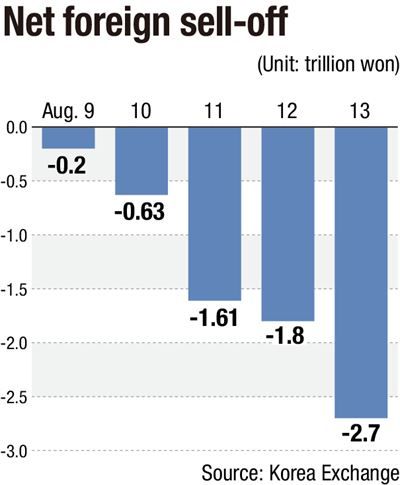
Foreign investors have been dumping stocks of major Korean companies amid growing uncertainties caused by the unrelenting fourth wave of the COVID-19 pandemic, sending a shudder through the local financial market.
Experts forecast that foreigners will continue to sell local shares, particularly semiconductor stocks, such as Samsung Electronics and SK hynix, which they expect will further weigh on the market.
Pounded by the selling spree, the benchmark KOSPI dropped for the seventh consecutive trading days Friday, while the Korean won continued to lose ground against the U.S. dollar.
The KOSPI dipped 37.09 points, or 1.16 percent, to close at 3,171.29 points, as major chipmakers came under heavy pressure from overseas investors amid concerns of a fall in semiconductor prices. The local currency closed at 1,169 won to the dollar, down 7.8 won from the previous close, and the weakest level in around 11 months since it ended at 1,169.5 won Sept, 29 last year.
Foreigners sold a net 3.77 trillion won ($3.26 billion) worth of local shares in July, according to the data from the Financial Supervisory Service (FSS). As of the end of July, the value of local stocks held by foreign investors came to 811 trillion won, accounting for 29.4 percent of the country's market capitalization.
The sell-off of Samsung Electronics and SK hynix shares is likely to extend for the time being.
Multiple analysts said foreign investors are panicked by the grim corporate earnings outlook following market expectations that fixed transaction prices for DRAM for use in PCs and peripheral devices will dip by 5 percent in the fourth quarter from three months earlier.
Samsung Electronics shares ended at 74,400 won, down 3.38 percent from the previous session. SK hynix ended at 101,500 won, up 1 percent, but failing to offset a steep fall from 121,000 won, Aug. 4.
The share price drops of the top two KOSPI market cap firms coincided with that of their Nasdaq-listed American peer Micron Technology, the world's third-largest chipmaker whose share price plummeted to $70.25, Aug. 12 (local time), from $82, Aug. 6.
The Philadelphia Semiconductor Index, also known as PHLX Semiconductor (SOX), an equity index composed of companies primarily involved in the production and sale of semiconductor products, dropped over 1.13 percent as of Aug. 12 (local time).
“The Micron shares ending lower for the past few days due to DRAM price concerns has affected Samsung Electronics and SK hynix shares,” Hi Investment & Securities analyst Song Myeong-sup said. “Investment sentiment in the top, large-cap electronics IT shares rapidly chilled, boosting the foreign sell-off.”
Foreigner investors sold 3.21 trillion won worth of Samsung Electronics shares and 1.79 trillion of SK hynix shares from Monday to Thursday.
Korean won hitting 11-month low
Also weighing on the local stock market is the weakening Korean currency, set to continue a downtrend on the expectations of a stronger U.S. dollar brought on by hawkish U.S. Federal Reserve (Fed).
“The Fed's tilting toward a hawkish stance is a burden on emerging stock markets including Korea, a reason why foreign investors are inclined to leave for higher returns,” Korea Standard Chartered Bank's Korea investment strategist Hong Dong-hee said.
The possibility of heavy foreign capital outflow from Korea similar to one in 2013 is not high, in Hong's view, but the greenback will appreciate for some time as monetary policy normalization from the pandemic-induced ultra-low interest rates begins.
Whether the U.S. dollar continues to gain will hinge on the county's jobs data and the extension of unemployment benefits. Also to be monitored is how the Chinese currency will fare, since Korea's currency tends to move in sync with the currency of the world's second-largest economy, he added.
The depreciation of the won was led in part by dollar-buying demand by foreign investors who needed the greenback after selling off Korean shares.
The most important factor in the currency volatility in the months to come will be semiconductor exports, set to dim amid projections by Morgan Stanley and other key market watchers, according to Shinhan Bank researcher Baek Seok-hyun.
“Foreigners continue to dump a greater number Samsung Electronics and SK hynix shares, sending the local currency further down in value. The selling-spree is likely to be sustained, due mostly to concerns over a slowdown in Korean chip exports, selling more and pushing up the exchange rate.”