Record FX reserve helps to offset external risks

A clerk stacks a pile of $100 bills at Hana Bank's headquarters in central Seoul, Wednesday. The Bank of Korea announced on the same day that the country's foreign exchange reserves reached an all-time high of $458.6 billion in July. Yonhap
Korea's foreign reserves reach all-time high $458.6 bil. in July
By Yi Whan-woo
An increase in foreign exchange reserves set in July helps assure Korea's economic stability against external risks, especially in the wake of the fourth wave of COVID-19 infections, according to analysts, Wednesday.
The benefits of abundant foreign assets are evident. The Bank of Korea (BOK) explained on its website this means a healthy solvency ratio ― an indicator of financial health ―and therefore can improve sovereign credit ratings.
It also makes it easier for business groups to raise capital from abroad and to facilitate foreign investments on the governmental level.
“And if you ask about the significance of record-high foreign exchange reserves in July … I would say it can consolidate belief to the outside world that Korea's economy remains healthy and will continue to be so despite the prolonged pandemic crisis,” said Joo Won, deputy director of the Hyundai Research Institute.
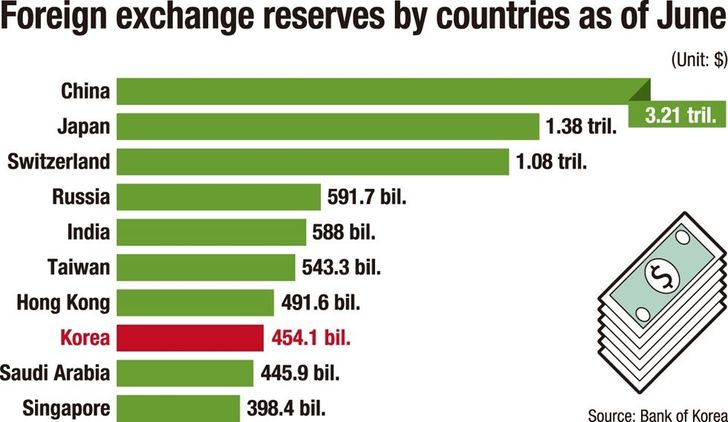
He referred to Korea's foreign exchange reserves reaching an all-time high for the third time this year ― $452.3 billion in April and $456.4 billion in May ― before slipping to $454.1 billion in June and then climbing to $458.6 billion in July.
The BOK said the foreign exchange reserves in July are a result of the weaker U.S. dollar boosting the value of non-dollar assets.
Foreign securities amounted to $414.9 billion, down $4.44 billion from June and accounting for 90.5 percent of the foreign reserves.
Deposits increased $8.92 billion month-on-month to $30.8 billion, and gold holdings remained unchanged at $4.79 billion.
The nation's foreign currency reserves have been on an upward trend for the past four years, rising from $389.2 billion in 2017 to $403.6 billion in 2019 and $443.1 billion in 2020.
Korea accordingly has been on the global top 10 list in terms of the size of foreign exchange reserves.
The country has kept a solid sovereign credit ratings given by global ratings firms ― Aa2 from Moody's, AA from S&P and AA- from Fitch, with each grade indicating Korea's economic outlook as stable.
“Together with these measurements, the new record-high foreign exchange reserves certainly help ensure Korea's capability in the era of growing uncertainties as shown from the pandemic,” Joo said.
A different economist noted the foreign exchange reserves tend to rise when a country's economy expands and is in surplus.
“These conditions suggest a country can better safeguard its economy in case of changes to the U.S. monetary policy as well as global emergencies,” he said on condition of anonymity.
The economist pointed out the Federal Reserve has signaled for post-pandemic interest rate hikes, which can influence the BOK's policy direction given that it is heavily reliant on the U.S economy.
“The hike in the U.S. interest rate can result in withdrawal of foreign currency and a worsening foreign exchange market here. But it may not be the case as we have abundant foreign exchange reserves this time.”
During the Asian financial crisis in the late 1990s, Korea saw a surge in foreign assets followed by their sudden withdrawal.
Joo said this is “very unlikely” to happen again, arguing robust exports will keep foreign cash flowing into the country.
Exports reached an all-time monthly high of $55.4 billion in July, thanks to strong sales of traditional export items such as semiconductors, cars and petrochemicals as well as emerging industries including bio-health and cosmetics.