ANALYSIS Korean insurers rush to attract foreign customers amid market saturation

Tsay Tatyana, left in front row, a Samsung Life Insurance sales agent from Uzbekistan, poses with her colleagues at the firm's branch office in Yeongdeungpo, a Seoul district with a large population of foreign residents, July 13. Courtesy of Tsay Tatyana
By Yi Whan-woo
Tsay Tatyana, a Samsung Life Insurance sales agent from Uzbekistan, is among many foreign professionals hired by Korean insurers to deal with the growing number of foreign nationals who are residing in Korea long-term and searching for insurance plans that will help them lead a more stable and secure life.
“The longer they stay, the more they are interested in insurance and saving for major life events, as they will have a higher chance of requiring dental implants, being diagnosed with cancer, sending their children to college as well as wanting to make sure their loved ones are not financially disadvantaged in the event of their unexpected death,” she told The Korea Times this week.
Tsay joined Samsung Life, the country's leading life insurer, in March 2020, almost 13 years after she first came to Korea and began witnessing a consistent growth in the number of long-term foreign residents.
She works as a team leader at one of the insurer's two branches in Yeongdeungpo, a Seoul district with a large population of such residents.
After opening its first branch with non-Korean sales agents a few years ago, the company set up an additional one in the same district in 2020 as the number of foreign subscribers there grew too fast for one office to manage. A total of 85 foreign consultants work at the two offices ― 45 in the first and 40 in the second.
The policies the branches offer cover a range of medical expenses ― from cancer treatment to dental implants ― as well as providing savings plans to help customers manage their pensions, prepare for retirement and pay for their children's university tuition.
While English and Chinese are the two most-served languages, services are also available in Kazakh, Mongolian, Russian, Ukrainian, Uzbek and Vietnamese.
“You can see how extensively we deal with foreign subscribers and help them understand terms and conditions,” Tsay said.
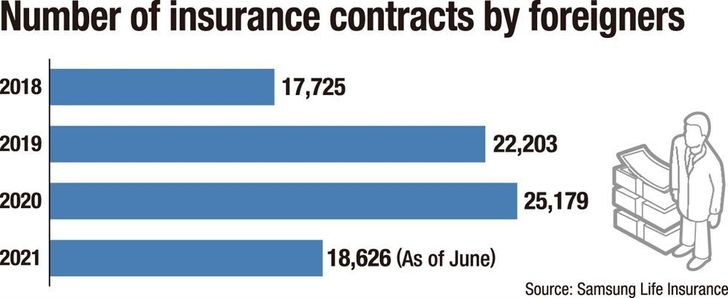
The number of Samsung Life's newly-signed foreign policy holders climbed from 17,725 in 2018, to 22,203 in 2019 and 25,719 in 2020.
This is a similar situation with the company's two rivals ― Kyobo Life Insurance and Hanwha Life Insurance ― with immigration continuing to rise and the market for Korean subscribers being saturated.
Kyobo has been gaining more than 32,000 new subscriptions from foreign nationals annually, and Hanwha more than 25,000.
Regarding sales agents, Hanwha has so far hired 508 multilingual employees nationwide, while Kyobo had 180 in 2019.
The subscription rate for Korean nationals stood at 98.2 percent in 2019, suggesting that virtually every eligible domestic customer is subscribed to at least one insurance product.
“The last time we conducted research on the potential number of foreign customers was in 2019 and we apparently need an update on the stats. Regardless, the general consensus in the industry is that the number is rising,” said Lee Gwon-hee, a brand communications team manager at Kyobo Life Insurance.
According to data released by the Ministry of Interior and Safety, the number of people with foreign nationality who lived in Korea for three months or longer reached 2.21 million in 2019, accounting for 4.3 percent of the country's total population, up from 4 percent in 2018, 3.6 percent in 2017 and 3.4 percent in 2016.
“The growth potential with foreign nationals here is huge, especially considering the fact that many of them are manual laborers and need a private safety net against industrial hazards and illnesses that are not covered by the Korean government's health insurance program,” an industry source said on condition of anonymity.
The source noted that migrant workers accounted for the highest number of residents of foreign nationality, which was divided into different categories in 2019. Their number totaled 515,051, followed by foreign national spouses at 173,882, and international students at 160,610.
With English and Chinese being the main languages used for foreign language services, the companies are also trying to hire people whose fellow citizens make up the major groups among the foreign national groups here.
Chinese, including ethnic Koreans, were the dominant group at 42.6 percent, followed by Vietnamese at 11.1 percent, Thais at 10.2 percent, Americans at 4.4 percent, Uzbeks at 3.5 percent, Filipinos at 2.8 percent and Cambodians at 2.6 percent.
“Customer services offered in various languages will be able to help minimize foreign nationals' cancellation of contracts, as well as legal disputes caused by misunderstandings associated with the language barrier,” Kyobo said in a statement.