Financial firms urged to shift focus to governance

This article is the third in a four-part series highlighting the importance of ESG criteria in management and making suggestions for Korea's financial, industrial and public sectors to come up with better ESG strategies for sustainable growth. ― ED.
Drastic board reshuffles considered necessary for banking groups
By Park Jae-hyuk
Domestic financial holding companies faced harsh criticism for their poor corporate governance structures again during this year's proxy season, because most of their nonexecutive directors successfully retained their seats despite growing calls for diversity in their board members.
Experts warned their apparent indifference to governance issues may even make their ongoing efforts for environmental factors less meaningful, causing the undervaluation of bank stocks in line with the global trend to prioritize the environmental, social and corporate governance (ESG) criteria.
According to regulatory filings by the nation's top banking groups, several foreign institutional investors have already carried out divestments from them over the past few years, amid lingering concerns over their governance.
BlackRock, Capital Group and Franklin Resources, which once held over 5 percent stakes in Hana Financial Group, are not its major shareholders anymore. Shinhan Financial Group is expected to cut its ties with BNP Paribas soon, considering the French firm did not recommend anyone to serve as a nonexecutive director of the Korean banking group, taking over for BNP Paribas Securities Japan CEO Philippe Avril.
Although foreign private equity firms, such as the Carlyle Group, Affinity Equity Partners and Baring Private Equity Asia, became new major shareholders of some domestic financial groups, they have been considered to be seeking short-term profits rather than making long-term strategic investments.
“From foreign investors' point of view, there are not many Korean companies having a fully functioning board of directors,” McKinsey & Company Senior Partner Richard Lee said. “The governance of conglomerates by their owner families has already been discussed many times, so the advancement of governance in the domestic financial sector will be the key question in the future.”
After ESG emerged as a global trend, Shinhan and KB financial groups have been regarded as the industry leaders in terms of sustainable management. Hana, Woori and NongHyup financial groups started to go after the large players recently, emphasizing the importance of ESG in their New Year addresses.
Their main focus has been on the environmental factors, which are considered relatively easier for financial firms to pursue. Earlier this month, 113 financial companies declared they will support the Carbon Neutrality by 2050 initiative to counteract climate change by divesting from industries using fossil fuels.
In contrast, financial groups have been criticized for ignoring calls from financial authorities, unions and global proxy advisers to reshuffle their board members.
Last year, the Financial Supervisory Service sent warnings to Woori and Hana to urge them to enhance transparency in their management of boards. Shinhan was also advised to reduce the proportion of Korean Japanese nonexecutive directors without expertise. It followed the recommendation by adding two more board seats.
Unions of KB and state-run lenders have continued to call for a codetermination system which provides board seats to employees or their representatives. Institutional Shareholder Services recommended shareholders of Shinhan and Woori to oppose reappointments of some of their directors, citing their failures to dismiss the CEOs, who are liable to get sanctions for fund fiascos that caused major investor losses.
“Although the six largest banking groups' boards are ostensibly managed by their nonexecutive directors, they have just acted as yes men for group chairmen and bank CEOs,” lawyer Kwon Ho-hyun of People's Solidarity for Participatory Democracy said in a conference this month.
Data compiled by the progressive civic group showed directors of KB, Shinhan, Hana, Woori, NongHyup and Industrial Bank of Korea passed 97.2 percent of topics in their original forms without any opposition or revisions between 2017 and 2019.
Critics pointed out that financial groups are just looking for legal experts and former government officials as their nonexecutive directors to lobby financial regulators, instead of attracting various experts in finance and technology.
The lack of female directors has also been mentioned as a risk factor for ESG in the domestic financial sector. The nation's four largest banking groups only have four women among their 33 nonexecutive directors. Woori did not appoint any women as nonexecutive directors again this year.
“Financial holding companies should widen their pools of nonexecutive director candidates, following the changing industry trend that emphasizes female experts,” Korea Capital Market Institute Senior Research Fellow Park Chung-gyun said.
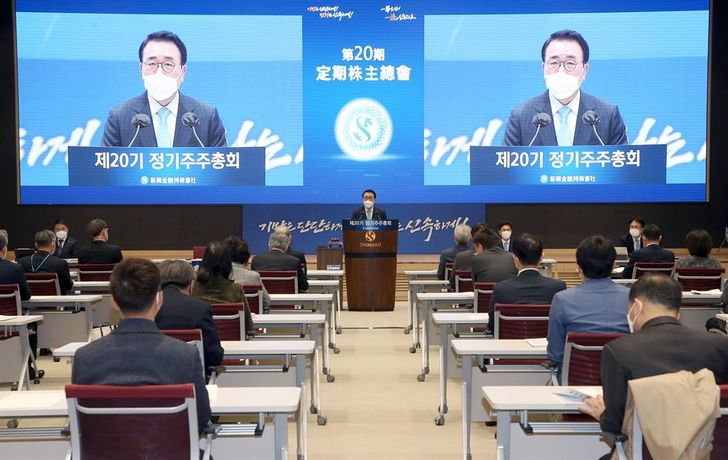
Shinhan Financial Group Chairman Cho Yong-byoung speaks during the company's general shareholders meeting, Thursday. Courtesy of Shinhan Financial Group
Putting brakes on powerful CEOs
In response to criticisms, banking groups have made efforts slowly but surely to reduce the power of their chairmen.
Shinhan decided to shift the control of its subsidiary management committee to the board of directors from the chairman, so as to enable more transparent personnel affairs and responsible management by the board.
Hana established an operating office under its board of directors earlier this year to help nonexecutive directors and enhance the independence of the board. Woori created an executive vice president position late last year to train a successor to the incumbent chairman for stable governance.
KB was recognized last year for offering fair opportunities to its chairman candidates including the incumbent by randomly deciding the order of their interviews and giving them each the same amount of time.