Shinhan recognized for green leadership 7 years in a row
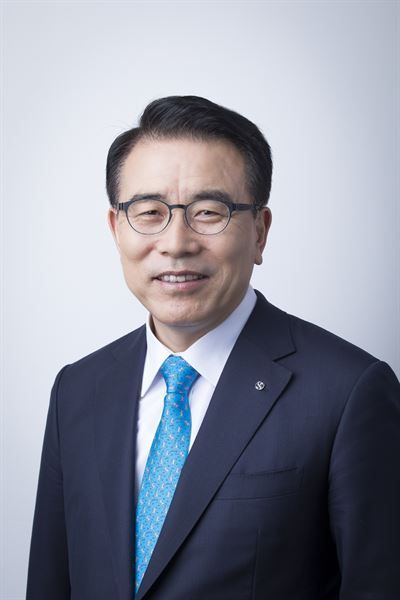
Shinhan Financial Group Chairman Cho Yong-byoung'
By Lee Kyung-min
Shinhan Financial Group has topped the 2020 list compiled by a global not-for-profit carbon-neutral advocacy group that recognizes firms with a vision for sustainable growth, for the seventh consecutive year.
This will help the group solidify its leadership in environment, social and corporate governance (ESG), a set of criteria prioritized among many leading international firms for green, sustainable growth.
The group said Thursday that it retained Leadership A, a score determined by the Carbon Disclosure Project (CDP) that runs a carbon disclosure system to manage environmental impacts for investors, companies, cities, states and regions. Some 270 firms from around the world are on the list.
The CDP's annual report is among the most respected independent sustainability ranking systems alongside the Dow Jones Sustainability Indices (DJSI).
The organization gives scores ranging from D- to A to ?take firms “on a journey?through disclosure to awareness, management and finally to leadership,” according to its website.
“The scoring measures the comprehensiveness of disclosure, awareness and management of environmental risks and best practices associated with environmental leadership, such as setting ambitious and meaningful targets. We are happy to have made the list for seven years in a row, a tangible result following group-wide efforts to advance green initiatives,” a Shinhan official said.
This is the latest of the financial group's efforts to go carbon-neutral by 2050, a vision the group said, Nov. 15, that was the first such move by a financial services firm in Northeast Asia.
This came about two weeks after President Moon Jae-in declared Oct. 28 that Korea would seek to reduce greenhouses gas emissions to net zero by 2050, the first pledge made by the country to go carbon-neutral.
This will materialize through 8 trillion won ($7.1 billion) in government spending on its Green New Deal, a key part of the Korean New Deal, defined by a five-year investment of 160 trillion won.
At a November meeting of a group subcommittee under the board, Shinhan Group Chairman Cho Yong-byoung declared a “zero-carbon drive,” a distinctive move to lead the discussion on the impending crisis of climate change and join the global wave of eco-friendly initiatives.
The group said it will reorient investment and lending rules from carbon-heavy firms and industries to ones whose business models that are environmentally conscious and therefore sustainable.
Greater opportunities for larger loans will be granted, it added, to firms with green growth business models, among other eased financing rules to be updated to foster future-oriented firms.
The group aims to reduce carbon emissions by 46 percent by 2030, and increase the target level to 88 percent by 2040.
Its asset portfolio will be restructured to have its investments reduce carbon emissions by 38 percent by 2030 and further to 69 percent by 2040, before reducing them to zero by 2050.
This will be enabled by increased financing for firms that develop technologies to advance green initiatives, firms that replace old facilities and equipment with new eco-friendly ones and greater equity investment in renewable energy sources.
Shinhan said the zero-emission objective will be achieved through a Science Based Target initiative, a joint program by the CDP, the United Nations Global Compact and the World Resources Institute among others intended to “increase corporate ambitions on climate action by mobilizing companies to set greenhouse gas emission reduction targets,” according to the CDP website.
The targets should be, the website added, consistent with the level of de-carbonization required to limit global warming to less than 1.5 degrees Celsius or 2 degrees Celsius compared to preindustrial temperatures.
The initiative is in support of the Paris Agreement signed in 2016 within the United Nations Framework Convention on Climate Change, dealing with greenhouse-gas-emissions mitigation, adaptation and finance.
This pushes leading companies to demonstrate the scale of emission reductions achievable, thereby positively influencing international climate discussions and domestic climate policy.