Reporter's notebook FSS chief losing ground?
By Kim Bo-eun
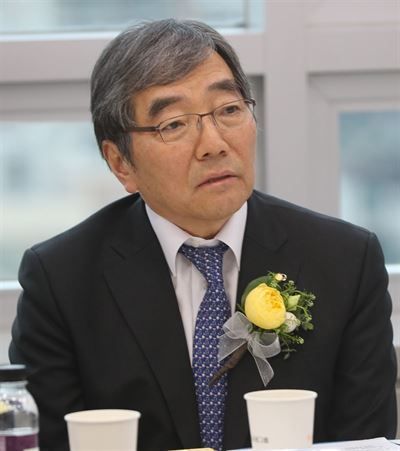
Yoon Suk-heun / Korea Times file
The Financial Supervisory Service (FSS) was once regarded as the absolute authority over financial firms.
As a supervisory agency, the FSS looks into financial firms' irregularities and directs them to take corrective action when deemed necessary. While the directions are not binding, firms have followed through with them voluntarily as it doesn't help to ruffle the feathers of the authority.
Yet banks have been defying advice by the FSS in a recent series of cases, which is raising questions over the authority of the agency.
After the incumbent FSS governor Yoon Suk-heun took office in May 2018, he has placed a top priority on protecting financial consumers.
One of the cases Yoon undertook was the decade-old dispute surrounding knock-in-knock-out (KIKO) contracts.
The currency-linked financial derivative products referred to as KIKO incurred over 3 trillion won in losses for local exporters at the time of the 2008 global financial crisis. The companies filed suits against banks that sold the derivative products, but the top court cleared the banks of fraud in 2013.
The FSS began reexamining the case in 2018 and in December last year directed banks to compensate up to 41 percent of the losses incurred from the KIKO contracts, stating they had engaged in mis-selling. Six banks were advised to pay a total of 25.5 billion won to four firms.
However, five of the six banks have refused to accept the settlement plan. Shinhan, Hana and DGB banks stated last week they will not follow the directive. Korea Development Bank and Citibank also said earlier they would not accept the plan. Only Woori Bank complied.
The stance of banks is that the right to seek compensation is no longer valid as such claims are subject to a 10-year limit.
Banks have also responding with action to punitive measures imposed for the mis-selling of financial derivative products referred to as derivative-linked funds (DLF), which caused major losses for investors.
In March, financial authorities fined Woori and Hana banks, 19.7 billion won and 16.8 billion won, respectively, over the case.
However, both banks have filed objections to the fine.
The fine was imposed in addition to sanctions placed on the chiefs of banks for their responsibility in failing to ensure the firms had functioning internal control systems.
Woori has also filed a suit against the sanction placed on its former CEO Son Tae-seung, who currently serves as the chief of Woori Financial Group.