Lenders deterred from preparing for worst-case scenario

Financial Services Commission (FSC) Chairman Eun Sung-soo, right, urges bank CEOs to offer financial support to small business owners during a meeting at the Korea Federation of Banks headquarters in Seoul in this March 20 file photo. / Courtesy of FSC
Gov't urges banks not to increase loan loss reserves
By Park Jae-hyuk
Domestic banks have been unable to brace for the negative impact of the COVID-19 pandemic, due to the government virtually barring them from increasing their reserves in anticipation for loan losses.
While banks in the United States and Europe have begun putting aside massive amounts of money to brace for the scenario, Korean lenders have not been able to do the same as they have been forced to lend more money to virus-hit businesses and extend the due dates for their loan payments.
Analysts have warned Korean banks of credit risks in upcoming quarters if they continue to keep pace with the government's massive liquidity supply.
According to regulatory filings by Shinhan, KB, Hana and Woori financial groups, Thursday, their combined allowances for bad debts rose 9.5 percent year-on-year to 730.5 billion won ($594 million) during the first quarter.
An allowance for bad debt is a valuation account used to estimate the amount of a firm's receivables that may ultimately be uncollectible. If its amount rises, the firm's profit declines.
The nation's four largest banking groups could post better-than-expected earnings during the first quarter, because the increase in their bad loan reserves was much smaller than those of global financial giants despite the growing concerns over uncollectible debts.
Standard Chartered raised its reserves for bad loans to $956 million in the first quarter from $78 million in the previous year. HSBC increased its provisions for loan losses and impairments to $3 billion in the first quarter, the highest since the first quarter of 2011.
Bank of America nearly quintupled its loan loss provisions to $4.76 billion. The amount of money Citigroup set aside in case of loan defaults tripled to $7 billion.
“U.S. and European banks are increasing their reserves to prepare for the worst. Our global operations have also set aside money,” a top executive of one of the foreign banks operating here told The Korea Times on condition of anonymity.
“Although the public has yet to realize it, the economic forecast is the worst it has been since the Great Depression, so it is proper that banks should set aside reserve money. We chose to brace for the worst-case scenario.”
Domestic banks said they did not increase their bad loan reserves, because they considered COVID-19 had a limited impact on them during the first three months of this year.
“We will decide whether to reserve more money or not, depending on how the pandemic unfolds,” said a spokesman of Hana Financial Group which was the only banking group here that decreased its bad loan reserves in the first quarter.
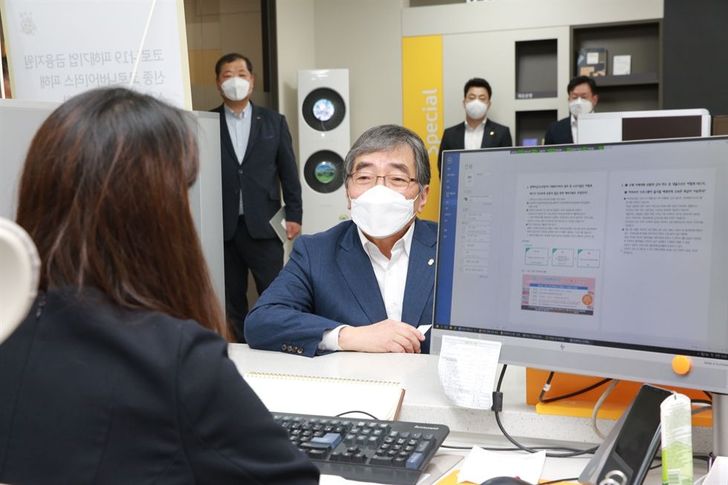
Financial Supervisory Service (FSS) Governor Yoon Suk-heun speaks to a bank clerk during his visit to KB Kookmin Bank's Sadang branch in Seoul, March 26, which was made to encourage the bank to lend money to businesses suffering difficulties from the COVID-19 pandemic. / Courtesy of FSS
Roh Young-hoo at the Financial Supervisory Service's bank supervision department said Korean banks did not need such a rapid rise in their provisions for loan losses, as the U.S. and Europe suffered bigger economic shocks from the coronavirus than Korea did, due to their lockdowns.
The Financial Services Commission also said in its press release April 13 that banks should not automatically regard deferred repayments as credit risks at this moment.
However, experts said the financial authorities are trying to hinder banks from increasing their bad loan reserves so they can continue offering financial support to virus-hit businesses.
“Banks actually want to put aside more money to brace for loan defaults, but the government does not want it because it may prompt them to cut the loans offered to businesses,” said Lee Tai-ki, a senior research fellow at the Korea Institute of Finance's banking and insurance industry division.
Kiwoom Securities analyst Seo Young-soo said in his recent report that the government will not be able to supply liquidity through banks as the COVID-19 crisis lingers.
“Banks may suffer financial burdens in the second quarter or the second half at the latest, because of a significant increase in their bad loan reserves,” the analyst said. “As they did not reserve enough money during the first quarter ― unlike banks in the U.S. and Europe ― they will have no choice but to pile up more money.”
Against this backdrop, global ratings agencies have revised credit outlooks for several Korean banks to negative from stable, citing their exposure to loans offered to small business owners.
“Under our baseline scenario, the average impaired-loan ratio for the eight Korean banks that we assign viability ratings to will increase by 1.7 percentage points in 2020,” Fitch Ratings senior director Chang Hea-kyu said.