Leaders of financial firms buying back stocks amid virus shock
By Lee Min-hyung

Woori Financial Group Chairman Son Tae-seung
Leaders of Korea's financial holding firms are standing at the forefront to defend their declining stock value by aggressively buying back their own shares.
A stock buyback is widely used by companies to enhance their corporate value when their share price plunges. The move by top management is seen as a message to shareholders that they will remain responsible for corporate growth.
It was only recently that local financial holding companies began taking similar action. They took the steps amid a growing sense of crisis over their declining share prices and widening business uncertainty stemming from the continued spread of COVID-19.
Woori Financial Group Chairman Son Tae-seung bought back 5,000 company shares recently, in an apparent gesture of confidence that the lender will continue boosting shareholder value.
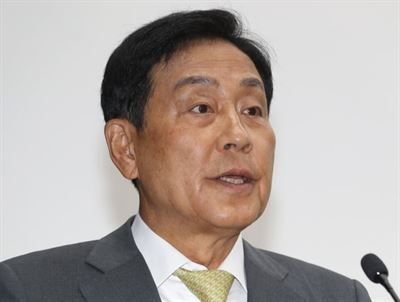
Hana Financial Group Chairman Kim Jung-tae
This is the third time in 2020 that Son has pushed a stock buyback. Starting January, the Woori chief bought back 15,000 shares. This has seen him obtain 78,127 shares in the company.
The stock price of Woori Financial Group nosedived to as low as 6,320 won as of March 20, a drop of more than 50 percent from nine months ago when it was traded at around the 14,000 won range. Over or the past month, Woori shares recovered to top 8,000 won, but they still have a long way to go to return to the range of a year ago.
Analysts said it remains to be seen whether the stock buybacks ― pushed by the leaders of the big lenders here ― will drive near-term rebounds in their share prices.
“Our view is that it will take time for the bank stocks to make a meaningful rebound due to continued uncertainties surrounding (the government's) virus-related capital market policies,” DB Financial Investment economist Lee Byung-gun said. “First and foremost, banks in the United States withdrew their plans recently to buy back their own shares, and those from Europe are also likely to jump on the bandwagon.”
Even if local financial firms have carried out stock buybacks, uncertainties remain in place due to the government urging them to refrain from engaging in the move and to follow the steps taken in the U.S. and Europe.
Financial Supervisory Service Chairman Yoon Suk-heun recently recommended lenders temporarily suspend their plans for stock buybacks, urging them to focus more on supplying liquidity to the market to fight the virus-driven shock in the real economy.
The stance is in line with those of global financial authorities.
Agustin Carstens, general manager at the Bank for International Settlements, said: “We need a global freeze on back dividends and share buybacks.” Korean regulators are also seeking to follow the global recommendation by putting a top priority on resolving the economic downturn and its potential aftermath.
Hana Financial Group is another financial holding firm that has pushed recently for a share buyback.
Group Chairman Kim Jung-tae bought back 5,668 shares April 8. This was the second time this year that Kim took the action following Feb. 5 when he bought 2,000 shares. This enabled the Hana leader to obtain 65,668 shares.
The stock price of Hana Financial Group has declined by more than 30 percent over the past year to 25,000 won as of Wednesday. Hana shares were traded at around 40,000 won a year ago.
Despite the big year-on-year drop, the lender's stock value is on a steady recovery track in recent weeks after hitting bottom in mid-March when the pandemic panic first swept the nation.
Banks in dilemma
The government and financial regulators here are going all-out to tackle the ongoing economic turmoil, as the global spread of the virus threatens the export-dependent local economy. A sense of crisis is represented by the recent stock fall and local firms' setbacks in securing dollars and liquidity.
To address the growing market volatility, the Bank of Korea and the Ministry of Economy and Finance have introduced a set of market stabilization measures including channeling more liquidity into the market. The authorities urged commercial banks to join forces in expanding market liquidity and play a part in tackling the economic crisis.
An analyst at eBest Investment & Securities said the government's recent moves will not serve as a positive factor for local banking stocks to help them achieve a short-term rebound.
“Banks' public role to deal with the crisis will do little to enhance their profitability,” Jun Bae-seung from the securities firm said. “But from a longer-term perspective, expectations are the latest steps by the government will eventually help ease regulatory hurdles in the financial sector, which is a positive factor for the longer-term growth of banks.”