INTERVIEW AI, big data becoming Shinhan's new growth engines

This is the first in a series of interviews with heads of the nation's top four financial groups ― Shinhan, KB, Woori and Hana ― to mark the beginning of New Year 2020. ― ED.
Chairman seeks opportunity from gov't initiative on 'data economy'
By Park Jae-hyuk
Shinhan Financial Group is set to upgrade its capability in artificial intelligence (AI) and big data in 2020 in line with the government's initiative to “invigorate” the data economy, according to the head of the nation's largest banking group.
The data economy refers to a global digital ecosystem in which data is gathered, organized and exchanged by a network of vendors for the purpose of deriving value from the accumulated information.
With the aim of enabling the use of data and AI technologies in the safest way, the government has sought to expand the value of the data market here to 30 trillion won ($25.6 billion) and nurture 10 “unicorns” in the AI sector by 2023.
Shinhan Chairman Cho Yong-byoung told The Korea Times his company will start pushing ahead with various projects from this year to gain more profit from the digital sector.
“We will integrate a massive amount of data in both the finance and non-finance sectors, and upgrade the group's major digital technologies, such as AI, big data and cloud computing,” the chairman said in a recent interview.
“Through our subsidiary Shinhan AI, we will apply AI technology to the entire value chain of our financial industry.”
In September 2019, Shinhan launched its 16th subsidiary, which was put in charge of AI-powered investment consulting services.
The nation's first AI-based investment advisory firm offers advice on investments to any customer, not just wealthy clients, with its NEO platform, powered by IBM Watson's analytical technology.
NEO, which stands for “new” and Shinhan's slogan of “ONE Shinhan,” studies the global financial market and recommends the best portfolio and products to customers by analyzing big data from the past 30 years.
Cho said Shinhan will also establish an integrated big data platform and become the country's first financial group using a public cloud, for better data management.
He expects the open banking service's launch last year will help the group accelerate such efforts.
“As we have been able to secure our customers' financial data thanks to the global trend of open banking, it has been important for us to offer optimized life-time asset management services to our customers, based on this data,” he said.
“With Shinhan Card's competence in big data, we will enhance our ability to manage our customers' assets comprehensively.”
The chairman also said Shinhan will engage in various businesses related to blockchain, digital marketing and cyber security.
“We plan to enhance our digital transformation initiative consistently,” he said.
Boosting glocalization
The digitization drive is part of Shinhan's efforts to become the Asia's leading financial group, moving beyond being the biggest banking group in Korea.
According to the chairman, another pillar for his company to achieve this goal is “glocalization.”
Glocalization, a portmanteau of globalization and localization, means the practice of conducting business according to both local and global considerations.
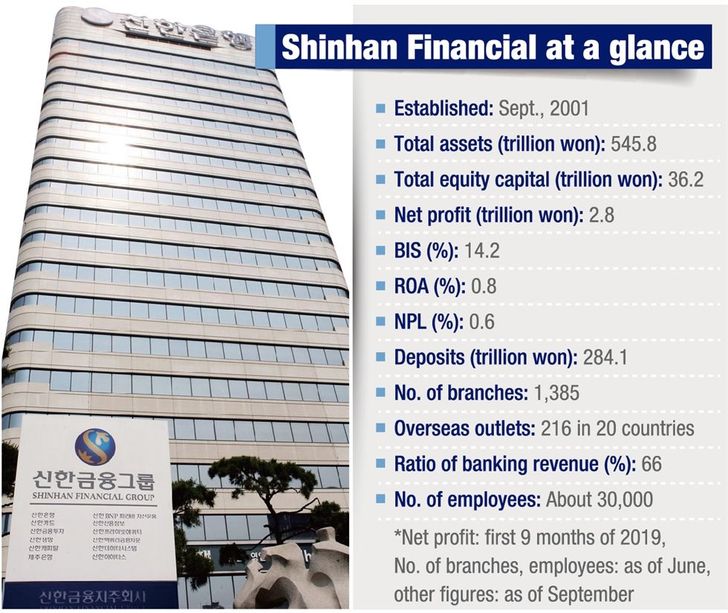
Shinhan, which runs 216 overseas outlets in 20 countries, is looking for success in the global market, based on a consistent strategy of localizing channels and employees, as well as customers and their assets.
“Unlike other financial groups, we have a global business division, and its head directs global businesses of the holding company, bank, card firm, brokerage and insurer. We have consolidated cooperation among our subsidiaries,” Cho said.
“We also appointed country heads for important regions, so as to boost cooperation among subsidiaries operating in the same countries.”
Shinhan will continue to enhance localization in the ASEAN market which has a huge growth potential.
In order to pursue the global-focused growth strategy consistently, the chairman also showed interest in M&As in the non-banking sector, the capital market and outside of Korea.
“We have already followed differentiated strategies, such as reinforcing the non-banking sector, enhancing competitiveness in the capital market and boosting our global business,” he said.
“We want to keep enhancing our competitiveness in the non-banking sector, and capital and global markets, based on the success of our 2020 SMART Project.”
According to the chairman, “SMART” stands for specific & segmentation, measurable, action-oriented, realistic stretch and time-based.
Open innovation
As of the first half of 2019, the financial group had around 30,000 employees, including subsidiaries.
Most of them have built their careers at Shinhan for a long time, but the proportion of outside experts throughout the group is expected to grow further.
On Dec. 19, the financial group's board of directors recommended former Samsung Electronics Vice President Lee Keon-hyok and Korea Investment Corporation senior managing director Park Tae-hyung as the CEO of Shinhan Future Strategy Center and the vice president of Shinhan BNP Paribas Asset Management, respectively.
Cho said Shinhan plans to improve its expertise through the continued hiring of talented “outside” people.
He is already well known for his efforts to break down the “exclusivism' prevalent in the nation's banking industry.
During his first term, the chairman offered major positions in the group to outside experts including Accion founder Sunny Yi and former Bain & Company partner Cho Young-suh.
When the group's chairman recommendation committee decided Dec. 13 to put Cho forward as a sole candidate for the next chairman, he also told reporters he will open the door to outside experts, mentioning openness and innovation as keywords for management during his second term.