Hana Financial prioritizes sustainable goals
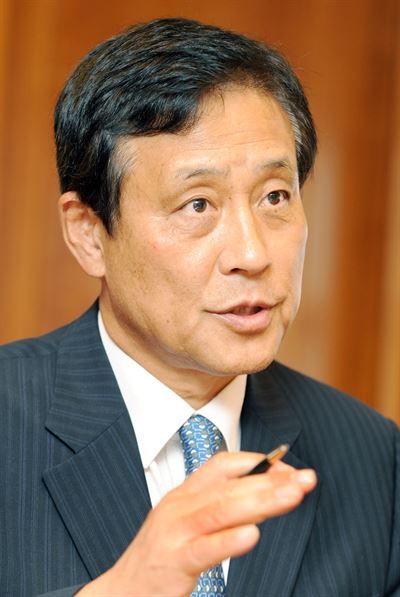
Hana Financial Group Chairman Kim Jung-tai
By Lee Kyung-min
Hana Financial Group will continue to focus on digitization, globalization and risk management while creating a corporate culture that values family, humanity and a sense of belonging, it said Sunday.
In its 2018 sustainability report, the group said these visions are in line with the United Nations' Sustainable Development Goals (SDGs) outlined to help governments, global business leaders and society build a more healthy and productive environment.
A particular emphasis was put on risk management involving climate change, a growing concern that could seriously damage people's living conditions following a series of unpredictable natural disasters.
Failure to implement regulatory standards in time, the report recognized, could hurt the firm's market reputation and could lead to a greater credit risks in both the financial and non-financial sectors.
This is why the group is pushing for a full disclosure of climate-related information from listed companies in Korea to help investors determine risk.
The move is in line with a recommendation from the Task Force on Climate-related Financial Disclosures (TCFD), established by the Financial Stability Board, a group of central bank heads and G20 financial leaders.
KEB Hana Bank, the group's most lucrative subsidiary will launch a more aggressive drive to achieve “Vision 2540,” under which the bank will seek to increase net income derived from overseas profits to 40 percent by 2025 from the current 15 percent.
Group-wide strategies will be formulated to strengthen the mindset that digital transformation is not a mere business objective, but a redefinition of identity.
“We will seek to change our identity from a financial services firm to an information-based entity,” the report read.
Hana says this is a fundamentally different approach from its competitors that mostly consider the transformation a tool to help advance their business objectives.
The group plans to strengthen parental leave packages and build more daycare centers, as part of its long-term goal to help create a family-friendly work environment.
“If the company could help working parents feel safe about their young children being in good care, they will be far less likely to be worried and distracted from concentrating on work. This in particular will help boost female workforce participation and improve work productivity,” a Hana official said.
The group had 20,539 employees and had a net income of 2.27 trillion won ($1.91 billion) in 2018.
Its return on assets (ROA) was 0.61 percent and return on equity (ROE) was 8.87 percent.