Extreme heat melts and warps asphalt, creating road risks
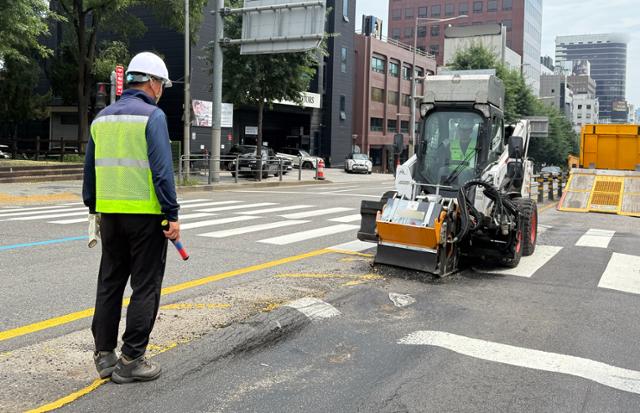
Jeong Byung-hee, head of the Seoul Southern Road Office repair team, stands on a road that buckled from extreme heat in Seocho District, Seoul, on July 31. Hankook Ilbo
Deformed asphalt is appearing across Seoul as extreme summer heat causes roads to warp, sink and crack, increasing the risk of accidents.
On July 31, when the mercury hit 34.6 degrees Celsius and a heat warning was in place, four ridges rose up in the middle of the central bus lane on Sinbanpo-ro in Seocho District, Seoul. Each ridge was about 50 centimeters wide and stretched roughly 10 meters. Responding to a public complaint, workers from the city’s Southern Road Office spent an hour grinding down the raised surface under the blazing sun.
“In this sweltering heat, it’s common for roads that were fine yesterday to suddenly warp overnight,” said Jeong Byung-hee, head of the road repair team. “Even if we repave the road, the asphalt can deform again in the heat. We'll carry out full repairs after summer, but in the meantime, we perform daily emergency fixes.”
Workers from the Seoul Southern Road Office repair a section of road in Seocho District, Seoul, on July 31 after extreme heat and heavy loads caused it to buckle. Hankook Ilbo
According to the Korea Meteorological Administration, Monday, last month’s nationwide heat waves lasted an average of 14.5 days — up 10.2 days from the same period last year, when it averaged 4.3 days. A heat warning is issued when the daily temperature reaches 33 degrees or higher. Asphalt, made from petroleum, begins to soften at 30 degrees and can suffer serious damage above 35 degrees. Consecutive days of extreme heat can push surface temperatures to 50 to 60 degrees, causing bulges and holes.
Last month, roads near Hongpa Elementary School in Seoul’s Dongdaemun District and Nongso Elementary School in Ulsan’s Buk District developed warped, melted surfaces that hardened again, prompting firefighters and municipal workers to carry out repairs.
The capital has been hit especially hard. Seoul recorded 15 days of heat warnings in July — 7.5 times more than last year’s two days. Since the city began tracking deformation cases this summer, there have been 88 incidents: 23 in June and 65 in July. Jeong, whose team handles repairs in five districts, including Yeongdeungpo, Dongjak and Seocho, said, “We fix one to three cases a day, but this summer there’s been a big jump compared to last year. It’s bad enough that bus stops often have warped roads in front of them.”
Warping typically occurs on bus-only lanes and outer lanes where heavy vehicles pass. If left unrepaired, they can jolt drivers, scrape the undersides of low-clearance vehicles, or trip pedestrians. Heavy rain can push deformed asphalt toward the curb, blocking drains and worsening flooding. “When crosswalks warp, people looking at their phones trip more often,” said Eom Doo-hyun, 29, a repair technician. “For older people, the risk of injury is especially high, so we have to fix them quickly.”
A sinkhole caused by high temperatures in Dongdaemun District, Seoul, newly paved over on July 27. Hankook Ilbo
Sustained heat can also trigger ground subsidence, leading to potholes and risking sinkholes. Between 2020 and 2024, of the 134,768 pothole repairs in Seoul, 35.8 percent (48,245 cases) occurred in summer. Potholes, ranging from a few centimeters to several dozen centimeters in size, can cause major accidents if hit by fast-moving vehicles, damaging tires and other parts of vehicles.
Worse than potholes, sinkholes can be deadly. While sinkholes are often caused by leaks from aging sewer pipes, high temperatures can also weaken the ground and raise the risk of an occurrence. On July 27, a sinkhole measuring 40 centimeters long, 20 centimeters wide and up to 30 centimeters deep opened near a light rail construction site in Dongdaemun District, Seoul, with experts pointing to heat-weakened soil as the cause. A Southern Road Office official said, “We fix 30 to 40 potholes a day in summer, and about two of them turn out to be suspected sinkholes.”
Experts say asphalt materials need to be upgraded to withstand climate change, but research and investment remain insufficient. “We need materials that can endure extreme weather like heat waves and heavy rains,” said Park Chang-geun, a civil engineering professor at Catholic Kwandong University. “Research shouldn’t focus only on cost-effectiveness or eco-friendliness — climate resilience must be a priority, with more investment going into that area.”
This article from the Hankook Ilbo, the sister publication of The Korea Times, is translated by a generative AI system and edited by The Korea Times.